
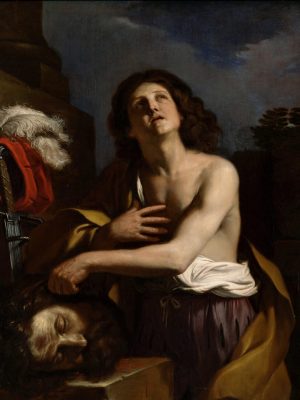

The story of David and Goliath offers a striking model for spiritual combat. Just as David carefully chose his stones, Christians must prepare precisely for battle against sin, the world, the flesh, and the devil. The occult, in all its forms—whether through tarot, Ouija boards, witchcraft, or hidden generational sins—opens doors to the demonic and distorts the sacred in mockery of God. Victory lies not in “dabbling” or seeking alternatives to divine help, but in purity of life, prayer, and unwavering fidelity to the First Commandment.
David’s Victory and the Weight of Upbringing
When David was presented to King Saul after his victory over Goliath, the king asked him, “Whose son are you, young man?” (1 Sm 17:58). His actions spoke not only of his own bravery and cunning but also of his upbringing. We are all a product of our upbringing—good or bad. As Clements states, “Although every one of us ‘speaks Egyptian’ in how we have been enculturated into non-Christian elements of society, we do not belong in the ‘Egypt’ of sin and oppression. Like the Israelites, we have been assimilated into a culture of oppression that militates against God’s law and ultimately seeks to enslave us.” The “Egypt” of oppression worsens if you do not reevaluate your past and break free by removing any obstacle that stands between you and the living God.
Precision in Spiritual Warfare
David did not grab just any rock, therefore; he “chose” specifically “smooth” ones. Precision is key in any warfare. Those who go through the first phase of the protocol know that it is not a retreat but a time of battle preparation—like David alone among the sheep. The skills he acquired while defending the sheep against lions and bears enabled him to beat the giant of Gath. For you, this means a withdrawal from the things which enmesh you with the three-fold enemy—the flesh, the world, and the devil. Now we must go deeper in identifying the lingering effects of sin which continue to empower the demon.
Understanding the Occult
You may be reading this manual to learn how to counter the effects of previous occult activity. As I explain, “occult comes from the Latin occultus, meaning secret or hidden. In normal usage, it refers to invoking superhuman, but not divine, powers in order to obtain results that are beyond the capacity of mere nature.” This includes “mystical knowledge, supernatural or magical powers, practices, or phenomena. Because these practices call upon powers other than the true God, the Church condemns all such practices as ‘gravely contrary’ to true religion (CCC 2117).” According to Father Ripperger, a generational spirit is “the spirit that is passed from one generation to another as the result of the sin of one of the ancestors or the suffering of grave harm by one of one’s ancestors.” Accordingly, any participation in the occult is a grave sin against the first commandment.
Generational Spirits and Familial Sin
When this type of sin enters a family and is not eradicated and atoned for, it can linger in the familial line for generations. Sometimes this takes the form of a curse from occult practices and other times a familial sin that plagues each generation. Interactive diabolic activity is a phrase used to describe the activities in which a person invokes—whether through incantation, pledge, or bodily ritual—a power other than the One, True God. The interactive component is meant that such invocations involve an exchange between participants and the demons. These can be seemingly innocuous things like the Ouija board of a previous generation, tarot cards and fortune tellers, or some (but not all) modern video games where real curses and spells have been coded into the game’s script. Thus, “tarot cards and Ouija boards, for example, invoke evil spirits for some favor and open the persons to diabolic affliction by giving permissions to the demons called upon.” These can also be overt, according to Fr. John Hardon and the Modern Catholic Dictionary, as in “Satanism, fetishism, black and white magic, spiritism, theosophy, divination, and witchcraft.”
The Unholy Inversion of the Sacred
Witchcraft works as an unholy inversion of the sacred, be it verbal, gestural, or physical movements. That is, occult practitioners use language, hand gestures, handshakes, et cetera to communicate with each other and with the preternatural. This communication includes bodily positions such as yoga poses, ritual dance, or other movements—all with determined, fixed patterns—designed to create a pathway between the practitioner and the preternatural world. Just as Gregorian chant is intoned at precise, patterned notes, occultists also utilize singing, or chant-like invocation, intoned at specific tonal frequencies. Just as Catholic priests wear sacred vestments when offering Holy Mass or in the performance of sacred ritual, occultists will perform their rituals wearing symbolically imbued regalia (or wearing nothing at all). The Catholic priest uses blessed objects, such as the Saint Benedict crucifix or relics of saints, to invoke heavenly assistance when blessing a person or when exorcising demons. In an unholy inversion of this, the witch holds cursed objects, uses drawnout sigils in the open, or ornately made symbols in the ritual area to invoke dark powers. In an inversion of Catholic liturgy and the liturgical calendar, witches also ritualize and sacralize space and time by means of specific locations, times of the day, and days/months as deemed sacred according to pre-Christian or other pagan calendars. Everything they do is exact and ritualistic, as if in mockery of traditional Catholic liturgy and liturgical calendar, but in an upside-down world. In addition, the occult practitioner can “level up” in a coven through increasingly dark ways, which we will not relate here.
Mortal Sin and the Dangers of “Dabbling”
A state of grace protects against curses, and the demon will attempt to draw you out of that protective armor. If a familial spirit is present due to previous occult behavior, a person becomes vulnerable to its effects when he commits grave sins. All witchcraft is mortal sin due its grave matter. That is, it is an intentional violation of the first commandment and severs the relationship with God. We often hear that someone only “dabbled” in witchcraft, saying things like, “Well, I only read the horoscopes for fun,” or, “I only do the tarot cards recreationally,” or, “It’s only ‘white magic’ not the dark stuff.” The implication is that if someone did not really mean to commit this or that sin, they are not culpable for its effects. This is false. Any activity where someone invokes false idols is a violation of the first commandment (mortal sin) regardless of his subjective intentions.
Victory Through Purity and Prayer
Victory in spiritual combat lies in purity of thought, word, and deed. This means militating strongly against all sin, for, as the Catechism states, “deliberate and unrepentant venial sin disposes us little by little to commit mortal sin.” While humans tend to be led by emotions and the subjective, the demon always works in the objective. The interactive aspect of the occult means that this activity is a two-way street. Prayer begets what it signifies. That is, you get what you ask for in prayer, according to the words of the Lord, “Ask and you shall receive” (Mt 7:7). Make no mistake: incantations, rituals using inanimate objects such as feathers, hair, clothing items, love potions, crystals, et cetera are all forms of prayers of petition to the demon behind them. The reason we emphasize this is because a significant number of possessions and deep obsessions are a result of occult involvement.
The Temptation to Seek Alternatives to God
Rather than entrusting their situation to God—whether it be infertility, loneliness, financial problems, health issues, and the like—many people turn to alternative sources such as curanderas, tarot, New Age, and the like. Ouija boards and tarot cards, for example, “invoke evil spirits for some favor and open the persons to diabolic affliction by giving permissions to the demons called upon.” The demon will happily respond, especially when he sees that the one petitioning bears the indelible mark of Baptism in his soul. Imagine one of Rogers’s rangers showing up at the enemy camp asking for some favor in exchange for information on Rogers’s battle plans. He would be called a traitor, and rightly so, but welcomed into the enemy’s camp with open arms. You are a spiritual traitor to the living God when you seek favors from the infernal enemy. Once inside his camp, it is not easy to get out.
ooo
This article is taken from a chapter in Liber Christo Method by Dan Schneider, PhD which is available from TAN Books.