Opening Prayer
I pray for a well-trained mind that recognizes reason as the humble handmaid of faith, never allowing it to rebel in pride or chatter in insanity against the truths Thou hast revealed. Let my powers of reason walk beside faith as a disciplined instrument to decipher the deep meanings of Thy Word. I recognize that Thou helpest us to eat—but not without our mouth; so too, Thou helpest us to believe—but not without our reason.
I petition Thee for the grace to use the reasoning skills Thou hast given me—to ponder, compare, and study—without ever forgetting that Thy special help is my most vital necessity. Grant me a mind that serves the Truth without rebellion, utilizing my intellect as a sharp tool in the service of Thy divine architecture.
Amen.

John 6:56-59
56For my flesh is meat indeed: and my blood is drink indeed. 57He that eateth my flesh, and drinketh my blood, abideth in me, and I in him. 58As the living Father hath sent me, and I live by the Father; so he that eateth me, the same also shall live by me. 59This is the bread that came down from heaven. Not as your fathers did eat manna, and are dead. He that eateth this bread, shall live for ever.

St. Thomas More
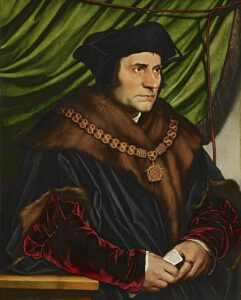
St. Thomas More argues that faith and reason are not enemies but companions. He notes that “faith never gets along without” reason, provided reason is “guided well.” This echoes the Church Fathers like St. Athanasius, who insisted that “striving after spiritual advancement” requires spiritual reading (Introduction). This intellectual effort is centered on the Sacramental life; we use reason to understand the Sacraments, yet we recognize their “power comes from God alone”. In the Mystical Body, we use our minds as instruments for Grace, acknowledging that while God helps us “eat,” He does so “not without our mouth.”

St. Thomas More warns that reason can become “proud” and “rebel” if allowed to “run riot.” However, when properly ordered, reason is a tool that God uses to help us decipher the meaning of Sacred Scripture. We must use our faculties to compare texts and ponder commentaries, always relying on “God’s special help.”
“Whoever would grasp what he must believe must use reason. Yet reason must not resist faith, but rather walk with her, waiting on her as her handmaid.”
— St. Thomas More
Mary and the Magisterium
Mary is the “Mirror of Virtue” and “Heavenly Wisdom”. She utilized her reason to ponder the words of the Angel, yet she submitted her intellect to the Divine Will. The Magisterium, through the Bishop, ensures that human reason does not devolve into “private judgment”, which leads to error. The Universal Church acts as the “living authority” to which we submit our reason, just as the Bishop “preserves the unity of the Church” by guarding the “Apostolic traditions” from those who argue for the sake of pride.

- Do I consider my reason a gift from God to be used in support of my faith?
- Do I make the best of my reasoning skills when interpreting Scripture by using helpful, Church-approved commentaries?
Closing Prayer
Lord, let the reasoning powers you’ve given me always be employed in the lively service of the faith that’s also your gift.
Amen.