Hell is often described with vivid imagery—fire that never dies, worms that do not die, and darkness without end. Msgr. Charles Pope explains that these images are not merely physical but point to deeper spiritual realities: the burning of unfulfilled desires, the consuming power of unchecked passions, and the eternal separation from God. In the end, hell is less about flames than about a soul forever unfulfilled.
Fire That Never Dies
Central to the imagery of hell is fire, although things of lesser importance make an appearance, such as worms that never die. We do well to ponder these images carefully. For while many take them literally, they are probably meant to be understood in less material and more otherworldly terms. To be sure, most of the Fathers and tradition understand the fire of hell to be an actual, physical fire, but it remains a question as to what effect physical fire would have on fallen angels who have no physical bodies. And while fallen human souls will eventually have their bodies, it seems hard to imagine how physical fire can affect their souls prior to the resurrection of the bodies of the dead. Hence, fire and other physical descriptions most likely speak also to deeper spiritual realities as well as physical ones.
Let’s look at a passage from the book of Revelation and ponder what the image is trying to teach us about the nature and reality of hell for those who choose to live there by rejecting the kingdom of God and its values.
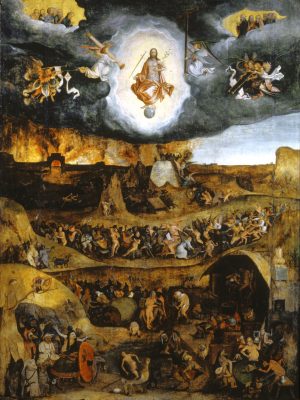
Then I saw a great white throne and him who sat upon it; from his presence earth and sky fled away, and no place was found for them. And I saw the dead, great and small, standing before the throne, and books were opened. Also another book was opened, which is the book of life. And the dead were judged by what was written in the books, by what they had done. And the sea gave up the dead in it, Death and Hades gave up the dead in them, and all were judged by what they had done. Then Death and Hades were thrown into the lake of fire. This is the second death, the lake of fire; and if any one’s name was not found written in the book of life, he was thrown into the lake of fire. (Rv 20:11–15)
A pool of fire is a dramatic metaphor. It is so dramatic, in fact, that it causes many moderns to reject outright the teaching of Jesus on hell. Even many who are otherwise believers in Jesus reject His consistent teaching on judgment and hell by either conveniently ignoring it or by espousing some artful theories that deny He said it or that suggest He was just trying to scare people who lived in less “sophisticated” times. Some who do not believe in God point to this teaching to justify their lack of faith. Because these objections are partially the result of ignorance, it is necessary to focus on what this metaphor is likely trying to teach us.
Though tradition does believe the fires of hell take a physical form, there is a deeper theological meaning below the surface imagery. For fallen angels without bodies (and for whom the fire was first prepared) do experience its pain. But how? And for fallen human souls (at least before the resurrection of the body), how is the fire experienced and to what does it point?
The Fires of Hell According to Origen
Perhaps Origen, the third-century Church Father, can provide an answer: “Wonder not when you hear that there is a fire which though unseen has power to torture, when you see that there is an internal fever which comes upon men and pains them grievously” (quoted in the Catena Aurea at Mat 25:41).
And thus, we gain some insight into the “inner” fire that rages in the fallen angels and in the souls of the damned. For even now, we often speak metaphorically of how our own passions can burn like fire. We speak of burning with lust, or of seething with anger, or being furious (“fury” being related to the word for fire). We speak of the heat of passion, of boiling over with anger, or of seething with envy. Even good emotions like love can burn like fire if they are not satisfied. How our thirsts and passions can rage like fire in us if they are not slaked or satiated by the only One who can truly satisfy us!
Points Made by Saint Thomas
Finally, St. Thomas adds the insight of the fire as “burning” in the sense that it limits the fallen angels and fallen souls:
But the corporeal fire is enabled as the instrument of the vengeance of Divine justice thus to detain a spirit; and thus, it has a penal effect on it, by hindering it from fulfilling its own will, that is by hindering it from acting where it will and as it will . . . that as the instrument of Divine justice [fire] is enabled to detain [a spirit] enchained as it were, and in this respect this fire is really hurtful to the spirit, and thus the soul seeing the fire as something hurtful to it is tormented by the fire (S.T. Supplement, q. 70, art. 3, respondeo).
In other words, someone who is no longer able to find satisfaction by following his own will seethes with indignation. Such apparent satisfaction is a lie, for it is rooted in the willful rejection of God and the values of His kingdom. The fire is a limiting fire that attests to the fact that nothing outside God will satisfy, and that roaming about seeking satisfaction in anything other than God must now end. The fire burns and is unquenchable, for only God can quench it. But the fallen souls and fallen angels have forever refused Him.
Worms That Do Not Die
To fire, Jesus also adds the image of worms that die not. We often speak of being devoured by our passions or consumed by them. There is less consensus on the worms being physical, but surely here, too, physical or not, they speak to a deeper spiritual reality. The worms, real and allegorical, gnaw at and devour what little energy the rage has not already burned away. Unjust anger is ultimately exhausting; it saps life the way worms do. Their gnawing brings weariness and weakness, lethargy and listlessness. Depression is anger turned inward. Anger saps us in the same way intestinal worms weaken the physical body.
So, the burning fire and devouring worms of hell speak also to deeper spiritual struggles. We were made for God, and God alone can satisfy us. To choose anything less than God is to remain gravely unfulfilled. Thus, one burns with desire but has rejected the “one thing necessary” to satisfy that desire. The fire seethes, and the fury grows.
And thus, the fire of passion forever burns unsatisfied in the damned and, like worms, their desires devour and consume them. In a word, hell is the state of being “unfulfilled” forever; it is a “place” where unrepentant sinners burn with a never-ending desire because the only source of satisfaction has been rejected.
Wailing and Grinding of Teeth
As for the wailing and grinding of teeth, this double image makes it clear that it has nothing to do with sorrowful repentance. The wailing is linked to anger, expressed in the grinding of teeth. This is an angry sorrow at having been conquered or bested, the reaction of a resentful loser. The defiant refusal to repent from serious sins and the anger at “being told what to do” are the source of this anger. No, this sorrow is not contrition leading to repentance but a kind of anger expressed or manifested by the gnashing of teeth.
The Outer Darkness
Since heaven is lightsome and Jesus is the light of the world, here then is an image of exclusion from the presence of God. Since the heart of heaven is to be with God, the heart of hell is to be apart from Him, for whom we were made. But, in a way, unrepentant sinners get what they want after death since, as Jesus says elsewhere, they prefer the darkness (see Jn 3:19). Even so, it is still tragic that they reject the very One who alone can satisfy, preferring the darkness and the trinkets of this world.
ooo
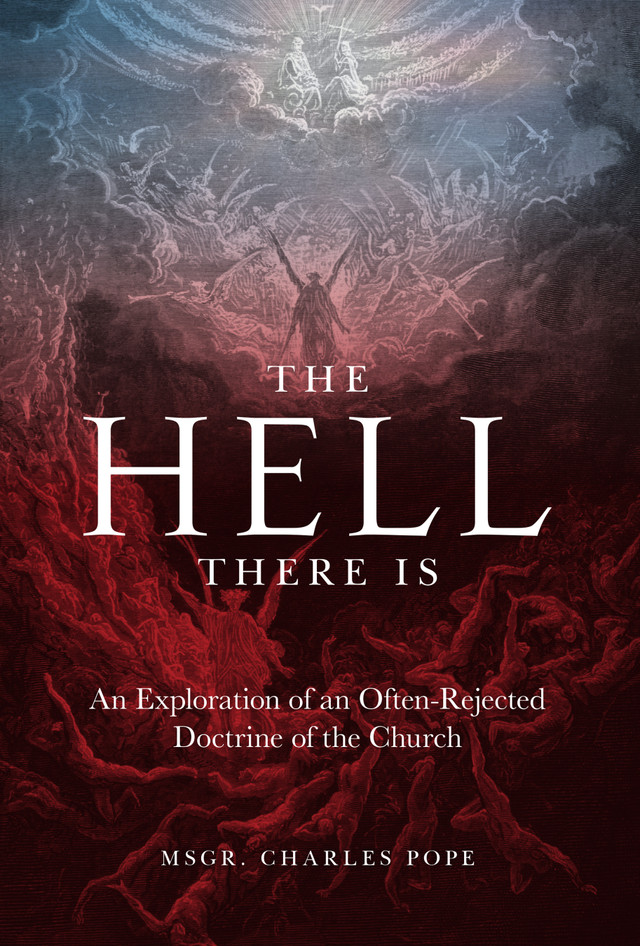
This article is taken from a chapter in The Hell There Is by Msgr. Charles Pope which is available from TAN Books.