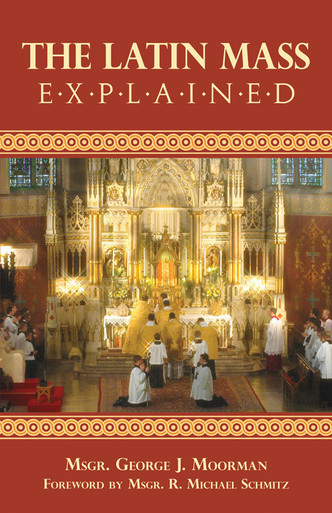
Should the Mass be said in the vernacular or in Latin? Discover the fruits of Latin in the Mass through this excerpt from The Latin Mass Explained by Monsignor George J. Moorman.
Many persons not familiar with the Catholic service are puzzled when assisting at Mass because it is said in Latin. Now, there is no weighty reason why the Mass should be said in English, but there are many reasons why it should be said in Latin.
Why Should the Mass Be Said in English?
You will perhaps say: So that the people may understand what the priest is saying. But the Mass is not a prayer, it is an action. The priest is not only praying at the altar; he is doing a work which is greater than prayer. The people join with him not in the words he is saying, but in the work he is doing. This work is the offering up of sacrifice to God.
But Why in Latin?
If there be no weighty reason for saying the Mass in English, what reasons are there for using the Latin language?
It Is a Venerable Language
It is venerable on account of its origin and its antiquity. It is the language in which the praises of God resounded from the lips of Christians during the first centuries. It is a sublime and solemn thought that the holy Sacrifice is now offered in the same language—nay, with the very same words—with which it was offered in times long past in the obscurity of the Catacombs.
It Is a Mysterious Language
Because it is a dead language, not understood by the people, there is an element of mystery about the Latin tongue. The use of an unknown tongue conveys to the mind of the people that something is going on upon the altar which is beyond their comprehension, that a mystery is being enacted. The Jews in their worship made use of the ancient Hebrew, the language of the Patriarchs. Both the Greek Catholics and the Greek schismatics employ the old form of the Greek language for divine service.
It is curious to note that the three foremost dead tongues—the Hebrew, the Greek, and the Latin—were employed at the crucifixion for the inscription fixed above the thorn-crowned Head: “Jesus of Nazareth the King of the Jews.” These were the languages chosen to tell the great truth to the whole world. So today, in the commemoration of the Sacrifice of the Cross, in the Mass, these three languages are still employed. The greater part of the Mass is said in Latin. The Kyrie Eleison is Greek. Vestiges of the Hebrew are found in the words Alleluia, Amen, and Hosanna.
It Fosters Unity in the Church
The use of Latin is a means of maintaining unity in the Church, as well as uniformity in her services, for the use of one and the same language in Catholic churches all over the surface of the globe is a connecting link—binding them to Rome and making one out of nations which are separated by diversity of tongues. The Universal Church must have a universal language.
It Safeguards Truth
A dead language is not subject to change. Languages in daily use undergo a continual process of change. Have you ever tried to read Chaucer? You will find it difficult without notes. You will meet with words that have dropped out of use and words which have changed their sense, or to which people today attach a far different meaning from the meaning which they had centuries ago. But the meaning of the words in a dead language is fixed. If a living language were employed in divine worship, heresies and errors would inevitably creep into the Church, and sacred words would be employed in an irreverent or mocking manner by the unbeliever.
ooo
This article is taken from a chapter in The Latin Mass Explained by Msgr. George J. Moorman which is available from TAN Books.