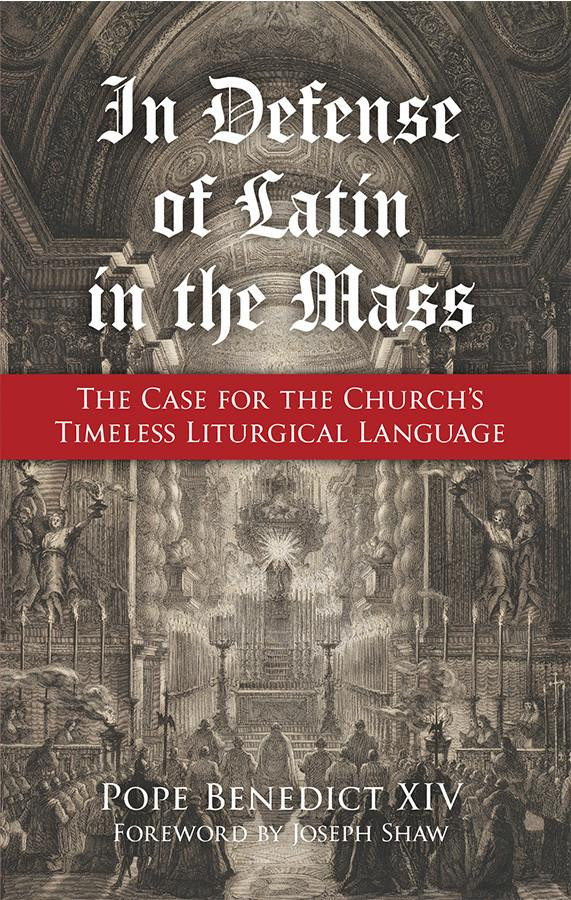
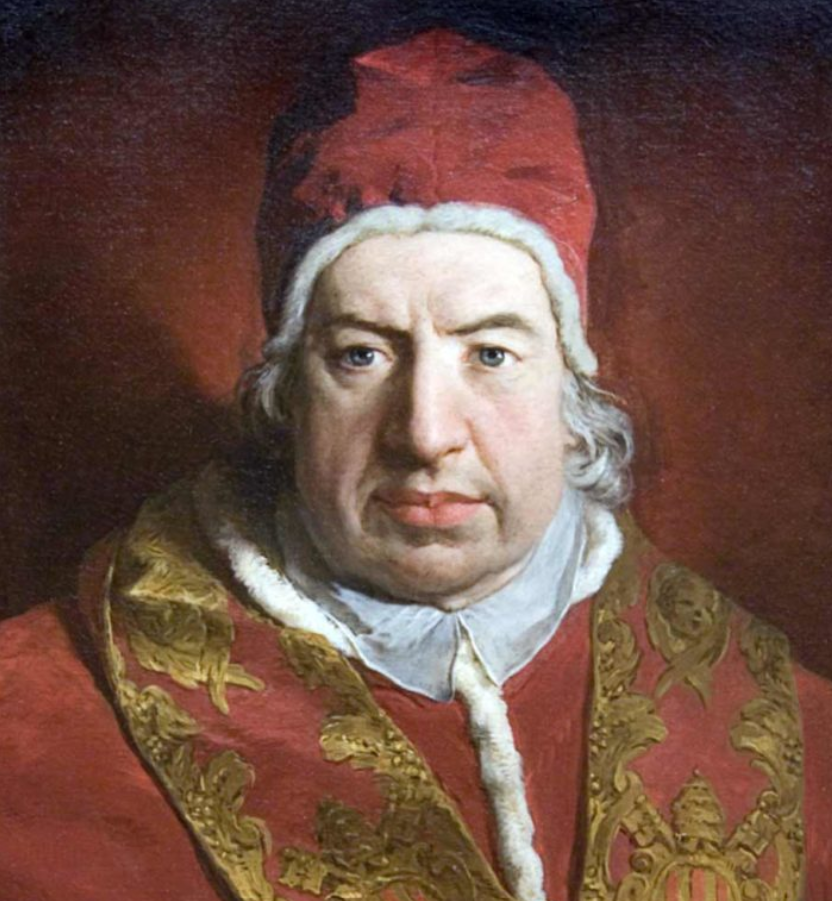
Pope Benedict XIV explains why the Church has historically resisted the use of the vernacular in liturgy. Continue reading in his booklet In Defense of Latin in the Mass.
Latin has been used in the liturgy of the Western Church since the earliest times. But this question is not, perhaps, the critical hinge of the controversy.
It is asked by some that if the liturgy in the early [Western] Church was said in Latin, which was the common or vernacular language of the time—but now is known only by educated people—should it not now be said in what is the common language at the present time?
Why the Church Rejected Vernacular Liturgies
The Catholic Church has consistently vehemently opposed such a step.
This question was considered thoroughly— and the proposition definitively refuted—in the pastoral letter of Jacques Golbert, bishop of Rouen (contained in the collection of documents of provincial councils for that diocese, p. 172).
Is there anyone of sound mind who would recommend that because there are so many vernacular idioms and local dialects, parish priests and preachers should be permitted to translate the Latin texts of the Mass into the local tongue themselves as they celebrate the liturgy?
Such a procedure would be totally absurd and wholly unworthy of the dignity of the Mass. [But such a procedure would be necessary because] vernacular languages are not proper to nations and peoples alone but differ significantly from city to city and village to village.
And as successive years pass by, any vernacular language is constantly changing and in fluctuation. Indeed, this mutation of meaning even happened in Latin itself [when it was the vernacular language], as Polybius relates in Book 3 [of his History of the Punic Wars].
He described how a treaty made for peace at the end of the first Punic war was no longer able to be understood with any certainty by the conclusion of the second Punic war. In whatever mutation of meaning or sense there is in a language, six hundred occasions for contention and disagreement inevitably arise! And even if the people were able to understand separately each individual word of the Mass in their vernacular language, there would not necessarily be consistent comprehension as to its overall sense. Hence an infinite number of errors and misapprehensions would spring up.
A Threat to Unity and Truth
There is a very real peril that many errors that are harmful to the harmony of the Church and to the unity of the Faith may arise from changes in the language of the sacred liturgy.
This was amply proven in the case of the missal translated into the French tongue, which Father Vois, of the Order of Preachers, published in 1660. In response to this novelty, the French clergy vehemently, and almost unanimously, objected to the missal. They feared that this publication would give rise to numerous errors, scandals, and dissensions.
Indeed, history has shown that this fear was well justified! The French clergy accordingly raised its grave concerns and fears with the pontiff of the time, Pope Alexander VII, and formally complained about the publication of the translation. And the Holy Father, in response to these concerns, condemned the publication in the following year. Nor did the book ever obtain authorization or permission for publication from the French crown, the provision of which was, indeed, prohibited by papal decree.
ooo
This article is taken from a chapter in In Defense of Latin in the Mass by Pope Benedict XIV which is available from TAN Books.