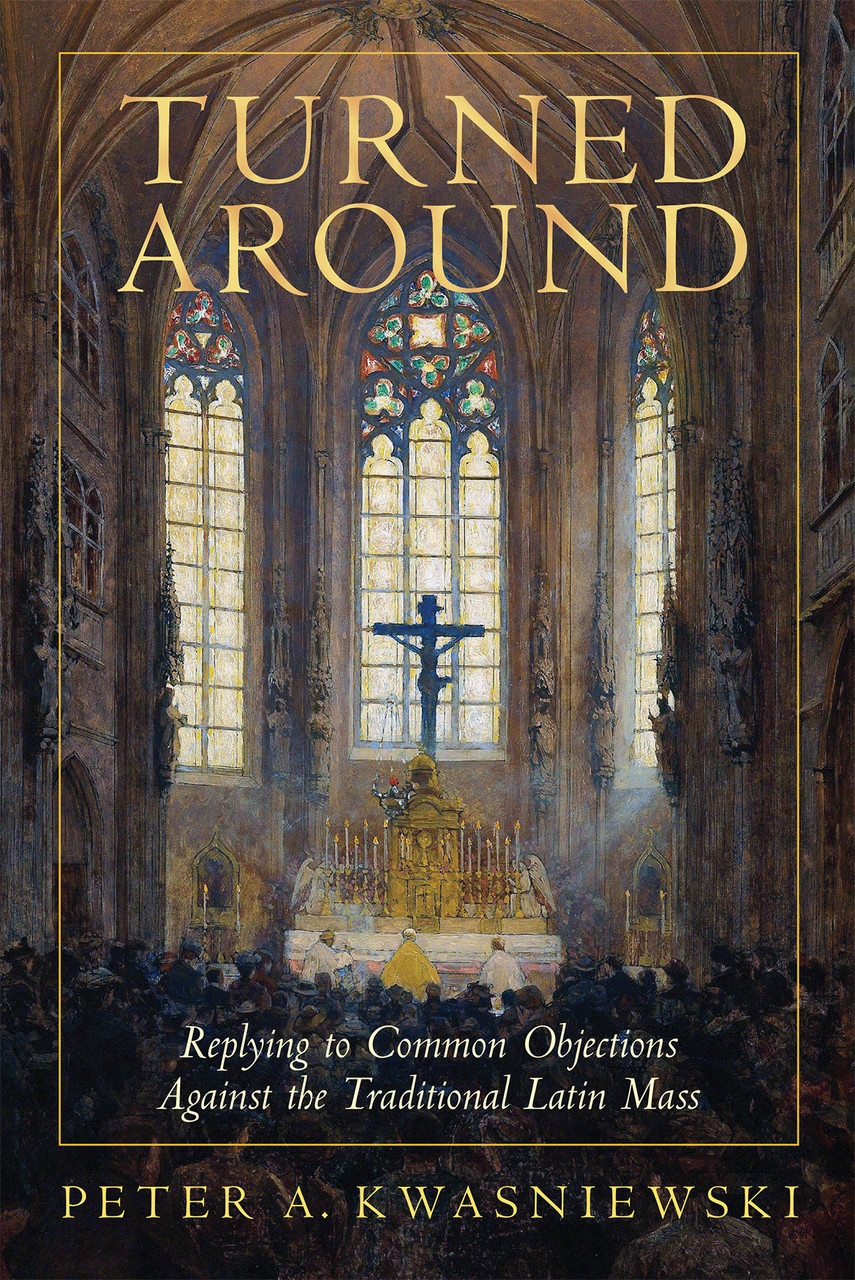
What’s the significance of the priest’s orientation during the Mass? Why is this the dire change made in the Novus Ordo? Read this excerpt to discover more about ad orientem and versus populum.
Catholics who delve into serious discussions of liturgy, wishing perhaps to know what all the fuss is about, quickly discover that one of the hottest of hot-button questions is the orientation of the liturgy.
Msgr. Klaus Gamber once claimed that turning the altar and priest around to face the people was the single most destructive change that occurred in the celebration of the Mass (and he was not favorable to most of the other changes either). What is the big deal, then, about the direction the priest is facing at Mass?
Historical Foundations
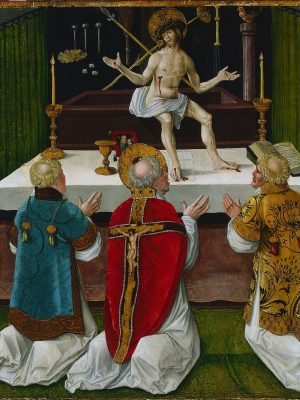
To avoid any risk of worshiping the Most Holy Trinity in vain, let us try to discover the deepest reasons for the ancient and, until recently, uninterrupted custom of praying eastwards—a custom that we find from the East to the West, in every traditional rite of Christian worship, be it Byzantine or Latin; Slavic or Greek; Roman, Gallican, Ambrosian, or Mozarabic; Chaldean, Coptic, Armenian, or Ethiopian.
For starters, the custom of all Christians either offering or participating in the Eucharistic liturgy facing east has the same apostolic roots and the same universality in Church history as the use of water baptism, the praying of the Psalms, the worship of the risen Christ on Sunday, the honoring of the Mother of God and the saints, and the veneration of their relics.
As a matter of fact, eastward orientation predates the use of official priestly vestments, consecrated church buildings, and the very Niceno- Constantinopolitan Creed that we recite every Sunday. Does that make it old enough and widespread enough to take seriously? If not, why do we take any of these other things seriously? They should be just as dispensable.
The Theological Meaning
It is not hard to see why this custom should have been nearly convertible with Christian worship as such—above all in the Mass, the highest act of worship. The Mass is both Patricentric and Christocentric: these are different but complementary perspectives.
Because Christ is both Head of the Church and our God, one in His divinity with the Father and the Holy Spirit, we can be at one and the same time on our way with Him to the Father in the power of the Spirit, and on our way to Him as our ultimate end.
It is therefore correct to say that the priest, praying ad orientem, is facing Christ (the Orient), and to say that he is praying, as alter Christus or in persona Christi, toward the Father.
In fact, the clear symbolic proclamation of the twofold mystery of Christ as both our God and our mediator with God is completely lost in the versus populum stance. To face Christ, and to face the Father with Christ, are mutually implicated, just as they are in Scripture: “You call me Master, and Lord; and you say well, for so I am”; “I and the Father are one”; “he that seeth me seeth the Father also”; “I go to the Father: for the Father is greater than I.”
The Mass Is Not a Gathering
Contrary to a steady stream of progressive propaganda starting in about 1960, the Mass is not first and foremost a “communal gathering”—for there are many sorts of communal gatherings that are not Masses, and as the Church has consistently taught, a Mass celebrated by only a priest and a server, or in a case of necessity by a priest alone, with no congregation in sight, is still every bit as true and proper a Mass as one offered in St. Peter’s Basilica with tens of thousands of faithful in attendance: each is the supreme sacrifice of Christ offered by and for the Church, His Mystical Body.
For the essence of the Mass is not the circle of people who may or may not gather around the table, but the all-pleasing immolation of the spotless Lamb who takes away the sins of the world: the sacrifice of Jesus Christ on Calvary, made present anew in the immolation of the Victim under the species of bread and wine, offered as a sweet-smelling oblation to the Father.
Conclusion
It is exactly for these reasons that celebration of the Mass versus populum or “facing the people” is not merely an unfortunate aberration based on poor scholarship and democratic habits of thought endemic to modern Westerners; it is a contradiction of the essence of the Mass and a distortion of the right relationship of man to God.
Because of its inversion of the worshiping community’s proper directionality (including the priest’s) to the uncreated Font and Origin, it functions as a sort of “immunization” against the rational self-sacrifice that turns our souls and our bodies toward the Father, in union with His beloved Son, whose meat is to do the Father’s will, not His own as a man. This directional inversion substitutes a Protestant notion of worship for a Catholic one.
ooo
This article is taken from a chapter in Turned Around by Dr. Peter Kwasnieski which is available from TAN Books.