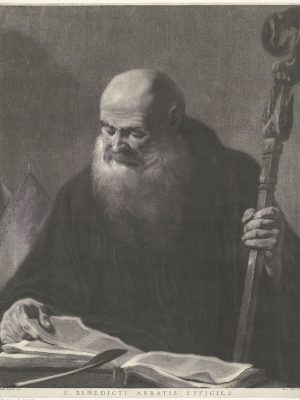
Center your household around Christ. With the example of St. Benedict, you can become the architect of your family.
Why Is St. Benedict the Master Architect?
Well, in a sense, he built the most sustaining, self-perpetuating organization that the world has ever seen. Monks today, 1,500 years later, still implement exactly what he said. This is quite remarkable.
As the rule of life became clear and monks came together to live in community, they learned to farm and become craftsmen so they could sustain themselves with food and money. The organizational technique of these men coming together and living behind walls and taking care of one another was so successful that communities of lay people would flock to them and begin living around the monastery. Much of the economic infrastructure of medieval society was soon centered around a monastery. The monasteries became the center of both spiritual and cultural life. The monks provided education and are largely responsible for education becoming accessible to the average person. This was because they had scriptoriums where they transcribed manuscripts and copied the Bible and other writings. Before the printing press, this made books available throughout the world. They also started schools for all the children in the town. They became this incredible source of information and stability for the entire community.
The heart and soul of the Benedictine life, however, are the rhythms and cadence of their prayer in the Liturgy of the Hours. Together, they would pray and sing all of the Psalms. This in turn gave a particular cadence and rhythm to their community, but also the greater community built around them. Monks might bicker during the day, but then they went to evening prayer and they all sang in one unified voice. That rhythm provided a structure.
When they prayed, they also rang bells. The people in the surrounding town or working in the fields would hear the bells tolling and they would pause and pray the Angelus. They would participate in this rhythm of life. On the one hand, you could say that this life and cadence of prayer became their faucet. Everything else that was built around it naturally reflected and resembled this way of life. Because the architecture of the Benedictine way of life was so sturdy, it preserved education, farming, economics, art, and sustained local cultures. It fostered devotion and unity.
Though we now have a post-Christian world, this Rule of Life continues to be one of the strongest foundations in human history. You know you have a master architect when the building is still standing 1,500 years later. And he not only built a building, but he built a system that would continually build buildings.
How to Live Like Benedict
There’s a famous book by Rod Dreher called The Benedict Option. Dreher’s book is inspired by Saint Benedict and the monastic community, and how we too need to build our own communities. We need to build our own way of life.
In one way or another, we all can pursue that Benedictine way of life. Dreher notes some key points such as withdrawal from the mainstream secular culture to some degree. It’s empowering when you realize that you don’t have to participate in the nonsense of society. We think we do. But you don’t have to pay attention to the news. You don’t have to send your kids to terrible schools. You don’t have to be consumed by social media. You don’t have to.
There are many options of how you can begin, but you have to be brave and step up. Saint Benedict and his monks moved out into the desert, away from all the noise of the world, and they did fine. They left the chaos of urban lifestyle (and it was just as corrupt back then) and found peace.
Another key point Dreher makes is that Benedict and his followers were intentional about building Christian communities. We have to do the same thing. We have to withdraw from culture to some extent, and we have to be intentional about forming our community at home, our community with our friends and extended family, our technology community, our social community, our sports community, our parish community. We have to focus on education and formation. Dreher even points out that we need to engage in politics on a local level. Not the crazed whorl of national media, but we should be paying attention to what’s going on in our little town, perhaps more than we’re paying attention to what goes on nationally.
We need to use technology and tools much more mindfully just as good monks are very intentional about how they use tools.
A good monk is not going to allow the outside world to break in through his cell phone and interrupt his prayer and work.
According to Rod Dreher, the goal of the Benedict option is not complete isolation, but rather intentionality of building stronger Christian identities and communities to withstand the attacks of the secular world. By living intentionally, focusing on prayer and work, mindfully designing his community and environment, Saint Benedict gives us a perfect example of what it means to be a master architect.
Now, I’m not saying move your family out to the desert and build walls around them, but you need to have some of that Benedictine mindset. You must have a little courage and gusto to say, “No, we’re going to go build our own systems and structures around prayer, work, education. We’re going to have rich, fulfilling relationships and communities.”
Like a good architect, look at what is around you, what resources you have, and build from there. If technology and excess screens are too much, cut down on it. If your kids’ educational environment is suffering, look at what options are available. Consider what you wish most for them and begin to design it. Set your rule of life in place. Build the architecture around what your family needs most.
ooo
This article is taken from a chapter in The Architect by Conor Gallagher which is available from TAN Books.