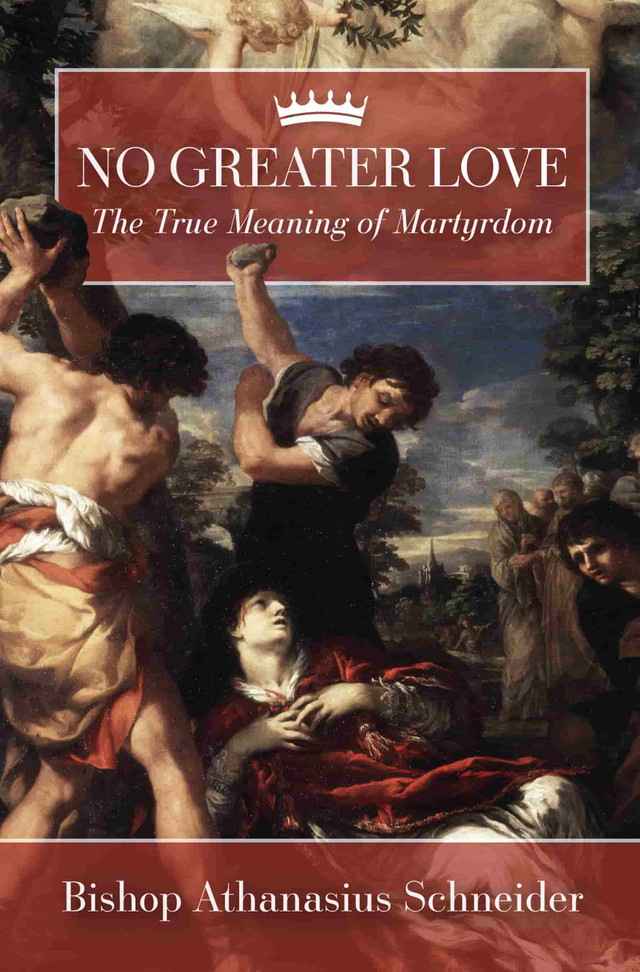
This excerpt from No Greater Love explains that non-Catholics who die for Christ may be martyrs before God, but the Church cannot officially recognize them as martyrs due to invincible ignorance. It emphasizes the unique and indivisible nature of the Catholic Church, which Christ established as the one true Church. Only God can judge the internal disposition of a soul at death, making public canonization for such cases impossible.
Those non-Catholics who lost their lives rather than apostatize from the Christian faith were heroes. However, one cannot call them martyrs in the same sense as the Catholic Church venerates her martyrs. In accordance with the Church’s tradition, Popes Pius IX and Pius XII recognized that a person in a situation of invincible ignorance regarding the Catholic Church, but who, with the help of grace, follows the natural law, fulfilling God’s commandments and believing in a just God Who rewards the good and punishes the bad, has faith by desire (in voto) and is somehow connected to the sole Church of Christ. Thus, that person can be saved through the Church (see Sacred Congregation of the Holy Office, Letter to the Archbishop of Boston [August 8, 1949]).
Pope Benedict XIV on Non-Catholics as Martyrs
Pope Benedict XIV (1740–1758), in his work De servorum Dei beatificatione et de beatorum canonizatione, spoke of people outside the visible Church through no fault of their own, because of invincible ignorance, who nevertheless give their lives in witness to a Catholic truth.
Distinction Between Martyrdom Before God and Before the Church
Can they be considered martyrs? In response, Pope Benedict XIV makes an important distinction: they may have been true martyrs, but only before God, not before the Church. They would be martyrs before God, provided they were habitually willing to believe whatever the Church proposed if they had had the means to know it and their ignorance was not due to their fault.
Limitations of the Church in Recognizing Martyrdom
They would not be martyrs officially recognized and proclaimed by the Church because only God knows the internal dispositions of a person’s soul at the hour of death. Now the Church can only make a pronouncement about external actions that can be known by one’s senses. Thus, she cannot publicly consider martyrdom something that only God can know—namely, that a person in the state of invincible ignorance decided in his heart, even if only as a desire, to belong to the Catholic Church and died united to her.
The Uniqueness of the Church
The Divine truth of the uniqueness of the Church excludes any ambiguous actions, such as the canonization of non-Catholics who died as martyrs for the sake of Christ.
“It is so evident from the clear and frequent testimonies of Holy Writ that the true Church of Jesus Christ is one, that no Christian can dare to deny it. . . .
. . . Jesus Christ did not, in point of fact, institute a Church to embrace several communities similar in nature, but in themselves distinct, and lacking those bonds which render the Church unique and indivisible after that manner in which in the symbol of our faith we profess: “I believe in one Church.”
“The Church in respect of its unity belongs to the category of things indivisible by nature, though heretics try to divide it into many parts. . . . We say, therefore, that the Catholic Church is unique in its essence, in its doctrine, in its origin, and in its excellence. . . . Furthermore, the eminence of the Church arises from its unity, as the principle of its constitution—a unity surpassing all else, and having nothing like unto it or equal to it” (St. Clement of Alexandria, Stromatum 8.17). For this reason Christ, speaking of the mystical edifice, mentions only one Church, which he calls His own: “I will build my church”; any other Church except this one, since it has not been founded by Christ, cannot be the true Church. (Pope Leo XIII, Satis cognitum [June 29, 1896], 4)
ooo
This article is taken from a chapter in No Greater Love by Bishop Athanasius which is available from TAN Books.