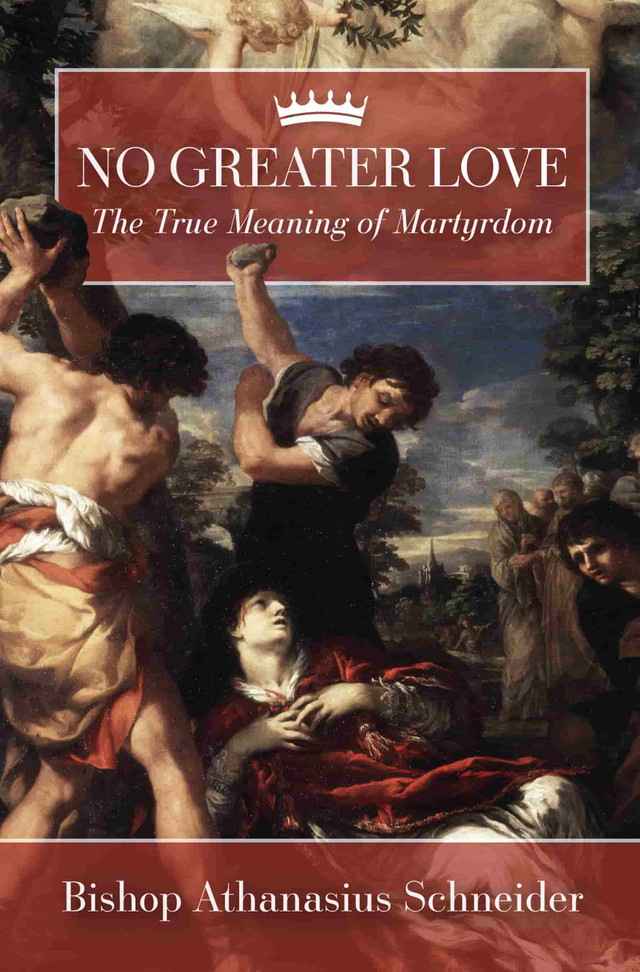
No Greater Love presents the Church’s teaching on martyrdom and a prayerful exposition of Catholic witnesses. Born from the sacrifice of Christ, the Faithful Witness, martyrdom remains the Church’s most powerful testimony to the Eternal Truth. From the Holy Innocents to modern saints, martyrs have offered their lives with unwavering love and fortitude. Discover the three kinds of martyrdom in this article!
Red Martyrdom
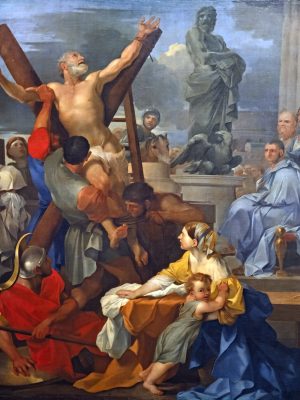
Our Lord said, “For he that will save his life, shall lose it: and he that shall lose his life for my sake, shall find it” (Matt. 16:25). Are we to understand that Our Lord, through these words, is subtly calling His followers to physical martyrdom, or is this only a type of spiritual death?
These words of the Lord refer firstly to a spiritual death, as not all disciples of Christ are called to bloody martyrdom. However, every Christian must be ready to forego all earthly advantages rather than to lose his union with God, to lose the life of sanctifying grace. We must also consider the words that immediately follow Matthew 16:25: “For what doth it profit a man, if he gain the whole world, and suffer the loss of his own soul? Or what exchange shall a man give for his soul?” (Matt. 16:26). These words of the Lord insist upon the necessity of our readiness to resist sin to the point of martyrdom. These words can be compared to the following command of the Lord: “If thy hand scandalize thee, cut it off: it is better for thee to enter into life, maimed, than having two hands to go into hell, into unquenchable fire” (Mark 9:42). Similar are also the words in the Letter to the Hebrews: “For you have not yet resisted unto blood, striving against sin” (Heb. 12:4).
The Fathers of the Church provide several profound interpretations of these quoted words of the Lord. Origen, a third-century writer, gives the following interpretation: “If any one, who has grasped what salvation really is, wishes to procure the salvation of his own life, let this man having taken farewell of this life, and denied himself and taken up his own cross, and following Me, lose his own life to the world; for having lost it for My sake and for the sake of all My teaching, he will gain the end of loss of this kind— salvation” (In Matt. 16).
St. Thomas Aquinas sees in the words of Christ in Matthew 16:25–26 a call to spiritual death for the sake of Christ. Yet corporal death for the sake of Christ is also included. St. Thomas Aquinas says, “Martyrs corporally imitate the Passion in a special way, but spiritual men imitate it spiritually, by spiritually dying for Christ. . . . It is natural to love the soul more than the body; hence, the wise man is the one who would prefer to suffer corporally rather than to endure a great disgrace. If then, it is so, a man ought rather to choose the salvation of his soul than the health of his body, even if he could possess the whole world. The detriment of the soul is inestimable harm” (In Matt. 16).
St. Thomas Aquinas also says, The truth of faith includes not only inward belief, but also outward profession, which is expressed not only by words, whereby one confesses the faith, but also by deeds, whereby a person shows that he has faith. . . . A person is said to be Christ’s, not only through having faith in Christ, but also because he is actuated to virtuous deeds by the Spirit of Christ. . . . Hence to suffer as a Christian is not only to suffer in confession of the faith, which is done by words, but also to suffer for doing any good work . . . for Christ’s sake. (ST, II–II, q. 124, a. 5, c and ad 1) He also stated that “many holy martyrs . . . through zeal for the faith or brotherly love gave themselves up to martyrdom of their own accord” (ST, II–II, q. 124, a. 3, ad 1).
White Martyrdom
One can have the spirit of martyrdom in confessing God heroically and living according to His commandments, as Clement of Alexandria, a Christian author from the beginning of the third century, said: “If the confession to God is martyrdom, each soul which has lived purely in the knowledge of God, which has obeyed the commandments, is a witness both by life and word, in whatever way it may be released from the body—shedding faith as blood along its whole life till its departure,” and furthermore, “We call martyrdom perfection, not because the man comes to the end of his life as others, but because he has exhibited the perfect work of love” (Strom. 4.4).
St. Augustine likewise said, “Let no one say: I cannot be a martyr, because there is now no persecution. Trials are never lacking. The battle and the crown are prepared. The Christian soul is tried, and, with the help of God, it conquers and wins a great victory; this it does enclosed in the body, with no one as its witness. It fights in its heart, it is crowned in its heart, but by Him who sees into the heart” (Sermo de martyribus).
Pope St. Gregory the Great said, “Our Redeemer died out of love for us; let us learn to conquer ourselves out of love for him. If we do it perfectly, we not only escape impending punishments but are rewarded with glory in common with the martyrs. This is not a time of persecution, yet our peace also has its martyrdom, because even if we do not submit our necks to the metal sword, still we are putting to death the carnal desires in our hearts with a spiritual sword” (In Ev. hom. 3.4).The same pope explains further, “There are two kinds of martyrdom, one in intention and the other in intention and actuality. Therefore, we can be martyrs even though we are not slain by the sword of persecution.
To die at the hands of persecutors is martyrdom that is performed in public; to bear insults, to love one’s enemy, is martyrdom in the hidden depths of the heart” (In Ev. hom. 35.7).
When the bloody persecutions came to an end at the beginning of the fourth century, consecrated chastity and virginity were considered as a continuation or a kind of substitution of the bloody, red martyrdom, since consecrated chastity was the expression of a total surrender to the Lord through the virtue of charity, and martyrdom was the highest expression of charity, the ultimate imitation of Christ. The life of consecrated chastity or virginity was, therefore, considered as a white martyrdom, being a total expression (in soul and body) of the imitation of Christ.
Green Martyrdom
According to the seventh-century Irish Cambrai Homily, red martyrdom meant dying for the Faith, while green martyrdom implied severe asceticism.
The homily states, “Now there are three kinds of martyrdom, which are accounted as a cross to a man, to wit: white martyrdom, green and red martyrdom. White martyrdom consists in a man’s abandoning everything he loves for God’s sake, though he suffers fasting or labor thereat. Green martyrdom consists in this, that by means of fasting and labor he frees himself from his evil desires or suffers toil in penance and repentance.”
Christian life itself is defined as a life of witness, as Our Lord says, “You shall be witnesses (martyres) unto me in Jerusalem, and in all Judea, and Samaria, and even to the uttermost part of the earth” (Acts 1:8), and St. Paul taught that “all that will live godly in Christ Jesus, shall suffer persecution” (2 Tim. 3:12). The character of bearing a public witness to the Faith flows out specifically from the sacrament of Confirmation.
St. Thomas Aquinas says that “all the sacraments are protestations of faith. Therefore just as he who is baptized receives the power of testifying to his faith by receiving the other sacraments; so he who is confirmed receives the power of publicly confessing his faith by words, as it were ex officio” (ST, III, q. 72, a. 5, ad 2).
That all Catholics are required to live out martyrdom to some degree is taught by the Second Vatican Council: “By martyrdom a disciple is transformed into an image of his Master by freely accepting death for the salvation of the world—as well as his conformity to Christ in the shedding of his blood. Though few are presented such an opportunity, nevertheless all must be prepared to confess Christ before men. They must be prepared to make this profession of faith even in the midst of persecutions, which will never be lacking to the Church, in following the way of the cross” (Lumen gentium, 42). The Christian family has the vocation to be a witness in the midst of a pagan world, since “by its example and its witness it accuses the world of sin and enlightens those who seek the truth” (Lumen gentium, 35).
ooo
This article is taken from a chapter in No Greater Love by Bishop Athanasius Schneider which is available from TAN Books.