Pray the ancient practice of Lectio Divina with Matthew and St. John Chrysostom. This article covers the parable of the sower, with a step-by-step guide to praying Lectio Divina.
LECTIO
MATTHEW 13:1–23
Subject: The Parable of the Sower
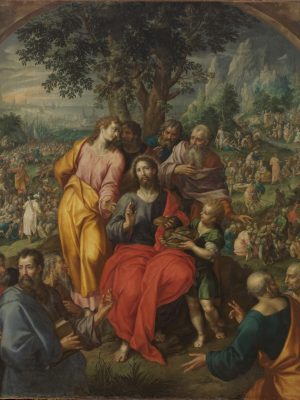
1 The same day Jesus going out of the house, sat by the sea side. 2 And great multitudes were gathered together unto him, so that he went up into a boat and sat: and all the multitude stood on the shore.
3 And he spoke to them many things in parables, saying: Behold the sower went forth to sow. 4 And whilst he soweth some fell by the way side, and the birds of the air came and ate them up. 5 And other some fell upon stony ground, where they had not much earth: and they sprung up immediately, because they had no deepness of earth. 6 And when the sun was up they were scorched: and because they had not root, they withered away. 7 And others fell among thorns: and the thorns grew up and choked them. 8 And others fell upon good ground: and they brought forth fruit, some an hundredfold, some sixtyfold, and some thirtyfold. 9 He that hath ears to hear, let him hear.
10 And his disciples came and said to him: Why speakest thou to them in parables? 11 Who answered and said to them: Because to you it is given to know the mysteries of the kingdom of heaven: but to them it is not given. 12 For he that hath, to him shall be given, and he shall abound: but he that hath not, from him shall be taken away that also which he hath. 13 Therefore do I speak to them in parables: because seeing they see not, and hearing they hear not, neither do they understand. 14 And the prophecy of Isaias is fulfilled in them, who saith: By hearing you shall hear, and shall not understand: and seeing you shall see, and shall not perceive. 15 For the heart of this people is grown gross, and with their ears they have been dull of hearing, and their eyes they have shut: lest at any time they should see with their eyes, and hear with their ears, and understand with their heart, and be converted, and I should heal them. 16 But blessed are your eyes, because they see, and your ears, because they hear.
17 For, amen, I say to you, many prophets and just men have desired to see the things that you see, and have not seen them, and to hear the things that you hear and have not heard them. 18 Hear you therefore the parable of the sower. 19 When any one heareth the word of the kingdom, and understandeth it not, there cometh the wicked one, and catcheth away that which was sown in his heart: this is he that received the seed by the way side. 20 And he that received the seed upon stony ground, is he that heareth the word, and immediately receiveth it with joy. 21 Yet hath he not root in himself, but is only for a time: and when there ariseth tribulation and persecution because of the word, he is presently scandalized. 22 And he that received the seed among thorns, is he that heareth the word, and the care of this world and the deceitfulness of riches choketh up the word, and he becometh fruitless. 23 But he that received the seed upon good ground, is he that heareth the word, and understandeth, and beareth fruit, and yieldeth the one an hundred fold, and another sixty, and another thirty.
Reading with St. John Chrysostom
In the Parable of the Sower, Christ offers not just a simple story, but a profound revelation of the human heart. As St. John Chrysostom explains, the “soil” in this parable represents the mind—the inner landscape where the Word of God is either received or rejected. The Lord does not discriminate between rich or poor, educated or simple, devout or sinful. The seed is scattered freely, and grace is offered to all. But the outcome depends not on the Sower, who is generous and impartial, but on the condition of the ground.
Chrysostom asks why Christ would scatter seed on rocky soil, among thorns, or along the path—places where no farmer would expect a harvest. In earthly agriculture, this would be folly.
But in the realm of souls, transformation is possible: The rock can become rich soil, the path no longer trodden down, the thorns uprooted. Christ’s parable reveals both the tragedy and the hope of human freedom: the vast majority may reject the Word, but change is always possible through grace and repentance.
Christ, foreknowing the hardness of many hearts, still sows. He does not withhold His teaching nor harshly rebuke the unfruitful, lest He drive them further away. Instead, He entrusts His Word to all, inviting every heart to become fertile soil.
To the disciples, Christ offers a unique consolation. Unlike the prophets of old who longed to see Him, they behold with their eyes what others only glimpsed through faith. Chrysostom reflects: “They saw not only what the Jews did not, but what even the righteous of old desired and did not see. For they had beheld these things only by faith, but these by sight, and even yet more clearly. You see how He identifies the Old Testament with the New, for had the Prophets been the servants of any strange or hostile Deity, they would not have desired to see Christ” (Homily 46.3). Thus, Christ affirms both the unity of the Testaments and the supreme privilege of those who encounter Him.
MEDITATIO
A sower went out to sow. Under the weight of the seed bag, he walks the dry field, casting by the handful. The wind carries the seeds in arcs, scattering them like tiny hopes across the waiting earth. Some fall near the path. They do not settle. The ground is too hard. Before the seed can breathe, shadows sweep overhead. Birds descend. With quick beaks, they consume the seed, and what might have been vanishes without a trace.
Some seed falls on rocky ground. It lands lightly, but within the cracks it finds a sliver of earth. Eager, it sends out roots, groping blindly for depth. But the stone is unmoved. There is no place for the roots to rest. The plant rises quickly, scorched by the sun, and without moisture or root, it collapses in silence.
Other seeds land among thorns. These find soil and stretch down with hope. For a while, they grow, thinking they belong. But beside them rise stronger, crueler plants—twisting, wrapping, choking. The thorn does not wound at once, but waits until the seed trusts the soil. Then, like a silent betrayal, it crushes the life from the tender shoot.
Yet some seed falls on good ground. The earth opens to receive it. Roots sink deep. Stalks rise strong. Nothing chokes them, nothing steals their sun. These grow and flourish—thirty, sixty, a hundredfold.
St. Chrysostom reminds us: the fault lies not with the Sower, but with the soil—that is, the heart. Christ sows in all alike, rich or poor, saint or sinner. But it is we who choose whether we will receive Him.
Even now, the Sower walks the field. Will your heart be stone, or thorns, or will you be soil ready to bear fruit?
ORATIO
1. Lord, in my daily life, do I relate to You with openness or routine? Help me notice where Your Spirit is moving me, and how I can respond with greater sincerity each day.
2. Father, am I open to hearing Your voice in both clear commands and quiet signs? Guide me to faithful people who can help me understand Your will and offer wise counsel when I am confused.
3. Jesus, change is hard, especially in long-held habits. Grant me the grace to welcome what You ask of me—even if it means doing what I always have, but with deeper love and intention.
CONTEMPLATIO
ooo
This article is taken from a chapter in Lectio Divina with the Spiritual Masters: The Gospel of Matthew with St. John Chrysostom which is available from TAN Books.