Do we dare approach the Creator of the Universe with our prayers? Read St. Anselm’s humbling and beautiful meditation on the proper posture of prayer and why we ask the intercession of the saints to make holy our petitions before God.
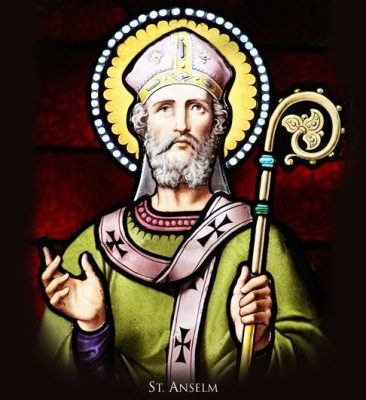
Anselm knew that a creature talking to its Creator is audacious. Prayer is daring, something we hear at every Mass: “At the Savior’s command and formed by divine teaching, we dare to say (audemus dicere).”
And this is precisely why Anselm dare not approach God alone but, instead, invokes the help of all the saints. In fact, as we shall see, everything Anselm highlights in his prayers is ultimately God’s doing, God’s gift entrusted to a particular person and thus lived out in his or her own personality, life’s experiences, and concrete historical period. In this way, prayer for Anselm really does prove to be God’s descent into a soul contrite enough to allow that mutual indwelling, and then the Lord finally has the fallen soul’s “permission” to be lifted out of its despondency into the heavenly life.
That is why constant throughout the following prayers is Anselm’s sense of self-abasement, a radically expressed sense of contrition which may not easily land on Christian ears today. The violence obvious in each prayer highlights the distance between God’s perfection and our wretchedness (miser, the Latin term Anselm uses most often to describe the state of his soul). That is why at the heart of every prayer is a call for compunction, a piercing of the fallen heart which must not be caused simply by self-deprecation but by a heavenly love which would otherwise shatter the human soul if it were not made more pliable through penance.
As such, sorrow, contrition, and a deep owning of our own fragility are all present at the onset of each prayer, as the sinner stands unadorned before the Almighty. Yet, like the Holy Mass Anselm celebrated daily as priest and bishop (and of which we still remain recipients), the penitential rite is only the beginning of worship—it may commence our communal praise of God, but it does so only to make room for further illumination (Liturgy of the Word) and then the ultimate goal of divine-human communion (Liturgy of the Eucharist). This is how we must read Anselm’s sense of deep and personal sorrow which at times can look like an ungodly self-loathing. Where he is introspectively harsh with himself, we are forced to admit some hyperbole, but we also want to appreciate the theology of his indebtedness.
Anselm was one who deeply and completely took to heart Jesus’s words that, “I am the vine, you are the branches. Whoever remains in me and I in him will bear much fruit, because without me you can do nothing” (Jn 15:5). Unlike most, Anselm certainly did not suffer from any sense of spiritual entitlement, realizing that without Jesus, it is not that he could not accomplish something grand, not that he could not perform miracles—it is that without Jesus, he knew he could do absolutely nothing.
Do you really believe that? Perhaps most of us pray and call for the presence of Christ usually as an afterthought, only when our plans are in peril or when we feel in need of “extra” help. But as we shall see, the real power of Anselm’s prayers comes through his awareness that everything depends on Jesus and that even a saintly scholar, monk, or archbishop has no good, no merit, no accomplishment of his own. All is Jesus’s doing, and it is here his sense of deep abasement begins.
ooo
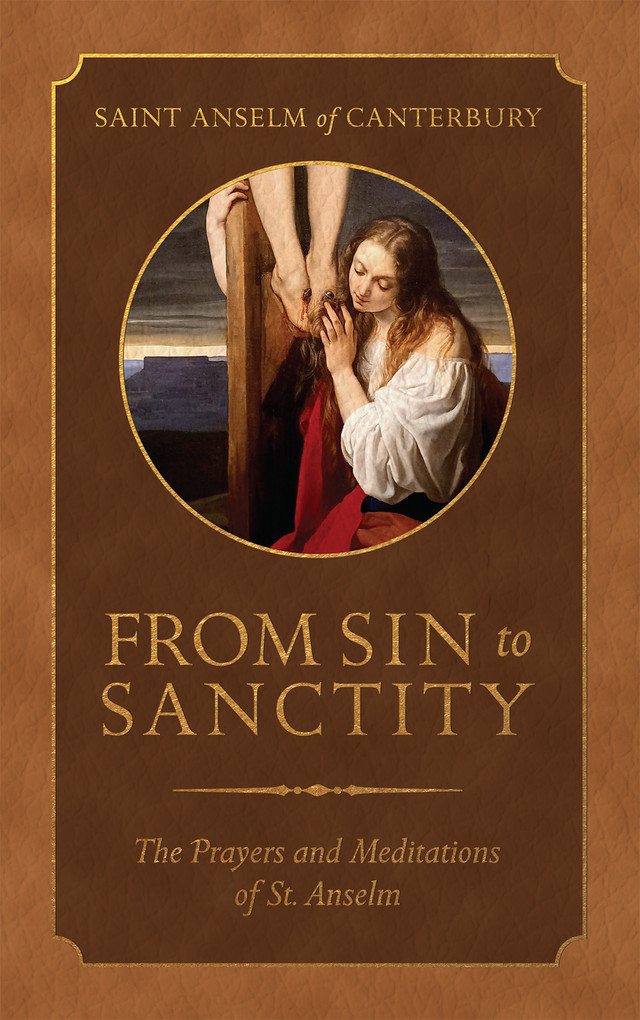
This article is taken from a chapter in From Sin to Sanctity by St. Anselm of Canterbury which is available from TAN Books.