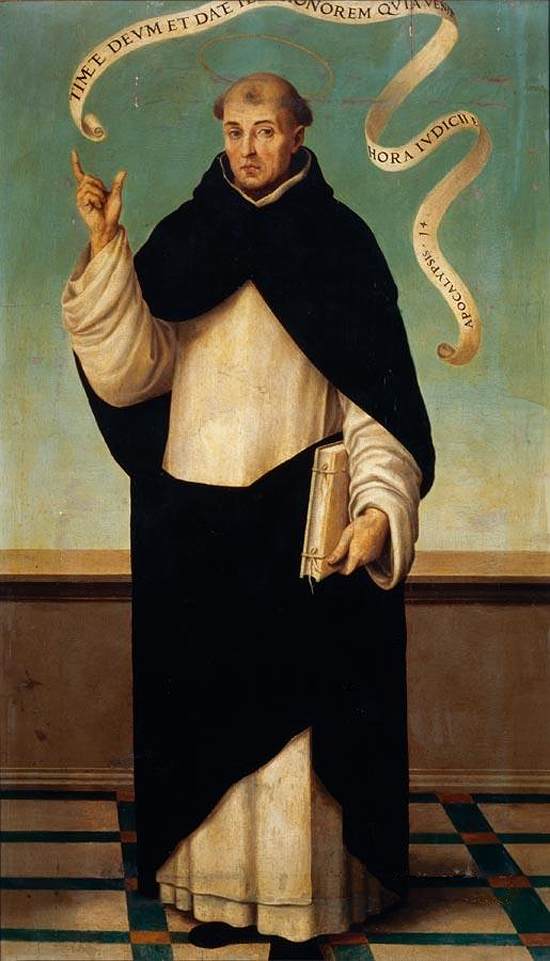
The Mass is rich with mystery and ripe fruits for meditation. Discover how the Incarnation is revealed through the signs and rubrics of the Holy Mass, from the wisdom of St. Vincent Ferrer.
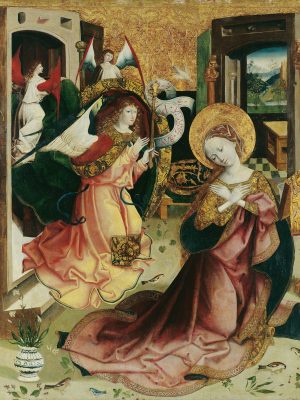
The first work which our Master and Savior Jesus Christ did for us in this world was His sublime and wonderful incarnation when, descending from heaven, He placed Himself in the bosom of the Virgin Mary, by which He put on our vesture, that is our humanity; for the divinity was hidden under the humanity. And this wonderful work is symbolized and represented in the Solemn Mass when the priest enters the sacristy, signifying the entry of the Son of God into the bosom of the Virgin Mary, where He was clothed with our humanity.
Here, the devout Christian ought to contemplate three things: first, that just as in the sacristy there are relics, jewels, and other ecclesiastical decorations, so in this glorious sacristy—that is, in the Virginal womb, there were relics—namely, the power of God the Father working, wisdom and the person of God the Son incarnating Himself, and the grace of the Holy Spirit informing. There were jewels—namely, grace and virtues, for in the Virgin Mary dwells the fullness of grace and the virtues; and ornaments with which our high priest is about to celebrate Mass, on Good Friday, on the altar of the True Cross, in the sacred and sanctified Body of Jesus Christ, from the purest and most chaste blood of the Virgin Mary formed and incarnated.
Second is that, when the priest is vested in the sacristy, no layperson sees him; but they believe that he is vested and they hope that he will come forward shortly. For which it must be noted that when our high priest Jesus Christ vested Himself in the virginal womb of the Virgin Mary, no one from the Jewish people saw Him or knew Him; in the same way that His incarnation was hidden and kept secret, the believers however believed and hoped that He would vest Himself, that is, be incarnated and born of the Virgin, just as it had been prophesied by many prophets.
Third is that the priest puts on seven vestments in the sacristy—namely, the cassock, if he is a simple priest—a rochet if is he is a bishop, a scapular if he is a monk;—amice, alb, cincture, maniple, stole, and chasuble. So, our great high priest vested Himself in the womb of the Virgin Mary, who is called a sacristy, with seven vestments—namely, the seven gifts of the Holy Spirit, by which the most sacred Body of Jesus Christ is vested and dressed (Is. 11:2–3). This is the first work in the symbolism of the Mass.
ooo
This article is taken from a chapter in The Life of Christ in the Mass by St. Vincent Ferrer which is available from TAN Books.