Day 7
Becoming Godlike
Overview: The Incarnation is still occurring. In Jesus Christ, God became a man so men and women could become like God. This is what the Church calls deification or divinization and it captures the entire point of the Christian faith. This is the central doctrine of all of Christianity and while ancient, it is something that may surprise you. We are called to be “little Christs,” to extend the Incarnation throughout all time and space. This is a teaching that enforces how all is grace: we are saved not by what we do but by who we become and only those who allow themselves to be formed into members of God’s family will enter the Kingdom of God.
Preparation for the Morning Exercise: As we near the end of our retreat together, it is important to ponder the meaning of this central Christian truth, that what Jesus Christ is by nature, we are called to become through grace—perfect(ed) children of the Father. As Christians profess, Jesus Christ is “the only begotten Son,” but we—while begotten human—are made “divine” as we give God permission to dwell in and through us. We too are sons and daughters of the same heavenly Father, Jesus is Son eternally and by nature, we are children in time and through grace.
Selection from Jean-Pierre de Caussade’s Abandonment to Divine Providence
He, therefore, who wishes to enjoy an abundance of all blessings had but one thing to do; to purify his heart by detaching it from creatures, and to abandon himself entirely to God. In this purity and abandonment he will find all that he desires. “May others, Lord, ask You for all sorts of gifts, may they multiply their words and prayers; as for me, my God, I only ask one single gift, I have only one prayer to make—give me a pure heart.” O pure heart! how happy you are; for by the liveliness of your faith you see God as He is in Himself. You see Him in all things and at every moment working within you and around you. In all things you are His subject and His instrument… (Abandonment, Bk. 2, ch. 1, sec. 8; p. 59-60).
A pure heart means we see all things as gifts from our heavenly Father. It is to understand reality thoroughly: that all is from God, sustained by God, and intended for God’s eternal glory. It is not to reduce things to “mine” or to view creatures apart from their Creator. More personally, purity means that I refuse to separate my life into two parts, secular and saintly. Everything in my life originates from and converges back to the one true God. This focus heightens our understanding and intellect, seeing God as he truly is and not as we expect him to be and, by extension, seeing all of God’s effects, all of creation, as it is and not as I think it has to be.
Your voice calls all the souls of men saying to them, “Look well at me; it is I who impart fair love, that love which chooses the better part and lays hold of it. It is I who give birth to that fear, so gentle and efficacious, which produces a horror of evil, and makes it easy to avoid; I, who bring to light those fine perceptions by which are discovered the greatness of God and the value of virtue; in fine, it is from me that those ardent desires take their rise, enkindled by holy hope. It is I who cause virtue to be practiced in expectation of the promised reward—that divine Object of our love, the possession of Whom will one day form the happiness of faithful souls.” Invite them all to come to you to be enriched with your inexhaustible treasures. All spiritual states and paths lead back to you. It is from you that they derive all that is beautiful, attractive, and charming, for all is drawn from your depths… (ibid.; p. 61).
God is inviting you to see him as the one who directs your hopes and fears, who guides all your senses and who causes all those good desires and impulses you sense in your heart when moved by love. Have you ever thought of God so concretely, so personally and intimately? Hopefully it is a consolation to understand how he sees every impulse of your loves, every desire of your heart. Yes, there are fallen impulses there, there is deceit and selfishness at times, but can you not see how in love God is with the way you are seeking him, loving him in those around you, and how you have grown to seek holiness now more than ever? He is the one propelling you slowly and in a way that only you could follow. It is from him that all which is “beautiful, attractive, and charming” comes. He simply wants you to possess him ever more strongly. Assure him of your love, speak to him of your gratitude.
Let us begin at once our journey to Heaven. There is no passage that we cannot discover, nothing is shut against us, neither the garden, nor the cellar, nor the vineyard. If we desire to breathe the fresh country air, we can go on our own feet and return when we please. With this key of David we can enter and depart; it is the key of science, and of that abyss in which are contained all the hidden treasures of divine Wisdom (ibid.).
Our journey to heaven begins right now. To wake up to this awesome journey, we must shake the sleep from our eyes and be reminded why we exist in the first place. To become saints, to share God’s life, this is why we have been created. The key to living heaven now is to be humble enough to let God meet you when and how and as he wills and not as we think God—or his Church or his commandments—should be. We are therefore reminded here to let God have us in the garden or the cellar or the vineyard. For Jesus is the great vine who is in need of branches in order to bear fruit in the world and only you can fulfill that unique place in the Lord’s harvest (cf. Jn 5:1-17). Only you can live the life God has given you. You are that needed, that unique, and the Lord thanks you.
With this heavenly key we also open the gates of mystical death with its sacred darkness. By it also we descend into the deep pools and into the den of lions. By it souls are thrust into those obscure prisons from whence they emerge unscathed. By it we are introduced into that joyful place where light and understanding have their dwelling, where the Spouse takes the midday rest in the open air, and where He reveals the secrets of His love to faithful souls. O divine incommunicable secrets that no mortal tongue can describe! Since every good thing that it is possible to possess is given to those who love, let us love then, in order to be enriched with them; for love produces sanctity with all that accompanies it… (ibid.; p. 61-62).
A key which comes from God’s own hand opens not only the door to life but is able to retrieve the dead as well. It is easy to thank God when the health report comes back with no issues, easy to thank God when the sunny day we prayed for beams brilliantly, but only the saint can continue to thank God when sick and when the dark storms come. This is not to thank God for the cancer itself, that would be ludicrous, but it is to remain faithful and thus always grateful for the Lord’s presence and trust in his working out your salvation. What is paradoxically and uniquely Christian is that his presence is greater in the Cross where he reveals the fullness of his love and it is there he “reveals his love to faithful souls. O divine incommunicable secret!” This is the power of the love that produces holiness, its ability to overcome even death.
Questions to Ponder
- How do you understand Jesus’ call to be pure of heart? Where is your heart still a bit impure?
- During this past week, what are some areas of life you have been sensing that God is prompting you to look at and maybe change?
- Does “abandonment” now seem more attractive than when you began? If not, what other image might best describe your relationship with God right now?
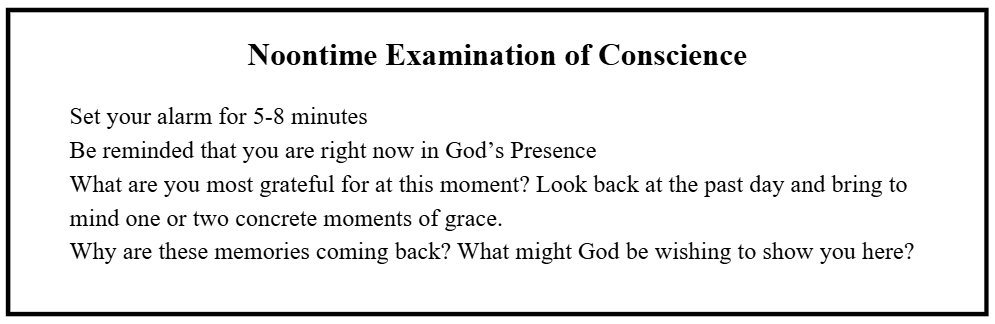
Pick one moment where you turned from God’s grace? Ask for forgiveness and ask yourself how you could work on this temptation or habit of sin?
When your alarm sounds, end with the Angelus or an Our Father and Hail Mary
Preparation for Afternoon or Evening Exercise
What does viewing the Christian life as “becoming another Christ” do for you? Does it inspire or discourage you? Do you even understand it or are terms like “becoming more Christ-like” or “becoming godly” more alluring?
Is it hard for you to admit that alone you can really do nothing (cf. Jn 15:5)? Do you really believe that? Is it freeing or disheartening to embrace the Christian truth that all the good in our life is a matter of God’s grace and his allowing us to share in his divine nature? Wrestle with what you feel here.
The devil’s first temptation is that we could become “like God” (Gen 3:5). We are made to become like God but what attracts you most about God—his selfless love or his almighty power? Why?
Selection from Jean-Pierre de Caussade’s Abandonment to Divine Providence
Jesus Christ yesterday, today, and for ever” (Heb. 13:8), says the Apostle. From the beginning of the world He was, as God, the first cause of the existence of souls. He has participated as man from the first instant of His incarnation, in this prerogative of His divinity. During the whole course of our life He acts within our souls. The time that will elapse till the end of the world is but as a day; and this day abounds with His action. Jesus Christ has lived and lives still. He began from Himself and will continue in His Saints a life that will never end. O life of Jesus! comprehending and extending beyond all the centuries of time, life effecting new operations of grace at every moment; if no one is capable of understanding all that could be written of the actual life of Jesus, all that He did and said while He was on earth; if the Gospel merely outlines a few of its features; how many Gospels would have to be written to record the history of all the moments of this mystical life of Jesus Christ in which miracles are multiplied to infinity and eternity (Abandonment, Bk. 1, ch. 2, sec. 5; p. 30).
In the Creed Catholics profess on Sundays, we hold that the Son was “eternally begotten.” There was never a time when the Son was not in existence, never a time when the Father was not Father. The Son is thus “yesterday, today, and forever,” and even when he became man in the womb of Mary, the Son’s divine nature did not change. What changed is what was added to his divinity, namely, humanity. When Mary says “yes,” it is not God who changes but we who change, having our human nature united now to God’s own self. This is how Jesus Christ “acts within our souls,” and why our becoming “divine” through graced participation is a reality and a goal! Jesus “continues in his Saints” and through baptism you have been grafted into this family, one more saint in whom Jesus himself lives.
This is how miracles continue to be multiplied, because Jesus is still at work. In fact, he promises that in his Church even “greater things” will be accomplished because now the Christ life extends no longer in just one man in Jerusalem. Now, in and through his Church, the Christ life is found in every baptized soul in every corner of the earth now that the Son has ascended and sent his Holy Spirit: “Amen, amen, I say to you, whoever believes in me will do the works that I do, and will do greater ones than these, because I am going to the Father” (Jn 14:12).
You must be praised but only because you take possession of us, for, from the moment you enter into possession of a heart, then reading, writing, speaking or silence are matters of complete indifference. One can take or leave anything, live in solitude, or as an apostle; one is well or ill, dull or eloquent, in fact anything that you will. That which you dictate, your faithful echo, the heart, repeats to all the faculties. In that compound of matter and spirit, the heart, which you regard as your kingdom, you reign supreme, and as it has no other instincts than those which you inspire, all the things that you present are equally agreeable (Abandonment, Book 2, ch. 1, sec. 8; p. 62).
As we have seen, an essential spiritual component of Jesuit spirituality is indifference. It is a principle St. Paul expressed very poignantly: “I know indeed how to live in humble circumstances; I know also how to live with abundance. In every circumstance and in all things I have learned the secret of being well fed and of going hungry, of living in abundance and of being in need. I have the strength for everything through him who empowers me” (Phil 4:12-13). This is what de Caussade is inviting us to live as well—to be loving and grateful in any circumstance we find ourselves. Are you able to look back at your life’s story and thank God for each chapter, each step along that way? Perhaps even your stumbles and sins somehow served to bring you closer into his friendship.
Those things that nature or the devil wish to substitute cause nothing but disgust and horror. If you allow it to be occasionally overcome, it is only to make it wiser and more humble; but from the moment it realizes its mistake it returns to you with renewed love, and clings to you with greater tenacity (ibid.).
See? We here learn that even those things in our life the devil thought was a victory has now brought us “disgust and horror.” This has resulted in our humility, a renewed sense of awe and gratitude and this new sense of realizing how weak and disappointing we really are apart from the Lord’s presence in our lives. Notice how in scripture how Jesus is received more gratefully and joyfully in the house of sinners than he is in homes of the religious professionals, the Pharisees and the Scribes. Jesus prefers the homes of sinners because they receive him with open arms, knowing they are in need of such a guest, in need of such a savior.
Questions to Ponder
- List 3 big projects in your life, your family or your finances, in your plans or dreams. Now offer each of those up to the Father if you are able, asking him to do with these as he wills. End each offering with a prayerful Our Father.
- Are you feeling nudged to volunteer some of your time with the poor or the most forgotten in your community? Could you realistically do more than give alms, but give of yourself, of your family’s time, a bit more? If so, see what volunteer opportunities lie around you and follow through with a phone call and visit to see what is needed and how you could love just a bit more fiercely. Be Christ for others.
- Does becoming “another Christ” invigorate you, scare you, or confuse you? Can you see how Love works—bringing the other into union and in a sharing of lives becoming evermore one?
Converting Thought into Possible Practice
It is fitting to close our retreat with Jean Pierre de Caussade in the manner with which he would have ended his annual retreat as a Jesuit, with the “Contemplation to Attain Divine Love,” the last meditation from St. Ignatius’ Spiritual Exercises. The goal of this concluding contemplation is to become mystically aware of how all creatures are gifts from God and that through them and in my very being, God longs to share his presence. Through the story of my life, the Lord longs to share his life with me as I open mine up to him.
The first step in the “Contemplation to Attain Divine Love” is to “to recall to mind the blessings of creation and redemption, and the special favors I have received.” To do this, Ignatius suggests that you:
ponder with great affection how much God our Lord has done for me, and how much He has given me of what He possesses, and finally, how much, as far as He can, the same Lord desires to give Himself to me according to his divine decrees.
So, take some time right now to see what God has done for you, savoring your blessings and growing in gratitude. How does the Lord long to give himself to you? What does this mean for you?
Next, Ignatius asks you to reflect upon what it is you want to give to God and, when appropriate, to pray the famous Suscipe Prayer, “Take, Lord, and Receive…”
Then I will reflect upon myself, and consider, according to all reason and justice, what I ought to offer the Divine Majesty, that is, all I possess and myself with it. Thus as one would do who is moved by great feeling, I will make this offering of myself:
Take, Lord, and receive all my liberty, my memory, my understanding, and my entire will, all that I have and possess. Thou hast given all to me. To Thee, O lord, I return it. All is Thine, dispose of it wholly according to Thy will. Give me Thy love and thy grace, for this is sufficient for me.
Notice how we can give to God only what he has first given to us. We give God our memory and intellect, our way of seeing and living in this world because in his Son Jesus Christ, God has first shared his mind and will and all human actions with us. This is the “great exchange” promised in the Scriptures, that in the Incarnation God became weak in our humanity so that we humans could become empowered in his divinity: “For you know the gracious act of our Lord Jesus Christ, that for your sake he became poor although he was rich, so that by his poverty you might become rich” (2 Cor 8:9).
Hereafter, Ignatius points us to the vast expanse of creation in order to see how God dwells in all things:
Reflect how God dwells in creatures: in the elements giving them existence, in the plants giving them life, in the animals conferring upon them sensation, in human beings, giving understanding. So He dwells in me and gives me being, life, sensation, intelligence; and makes a temple of me, since I am created in the likeness and image of the Divine Majesty. Then I will reflect upon myself again.
This is Scholastic Philosophy at its best: God not only creates but gives all things their continuance in existence. So while some things only “exist,” like a rock, to some higher creatures God also bestows life, as in the plants. To the next level of creatures he grants not only existence and life but also sensation, as in the animals. Yet to some he grants intelligence, persons like us who have also been made temples (cf. 1 Cor 3:16) through the gift of our baptism. Reflect, Ignatius says, on the glory that you are. Maybe you could spend some time praying over some photographs of all the people who have loved you all of these years.
The next point is to see how God not only dwells but now actually labors in the created goods of your life:
Consider how God works and labors for me in all creatures upon the face of the earth, that is, He conducts Himself as one who labors. Thus in the heavens, the elements, the plants, the fruits, the cattle, etc., He gives being, conserves them, confers life and sensation, etc… Then I will reflect on myself.
How has God been laboring for you? How has he helped to form your life into the life it is today? Do you see how he has been orchestrating all of this for you and your salvation? Do you have any regrets or wish things might have gone differently? Talk to him about those experience and sorrows and let him speak to you there.
Finally, the end of the Spiritual Exercises which de Caussade would have made every year of his religious life arrives. We now consider how everything that surrounds us and all of our life’s attachments and experiences have “descended” from God himself. This puts into a world that is wholly sacramental, with each level of creature—rocks and plants, animals and other human persons—manifesting the love of God to us, each in its own way:
Now consider all blessings and gifts as descending from above. Thus, my limited power comes from the supreme and infinite power above, and so too, justice, goodness, mercy, etc., descend from above as the rays of light descend from the sun, and as the waters flow from their fountains, etc… Then I will reflect on myself.
As I begin to reflect on myself, I should begin to see how my love of justice is a faint reflection of God’s own justice. My desire for mercy is a direct echoing of God’s own mercy. My love of what is beautiful and good is a direct participation in God who is Beauty and Goodness. Here heaven and earth become united and the chasm we feared between us and God is bridged by the sacred humanity of his Son, Jesus Christ. All is gift and all is meant to bring us closer to him. And to allow that to happen is the aft of abandonment.
Theological Meditation on Becoming Godly
The Church has enlisted her greatest theologians to provide an official teaching that the Christian life means our becoming divine! This is a supernatural call and a way of life only God can achieve in us, with us, and even as us. Read carefully the very strong language some of the greatest theologians have used to express this:
The Word became flesh to make us “partakers of the divine nature” (2 Pet 1:4). “For this is why the Word became man, and the Son of God became the Son of man: so that man, by entering into communion with the Word and thus receiving divine sonship, might become a son of God” (St. Irenaeus, d. c. 200). “For the Son of God became man so that we might become God” (St. Athanasius, d. 373). “The only-begotten Son of God, wanting to make us sharers in his divinity, assumed our nature, so that he, made man, might make men gods” (St. Thomas Aquinas, d. 1274).
—Catechism of the Catholic Church §460
What arises in you when you read these words? Does it seem out of reach? Does it seem heretical? The point here is that when we finally abandon ourselves to God’s loving care, we not only receive his love we eventually become that love! Have you not noticed that you and the person you love the most, the person with whom you spend the most time, have become more and more alike over the years?
Sit quietly and think of the person you love the most. What qualities first attracted you to that person? List those. Over the years, has that list remained pretty much the same or have you come to see even greater qualities about him or her? How have you two grown in a unity of love and have you become a bit more like one another? Do you see this as enslaving or liberating, demeaning or freeing? Through this person you have learned to come out of yourself and live for another, precisely an imitation of the Trinity and how God’s very being is a total gift of self. End this time with gratitude for the people God has put into your life to teach you this lesson. Be concrete.
When we begin to do this, we can understand St. Paul’s teaching at Gal 2:19-20: “For through the law I died to the law, that I might live for God. I have been crucified with Christ; yet I live, no longer I, but Christ lives in me; insofar as I now live in the flesh, I live by faith in the Son of God who has loved me and given himself up for me.” When we practice the art of abandonment, we begin to let Christ live our life and in so doing, we begin to do things that we could never accomplish alone—like love, and forgive, and show mercy to our persecutors and to pray for our enemies. In Christ we can now be joyful amidst distress, we can live forever, and we can finally call God our Father and all the saints our siblings! When this happens we do not disappear or lose ourselves. This is why we need to understand St. Paul carefully when he boasts that, “I live no longer I but Christ who lives in me.” That is, Paul is no longer living as an isolated “I” but as one who lives as one with Christ. For it is “Christ who lives in me,” meaning that the truest “me,” the most authentic self that I am, is a self that lives in harmonious union with the one who created me, Jesus Christ. See? Christ in my soul actualizes all of my human potential as his life in me elevates me into the divine nature (cf. 2 Pet 1:4).
In making this happen, one must begin to be able to identify those places where one still lives as a selfish “I.” Where are your plans still totally yours or where is your judgment is clouded by your own biases, hurts and triggers? It is only when you begin to think and speak and act as Jesus does will you understand how beautiful and glorious your human existence really is. St. Paul promises that in Christ we shall all become “new men”:
So whoever is in Christ is a new creation: the old things have passed away; behold, new things have come. And all this is from God, who has reconciled us to himself through Christ and given us the ministry of reconciliation, namely, God was reconciling the world to himself in Christ, not counting their trespasses against them and entrusting to us the message of reconciliation. So we are ambassadors for Christ, as if God were appealing through us. We implore you on behalf of Christ, be reconciled to God. For our sake he made him to be sin who did not know sin, so that we might become the righteousness of God in him (2 Cor 5:17-21).
You have been made “new” and all your sins and past regrets can be reconciled to God through the Cross of his Son. For you, as you are right now, Jesus Christ “became sin,” meaning that he took on every vile thought, malicious intent, mean word and cruel action that any sinner since the time of Adam ever meant. In nailing such filth to the Cross by One who is the “New Adam,” the new humanity, all humans have been made righteous. This is what allows us to become “ambassadors for Christ,” because he now lives in us and can speak his words of reconciliation and truth through us.
What would the “new man” look like for you in very practical ways?
Concluding Our Retreat
With our retreat now ending, simply look back at the past 7 themes and circle around the theme that most struck you as inspiring and encouraging. Stay with those feelings and talk to the Holy Spirit about why you feel so excited here. Look back at all the graces of these days. What has resonated most lovingly with you? What has been the most challenging? Take some time in the next few days to sit down and list all the areas of consolation in your life’s story: Whom have you loved, where did you love, what are the strongest memories of God’s presence? Make sense of some pattern here. What are the commonalities and where can you detect even a hint of providence?
The ultimate conclusion of Abandonment is this: Whose will are you going to follow throughout your lifetime, yours or God’s? Furthermore, let us illumine this question by asking a more difficult one: Just because you will religious and pious things, are you really doing God’s will? Might tending to a screaming child be “holier” at that moment than remaining in a state of contemplation? Might doing a chore around the house or office bring more grace than leaving early to go to Mass?
The spiritual life as laid out in Abandonment requires two great graces: trust that God is in fact at work in the very concrete moments of your life and, second, each of has to let go of many of the categories by which we thought we understood how God must act. How many of us have no problem understanding God works Sunday at Mass but what about Monday at that meeting? Sure, he is present around the altar but what about my family dinner table or business board room? Of course, God is present in the Most Holy Eucharist but how does he hide in my spouse, my child, my friend, my enemy?
There are not many scarier things in our lives than the unknown. We all have a need to know and to control and to plan. But in the art of abandonment, we place God’s will before our own securities. Giving up the familiar as well as the categories by which we have understood God in our lives so far can be very frightening. We are now coming to Christ in a most vulnerable way, coming to him with empty hands and with purified minds. We have let go of who we think he must be for us and how we think he has to act if we are going to be fulfilled.
Abandonment, on the other hand, asks that we simply trust. This means that we quit making plans and laying out our future first and then asking God to bless what we think is going to happen. Instead, it means that we begin each day on our knees asking first for the grace to receive love and in turn become that love for all God will put into our day. It then means acknowledging our duties and responsibilities, taking delight in the Lord and asking him that he grant us the desires of our heart (cf. Ps 37:3-4) but, and here is where we finally become saints, that we desire nothing apart from his holy will.
Steeped in such a vision of God and the world, de Caussade wants to show us that the only way to realize the great purpose of human living is to see God’s will in all things, as we learned in the Principle and Foundation. Such a spirituality is very “world friendly” in that God is never relegated to ceremony or religious piety but is found in and through the definite demands of every life. In order to proceed with the confidence of a child of God, de Caussade’s theology of abandonment thus begins by accepting the fact that nothing can occur in my life which cannot further sanctify my soul and result in God’s greater glory. God may allow setbacks and even permit sin but only so as to bring some greater good out of it. In all of this, God labors in each and every human life in order to bring about an eternal kingdom of saints. It pleases the Father to give us the kingdom (cf. Lk 12:22-32).
God is our Father and he delights in his children who try to please him by living like his only-begotten Son, Jesus. Mary did this perfectly and through her maternal care God draws us into his own light and joy
Your children have only to love You without ceasing, and to fulfill their small duties like children. A child on its mother’s lap is occupied only with its games as if it had nothing else to do but to play with its mother. The soul should soar above the clouds, and, as no one can work during the darkness of the night, it is the time for repose. The light of reason can do nothing but deepen the darkness of faith: the radiance necessary to disperse it must proceed from the same source as itself. In this state God communicates Himself to the soul as its life… (Abandonment, Bk. 2, ch. 4, sec. 1; p. 96).
As we move from accepting God’s “permissible will” (that all happens out of his providential care) to more actively embracing his “expressed will” (by seeking to live out the commandments of scripture and the teachings of the Church), we grow in childlike trust and joyful innocence. The incessant anxiety and stress of contemporary society begins to fade and the otherwise unnoticed pieces of our lives can start to make sense. Yet de Caussade is never Pollyannaish: he knows many things in our lives may still cause sorrow and pain, but once freely placed in the Father’s hands, they open our hearts to receive more of God’s tenderness and care. For, when offered to him, there is nothing in our lives that goes unused.
So, with Jean-Pierre de Caussade, we have embarked upon the great paradox: the more we abandon ourselves to the one in whose image we are created, the freer and the more alive we become. As the Son of God came to teach us, the more we allow ourselves to be a gift to God and others, the less enslaved we become. For only in Christ is true freedom realized as service, death as life, and acceptance as abandonment.