Day 6
Sacrament of the Present Moment
Overview: Among the more memorable images from Abandonment is de Caussade’s coining of the phrase, “the sacrament of the present moment.” By this he means that at every instance throughout each day, the Lord’s graces are being channeled through our experience into our souls which are being more and more conformed to the divine life. A major characteristic of the French School is that God meets us always and everywhere. Whereas the Jansenists relegated the divine to ceremony and pious practice, de Caussade emphasized a childlike simplicity; whereas the Quietists emphasized passivity, de Caussade is always calling the Christian to active abandonment, trusting the Lord will work through my deeds in the world.
Preparation for Morning Exercise: Have you ever asked God for the gift to be able his presence in your daily experiences? What might be the criteria you trust to be able to discern between the Good Spirit, the Enemy of our human nature, and your own personal thoughts and inclinations? This will take time and a lot of experience, so be patient and trust that the Lord longs to give you this gift of spiritual discernment.
Do you ever tend to think you will become “holier” later on in life? Are you ever tempted to delay a greater thirst for Jesus once life slows down or when you have more time to pay attention to such things?
Have you given God thanks for the work of his sacraments—your baptism which adopted you into his holy family, the Eucharist you have received and thereby have had Jesus literally inside of your body and soul, your confirmation which strengthened the Holy Spirit’s life deep within you? How might you understand the present moment as a sacrament?
Selection from Jean-Pierre de Caussade’s Abandonment to Divine Providence
What great truths are hidden even from Christians who imagine themselves most enlightened! How many are there amongst them who understand that every cross, every action, every attraction according to the designs of God, gives God to us in a way that nothing can better explain than a comparison with the most august mystery? Nevertheless there is nothing more certain. Does not reason as well as faith reveal to us the real presence of divine love in all creatures, and in all the events of life, as indubitably as the words of Jesus Christ and of the Church reveal the real presence of the sacred flesh of our Savior under the Eucharistic species? Do we not know that by all creatures, and by every event the divine love desires to unite us to Himself, that He has ordained, arranged, or permitted everything about us, everything that happens to us with a view to this union? (Abandonment, Book 1, ch. 2, sec. 7; p. 34-35).
A sacrament for Catholics is usually defined as an action instituted by Jesus Christ himself which imparts his own life, the life of grace, into the souls of its recipients. Here de Caussade begins by focusing on the sacrament of the most Holy Eucharist as the “presence of divine love.” While Jesus’ presence can be encountered in all creatures, and while his presence of absolution encountered in the confessional or his healing in the Anointing of the Sick, his presence in the “sacred flesh” of the Eucharist is where we most fully encounter the God-made-flesh. Jesus promised never to leave us orphans (cf. Jn 14:18). He promised that he, the incarnate Word, would be with us until the end of time (cf. Mt 28:20). So, how is this God-made-man still with us? Through the Eucharist where we encounter his own Body and Blood! That is why attending Mass as often as possible (not only on Sundays) and why committing time to a Holy Hour at Eucharistic Adoration at least weekly is so essential in our coming to learn who Jesus really is. He is divine love, which we hear, who “desires to unite himself to us,” and in the Eucharist he begins this invitation toward divine intimacy. Think about it: could you get to Mass during the week, and could you make time to experience the silent joys of Eucharistic Adoration?
This is the ultimate object of all His designs to attain which He makes use of the worst of His creatures as well as of the best, and of the most distressing events as well as of those which are pleasant and agreeable. Our communion with Him is even more meritorious when the means that serve to make it closer are repugnant to nature. If this be true, every moment of our lives may be a kind of communion with the divine love, and this communion of every moment may produce as much fruit in our souls as that which we receive in the Communion of the Body and Blood of the Son of God. This latter, it is true, is efficacious sacramentally which the former cannot be, but on the other hand, how much more frequently can it not be renewed, and what great increase of merit it can acquire by the more perfect dispositions with which it may be accomplished (ibid.; p. 35).
De Caussade insists that the ultimate goal of God the Father is to use all things—every creature and every experience—in our lives to unite us more closely to himself. God can therefore use whatever he chooses to bring this about: we may relegate him to health and prosperity and all things shiny and bright, but the truth is that real intimacy is fostered not in those places we are proud to announce to anyone but, rather, in those places where we trust only an intimate few—those places in our lives where we are broken, embarrassed and knowingly in need of healing. Perhaps this is why Christ dies such a shameful death, why the Eucharist is visibly “broken,” and why God uses those parts of our life which “are repugnant to nature,” as we here see.
Because this is in fact true, God can use all things to show us how much he loves us and in the Eucharist we literally receive Love himself. But de Caussade is free enough, as he is trying to help us become as well, to see Christ’s presence in all of creation. That is why our reception of the Most Holy Eucharist may be sacramentally efficacious, as he puts it, but there are other non-sacramental ways Jesus meets us. What might those be for you? Where do you feel most alive, most encouraged, most your best self? Who are those people for you? Where are those places, what are those experiences? Be concrete and take some time to list those and thank God for meeting you there. So, while the Eucharist may be the surest and most direct way of divine intimacy, de Caussade reminds us that other ways are more easily renewable and able to be experienced 24/7 and not just in front of the Blessed Sacrament. This is what spiritual masters have called being “recollected” throughout the day, living consistently and always consciously that God is happening wherever we choose to allow him. What a vision of the Church, what a trust in Jesus Christ’s awesome presence.
Questions to Ponder
- How is your sacramental life? Do you get to Mass as possible as often? The Eucharist is how Jesus, God-made-flesh, meets us. Do you know where there is a chapel near you with perpetual adoration? Could you commit to a weekly or at least monthly Holy Hour? Do you get to confession on a regular basis? Are your confessions vague generalities or do you know yourself well enough to confess not only what you did but why?
- Do you ever excuse yourself from greater holiness because you do not understand the finer points of theology? Do you ever excuse yourself from evangelizing because you are afraid you do not know enough? Those fears are not from the Holy Spirit who will use you and your life’s experience to speak to others of God’s love and care for them (cf. Mk 13:11). You have an authority that even priests, nuns and most professional theologians do not have—you have raised your family, paid your bills, gotten your children to soccer and what not, etc… So, when you are courageous enough to let God speak through you, you are more convincing and people will be moved closer to Jesus.
- How do you understand de Caussade’s phrase, “Sacrament of the Present Moment”? Do you really believe the circumstances of the “now” can reveal God’s most holy will for you?
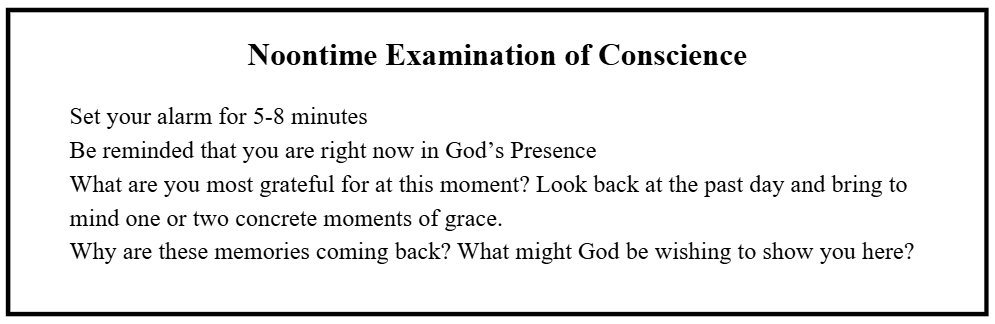
Pick one moment where you turned from God’s grace? Ask for forgiveness and ask yourself how you could work on this temptation or habit of sin?
When your alarm sounds, end with the Angelus or an Our Father and Hail Mary
Preparation for the Afternoon or Evening Exercise: The Holy Spirit is next likened to a school master who forms each of us uniquely and personally. One of the bedrock beliefs of de Caussade’s Jesuit spirituality is that the Holy Spirit treats us as he knows best. First, he acts only insofar as we allow him and, then, he chooses to use words and images and experiences that we can easily understand.
One of the challenges in the Spirit’s personalizing our journey for us is not judging others in the way we think they should be living. Obvious sin is clear and needs to be called out, but how subtly we can look down on others because they are not being called to the gifts we enjoy. How easy it is to demonize “those” people or that way of life when we simply do not understand.
Selection from Jean-Pierre de Caussade’s Abandonment to Divine Providence
Consequently how true it is that the more holy the life the more mysterious it becomes by its apparent simplicity and littleness. O great feast! O perpetual festival! God! given and received under all that is most feeble, foolish and worthless upon earth! God chooses that which nature abhors, and human prudence rejects. Of these He makes mysteries, sacraments of love, and by that which seems as if it would do most harm to souls, He gives Himself to them as often and as much as they desire to possess Him (Abandonment, Book 1, ch. 2, sec. 7; p. 35).
Have you ever noticed that some of the most cynical and unbelieving Christians have Ph.D.’s in theology? Unfortunately, many so-called Catholic universities today have failed to teach sacred doctrine humbly and faithfully but have instead taken on a posture of critique and ridicule. De Caussade knew this phenomenon and he calms us by teaching that the holier one becomes, the simpler one develops. Knowing our faith is of course important but even the most sublime of dogmas is not exactly Jesus. We are saved by a Divine Person not by well-formulated propositions. That is why St. Paul told the very learned Corinthians in ancient Greece that,
the world did not come to know God through wisdom, it was the will of God through the foolishness of the proclamation to save those who have faith. For Jews demand signs and Greeks look for wisdom, but we proclaim Christ crucified, a stumbling block to Jews and foolishness to Gentiles, but to those who are called, Jews and Greeks alike, Christ the power of God and the wisdom of God. For the foolishness of God is wiser than human wisdom, and the weakness of God is stronger than human strength (1 Cor 1:21-25).
By extension, for us, look for God more in the places where you feel weak and stumbling than in those places where you feel strong and successful. This is the paradox of the Cross.
This is the school of the Holy Spirit who in this way speaks life-giving words to the soul, and those which He speaks to us through others come from the same source. Reading and seeing become fruitful and possess virtue and light only by the acquisition of this divine science, otherwise they are like dough to which leaven is necessary, and the salt of experience to season it. And since without this salt, we have only vague ideas to act upon, we are like visionaries, who, though knowing the roads that lead to all the towns, yet lose their way going to their own house.
We must listen to God from moment to moment to become learned in the theology of virtue which is entirely practical and experimental. Do not attend therefore to what is said to others, but listen to that which is said to you and for you; there will be enough to exercise your faith because this interior language of God exercises, purifies, and increases it by its very obscurity (Abandonment, Book 1, ch. 2, sec. 8; p. 36).
Abandonment presents life on earth as a “school of the Holy Spirit,” a life-long choice teetering between two eternities, heaven or hell. To help get us to where we were created to be, however, the Spirit is gracious enough to use other creatures to teach us. These are the saints, the ones who “speak to us” on behalf of God. These better-known saints are encountered through our reading (exactly what you are doing now), but there seem to be another kind of saint, the ones we can see and interact with today. Perhaps there are holy men and women in your family, your parish, your workplace, people who speak to you of God’s love and virtue. Who is your living example of what it means to be a friend of Jesus? Who is your salt who gives your life flavor and purpose? These concrete persons are what keep our Christian discipleship from being just “vague ideas.”
That is why abandonment is that constant listening “to God from moment to moment.” What do you listen to throughout the day? What most fills your ears—music, news, sports? Perhaps it is nothing in particular but it is always on. That is the modern world, full of noise but with no one really listening. One caution offered here is being aware that we do not eavesdrop on what is being said to others. Your way of abandonment is not your neighbor’s way; it may not even be your spouse’s or child’s way. God’s call to you is a unique gift tailored just for you in your particular life circumstance. This call may be obscure, as admitted here, but in that stillness your ability to hear grows and in that growth, your familiarity with God’s voice and God’s ways only increases until your instinct and impulses become more and more one with his.
Questions to Ponder
- Is your desire for greater holiness clouded by doubt and despair, thinking, “Well, it hasn’t worked out very well before,” or is it buoyed by hope and the trust that God’s will for your wholeness is greater than your sins?
- Do you find a particular place, posture, or time of day more conducive to your “hearing God,” the foundation of true abandonment? Be very concrete here and think back and learn from those times and periods when you sensed God’s presence powerfully.
- What or who are your trustworthy guides when discerning God’s voice? Do you turn more to Church teaching or a trusted friend? How is this and what changes for the better might you make?
Converting Though into Possible Practice
Could you see getting to Church, attending daily Mass and/or making a weekly Holy Hour as romantic adventures that will inspire the rest of your life’s commitments? This is precisely how the great Catholic and author, J.R.R. Tolkien (1892-1973), went through life, approaching the Church as a love affair which infused the rest of life with meaning and purpose. Or as he wrote to one of his sons:
Out of the darkness of my life, so much frustrated, I put before you the one great thing to love on earth: the Blessed Sacrament… There you will find romance, glory, honour, fidelity, and the true way of all your loves on earth, and more than that: Death. By the divine paradox, that which ends life, and demands the surrender of all, and yet by the taste -or foretaste- of which alone can what you seek in your earthly relationships (love, faithfulness, joy) be maintained, or take on that complexion of reality, of eternal endurance, which every man’s heart desires.
The only cure for sagging or fainting faith is Communion. Though always Itself, perfect and complete and inviolate, the Blessed Sacrament does not operate completely and once for all in any of us. Like the act of Faith it must be continuous and grow by exercise. Frequency is of the highest effect. Seven times a week is more nourishing than seven times at intervals (J.R.R. Tolkien, letter to Michael Tolkien, 6-8 March 1941).
Here so many principles of de Caussade are evident: the freeing paradox of surrender, the beauty of personal friendships and God’s honoring your heart’s desires. Here is found the awareness that no sacrament or prayer is magic, that like all relationships, our intimacy with God will take time and commitment as well as a patience with our own imperfections.
Do you ever prepare for Mass more than simply getting there on time? Could you look at the readings beforehand, pray over the prayers for the Mass that week? What about confession? Do you journal throughout the week or keep notes of the places you need to be absolved and thereby grow in self-awareness?
Make a firm amendment right now that you will not let the next week go by without either attending as many daily Masses as you can or making a firm resolve to find a place of Adoration and making a Holy Hour. Try to get to the Sacrament of Reconciliation at least monthly, if not weekly. Could you? After praying over each of these possibilities, list how you felt and if you sense the Spirit’s asking you to continue this practice.
Turn now to your calendar and to your local parish bulletin. Find what you might be able to do to increase your attendance at Mass, regular confession, or a Eucharistic Holy Hour.
Theological Mediation on the Present Moment
So much of Christian evangelization today is just getting people to recognize what is right before them. When we think of trying to live in the present moment, we are simply becoming aware that the “now” is all there really is. The past exists only in our memory and the future only in our anticipation. Time continues on, but the only time that actually exists is the immediate now. For de Caussade wants us to realize that the “past” is really our present recall of prior experiences, while what we call the “future” is really our present expectancy of imagined events.
This is important not only because it is true, but learning to live in the “now” conforms us more and more to God. For God is not caught up in the rapid succession of time’s constant. For him all time is an eternal now. As the Creator of time, God has never known a past or a future but dwells in timelessness. Here, in eternity, the “now” does not slip into the past or is weighed against the future. Therefore, learning to live in the present moment is, in a way, divine.
The Annunciation of our Lord happened in a single moment, but Mary was ready to say yes and give her assent to the Father’s will since her Immaculate Conception. The first Mass in the upper room happened in a single moment but our Lord was preparing his whole life for that moment of consecration. Similarly, both the death of our Lord on Good Friday as well as his glorious resurrection three days later all happened in a moment, changing all of human history forever. The Enemy wants to tempt us to think that we missed our chance for perfection or that we can figure all of the essential matters of our life out later when we have more time.
All we have is the present moment, the now. That is why de Caussade calls the present moment a sacrament(al), because it is the only opportunity for us to receive the Lord and to commune with all his saints. The past is no more and the future never really comes. Only the “now” exists. As our retreat begins to wind down, let us take the words of the psalmist to heart, remembering that, “Seventy is the sum of our years, or eighty, if we are strong; most of them are toil and sorrow; they pass quickly, and we are gone… Teach us to count our days aright, that we may gain wisdom of heart” (Ps 90:10,12). This is not to scare us but to bolster our resolutions and remind us that each day we are that much closer to meeting God face to face. Rest assured, he loves you and longs for that day so he can finally lavish you with all of his fatherly care. For now, then, let us respond generously, slow down, and pay attention to what is going on right now, in the present moment.