Day 1
On the Art of Abandonment
Day 1 Overview: Most simply put, whose will for your life do you trust more—yours or God’s? Who loves you more—you or God? That is the ultimate question de Caussade’s Abandonment wants you not only to answer but, more importantly, to live out. Yet the answer is not simply “God,” because you matter too: because both you and God have certain plans and hopes and dreams for your life. The art of abandonment means that we trust God not by extinguishing the desires of our heart but by uniting them to God’s desires for us. This means we bring ourselves and all of our relationships and commitments to God in order that he can use all we are for our greater sanctification. The next 7 days will guide us in this conformity of wills and today aims simply to make this invitation toward abandonment more personally attractive and more theologically understandable.
Preparation for the Morning Exercise: The essence of holiness consists in abandonment to God’s holy will. It means that I live out my baptized claim as a child of the Father, as someone who trusts in God’s care for me more than what I can secure for myself. As our week together begins, find the possible reason why you are making this retreat right now? Are you able to detect why “abandonment” has attracted you at this exact point of your life? Is there anything in your recent experience that you can link directly back to this invitation? Is there anything that scares you about praying to be open to God’s will, whatever that might mean, wherever that might lead you?
Selection from Jean-Pierre de Caussade’s Abandonment to Divine Providence:
Our whole science consists in recognizing the designs of God for the present moment… It is by doing the will of God and obeying His holy inspirations that we obtain grace, and this grace works in our hearts through our reading or any other employment. Apart from God reading [or any other activity] is empty and vain and, being deprived for us of the life-giving power of the action of God, only succeeds in emptying the heart by the very fullness it gives to the mind (Abandonment, Bk 1, ch. 1, sec. 5; p. 10)
Christian holiness is not a matter of theological sophistication or learned technique. This does not mean, of course, that the intellect does not play a role. The Catholic Church has been home to history’s greatest thinkers in all areas of human genius—but de Caussade’s foundational point here is that holiness is a gift wholly free and entirely coming from God, holiness himself. The one thing God asks of us is simply to open up our souls more and more to his initiative. We do this through study, time for prayer and acts of charity, but those are only responses to God’s action, showing that he has already been at work in our souls. All is gift and that gift is realized not yesterday or tomorrow but right now, in the grace of this present moment.
This divine will, working in the soul of a simple ignorant girl [namely, Mary the Mother of God] by means of sufferings and actions of a very ordinary nature, produces a state of supernatural life without the mind being filled with self-exalting ideas; whereas the proud man who studies spiritual books merely out of curiosity receives no more than the dead letter into his mind, and the will of God having no connection with his reading his heart becomes ever harder and more withered (ibid).
During de Caussade’s years with the Visitation nuns, it had become somewhat of a fad for a religious sister to find exactly the correct spiritual reading in the hopes of finding the key which would unlock so many mysteries particular just to her. As the Quietists stressed, however, such a pursuit often ended in pride, with the person thirsty for holiness unwittingly congratulating herself on having chosen (and staying committed to) the right text. Perhaps Christians of every generation are tempted to think of their walk with Christ as the result of their own reading or prayer or church attendance, whereas the truth is that all the good in our soul is from God alone and we must always remain in the posture of recipient, of beneficiary, of bride.
Take time right now to thank God for inspiring you to make this retreat. He is carefully at work in you and is eager to see what kind of life you are going to build with these new graces. As providential as stumbling across this retreat or as providential as your spiritual reading or conversations have been up to this point, we must first recognize that it is really our Lord who has been at work, weaving his holiness into, what seemed to you, your life’s chance encounters. Are you able to trace this unbroken arc of grace to understand what abandonment might mean for you at this point in your personal history? Where has it been easy to trust in God’s will and how might you still tend to disregard it?
The order established by God and His divine will are the life of the soul no matter in what way they work, or are obeyed. Whatever connection the divine will has with the mind, it nourishes the soul, and continually enlarges it by giving it what is best for it at every moment. It is neither one thing nor another which produces these happy effects, but what God has willed for each moment. What was best for the moment that has passed is so no longer because it is no longer the will of God which, becoming apparent through other circumstances, brings to light the duty of the present moment. It is this duty under whatever guise it presents itself which is precisely that which is the most sanctifying for the soul. (Abandonment, Bk. 1, ch. 1, sec. 5; p. 10-11)
Here de Caussade invites each of us to a tremendous freedom. This new sense of childlike wonder may require that we enlarge, as he says, some of our categories. His point here is that anything in our life can bring us closer to God and that this is up to God and not determined by what we think we need to find him. Remember what he writes here: God longs to nourish the soul, enlarge our frame of reference, give us what is best at every moment—how comforting! Yet how these gifts will appear is not up to us but to the great Giver. At times the Lord may choose pious practices or natural wonders to bring us closer to him. However, and here is what only the saint understands, God can also choose sickness or divorce or heartbreak to bring us closer to him. This is the entire point of the Incarnation and Crucifixion: it is in one way easy to find God in the delights of life, but can we also let him find us in the despair, the destruction and even the deaths? It is our duty, if we are insistent on becoming saints, to let God use “whatever guise” he chooses to bring us closer to him. This is the art of true abandonment.
Adore it, put it first, before all things; tear all disguises from vain pretenses and forsake them all going straight to the sole reality. The reign of faith is death to the senses; it is their spoliation, their destruction. The senses worship creatures; faith adores the divine will. Destroy the idols of the senses and they will rebel and lament, but faith must triumph because the will of God is indestructible. When the senses are terrified, or famished, despoiled, or crushed, then it is that faith is nourished, enriched and enlivened. Faith laughs at these calamities as a governor of an impregnable fortress laughs at the useless attacks of an impotent foe. When a soul recognizes the will of God and shows a readiness to submit to it entirely, then God gives Himself to such a soul and renders it most powerful succor under all circumstances. Thus it experiences a great happiness in this coming of God, and enjoys it the more, the more it has learnt to abandon itself at every moment to His adorable will (Abandonment, Bk. 1, ch. 2, sec. 3; p. 27-28).
Here de Caussade warns us from falling for anything short of God. This would be idolatry and it is all too easily done. We can make an idol out of anything that is not God himself. We can do this even when our supposed categories are good—we can, for instance, think God can meet us only in church or in a particular kind of liturgy. It is an idol to think that only when we close our eyes and kneel down to pray do we come into God’s presence. These might be very, very good and worthwhile things to do, but the problem arises when we think this is how God too must act, denying him his right to act as he chooses and not how we think things should be. This is what is called here, “the reign of faith,” when we begin to no longer live at the merely human level but to be elevated to seeing with God’s eyes and loving with Jesus’ own tender heart. The human senses judge by human standards unless they are united to a soul abandoned to God-man Jesus Christ, and then we can finally see and hear and touch and sense rightly.
Questions to Ponder
- What does the term “abandonment” mean to you? Does a positive or a more negative image come to mind?
- Have you tended to confine God to religious practices, to “church” and Sunday mornings only? But, has the simple life of Mary and most of the saints ever struck you as something you too live out—the daily “grind” of everyday living and the burdens of family, work, the wider community and how God meet you in all of these realities demand?
- What does it mean for you to meet God in “the present moment”? Do you live recollected enough to be able to pause and sense God’s presence throughout the day or do you tend to relegate him to clearly defined times and places and rituals? Could you pray for greater freedom here and let God speak to you when and how he desires?
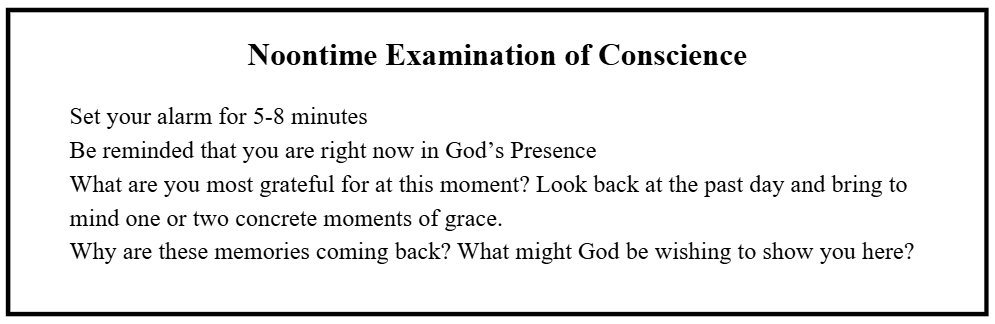
Pick one moment where you turned from God’s grace? Ask for forgiveness and ask yourself how you could work on this temptation or habit of sin?
When your alarm sounds, end with the Angelus or an Our Father and Hail Mary
Preparation for Afternoon or Evening Exercise: There is not much we agree on anymore. But perhaps there is one general concept which is beyond dispute: We all want to be happy. What sane person would deny this? Of course every generation and possibly every single person has his or her own definition of what it means to be happy. Some will argue that financial success, popularity, or bodily pleasures make up the happy life; while others have argued that only the quiet life of contemplation and virtue can bring true happiness. According to de Caussade, the only way we humans who are made in God’s own image and likeness (cf. Gen 1: 26-27) can ever be happy is to abandon ourselves into our loving God’s arms and allow him to lead us through the travails of life into the glories of heaven, always infusing a purpose and a joy into all we do and are about. Trying to live our life without God will inevitably bring frustration, sorrow, and self-imposed isolation in ways we cannot now even begin to imagine.
How do you define happiness? Whom do you love most in this world? Can you see this love not as the product of your own preferences or history but as God’s direct action in your life, letting that person you love become a sort of representative of his love for you? Trace your history and ask yourself what you thought would bring you happiness as a child, as a teenager, as a young adult, and so on. How have those expectations changed and what have you learned about happiness and love as you have matured over the years?
Selection from Jean-Pierre de Caussade’s Abandonment to Divine Providence
If, by the divine will, it is a present duty to read, then reading will produce the destined effect in the soul. If it is the divine will that reading be relinquished for contemplation, then this will perform the work of God in the soul and reading would become useless and prejudicial. Should the divine will withdraw the soul from contemplation for the hearing of confessions, etc., and that even for some considerable time, this duty becomes the means of uniting the soul with Jesus Christ and all the sweetness of contemplation would only serve to destroy this union. Our moments are made fruitful by our fulfillment of the will of God. This is presented to us in countless different ways by the present duty which forms, increases, and consummates in us the new man until we attain the plenitude destined for us by the divine wisdom. This mysterious attainment of the age of Jesus Christ in our souls is the end ordained by God and the fruit of His grace and of His divine goodness (Abandonment, Bk. 1, ch. 1, sec. 5; p. 10-11).
Here is a concrete example of abandonment. If I am sensing a nudge to carve out some time to read or listen to some worthwhile podcast, this will produce grace in the soul only if this is what God wills for me in that present moment. The same could go for watching television, going for a walk, engaging in conversation, scrolling social media, and so on. If I go against what God is inviting me to do in any moment of the day, I will look back in disappointment and realize how “useless and prejudicial”—what de Caussade means here is really how “self-centered”—that time was spent. Fulfilling God’s will in this way is the only movement of one’s soul that can bring happiness.
Of course, the immediate question is: How do I know what God’s will is for me at any particular moment? Hopefully this answer early on will not disappoint you but bring you some peace. Answer? You don’t know. Apart from the obvious Commandments and the teachings of the Christ’s Church, you need to practice abandonment and get a “feel” for what is from God and what is not. When you sense God is prodding you toward this or that action, do what you feel is coming from the Lord and then reflect later back on your response. Did that feel like it bore fruit, was it worth your time, resulting in a closer union with Jesus in the fullness of his humanity? Or did it leave you anxious, in doubt, stressed and bordering on anger or uncharity? If the former, continue that practice of saying “yes” and detecting how you read God’s will. If the latter, ponder where you might have misread the signs or how you think God chooses to communicate with you.
So, as we begin, relax and trust in the long process of abandonment. If you are not willingly violating clear Christian guidelines, you are learning how to hear God’s voice. Be patient, for absolute surety is rare for us creatures. But do keep this in mind, as de Caussade illustrates: at times you may be reading and feel a prompting to get to confession or to a Holy Hour or to a conversation with a family member or a friend (or maybe an enemy!) that you have been putting off. Trust that God is the one calling you to this encounter and this is how he chooses to meet you. He loves you and invites you to trust that he knows you and wants nothing other than your joy and your flourishing, forever.
The present is ever filled with infinite treasure, it contains more than you have capacity to hold. Faith is the measure. Believe, and it will be done to you accordingly. Love also is the measure (Abandonment, Bk. 1, ch. 2, sec. 3; p. 27).
Love is never easy to define, but in the Catholic Tradition love is traditionally characterized by two things, benevolence and union. That is, to say you love someone is to say that you desire that person’s good and that you long to be in their presence. This is of course what heaven is: our ultimate good realized in the company of God’s beloved children. When we love we begin to identify our own blessings and burdens with what our beloved is going through. Their joys become ours; their sorrows become our own. We begin to live that other-centeredness which is the foundation of abandonment, no longer just an “I” who lives but love allows another to live in us as well.
The more the heart loves, the more it desires; and the more it desires, so much the more will it receive. The will of God is at each moment before us like an immense, inexhaustible ocean that no human heart can fathom; but none can receive from it more than he has capacity to contain, it is necessary to enlarge this capacity by faith, confidence, and love (ibid.)
This next line is key, uniting our loves with our desires. See? Our desires matter! It is those very attachments and commitments that make us who we are. Moreover, our hearts are infinite because they were not only made in the likeness and image of an infinite God but because he himself longs to come and dwell therein. So, the more we love, the more we desire to be filled with love himself. Perhaps a challenge for many of us is to quit separating our loves into human and divine. For, if God is love (1 Jn 4:8), then all love is divine. There are many imposters here, of course, lust or nostalgia or the need to be desired, and so on; but true love is how God enlarges our hearts and thereby makes more and more room for himself. The people to whom we say, “I love you” is how God shows us his love and how we are to show our love for him in return. That is the whole purpose of the Incarnation—to unite heaven and earth, to unite our loves and to show us how concrete, how particular, how “human” or close love has become. It is all too easy to love in the abstract, to relegate the divine to something extraordinary. But in Jesus Christ, this is no longer possible. This is why love of God and love of neighbor are inseparable commands in Christianity, because only loving those we can see and with whom we daily interact can we finally love—and allow ourselves to be loved by—the God who is Love.
The whole creation cannot fill the human heart, for it is greater than all that is not God. It is on a higher plane than the material creation, and for this reason nothing material can satisfy it. The divine will is a deep abyss of which the present moment is the entrance. If you plunge into this abyss you will find it infinitely more vast than your desires. Do not flatter anyone, nor worship your own illusions, they can neither give you anything nor receive anything from you. Receive your fullness from the will of God alone, it will not leave you empty (ibid.)
St. Augustine, whom de Caussade read with great relish, begins his famous Confessions with the line, “our heart is restless until it rests in you, O God.” Because we were not made for this world, because we are not made in the image and likeness of one another, no creature can satisfy us for too long and certainly not completely and forever. Regardless how much we enjoy the things in our lives and no matter how wonderful our marriages and parenting might be, those creatures cannot make us eternally happy apart from the Eternal God. The reality is this: those people are the ones with whom we can share God’s happiness, but the source and end of true happiness is God himself. This is not to take anything away from those around us or to suggest in any way that this world does not matter, but creatures are conduits of happiness not the causes. When we can finally grasp that, heaven and earth become one and we begin to love and serve God in all those whom he providentially puts into our lives.
Questions to Ponder
- As this first day of retreat closes, what are some inspirations you are sensing, and, what are some internal resistances you might be feeling? Are you able tonight to pray: “I surrender to you freely and without fear, Lord, because I know you love me more than I love myself”?
- Do you still make judgments by your earthly senses, by your political persuasion, by your own prejudices and expectations? Have you ever turned away or looked down upon someone because of one of these reasons?
- What would it mean for you to see Christ in everyone you meet? What preconceptions and unfair biases would need to be consecrated? What practical changes might be asked of you here?
Converting Though into Possible Practice
Beginning tomorrow, try to foster a constant awareness that each moment of your waking day is infused with God’s holy will for you. Practice the art of mental prayer dear to all the saints. How? Compose some short prayer like, “God, I know you are leading me—show me where to go, what to say, how to react, how to love…” or words to this effect. You may want to affix whatever prayer you choose to your bathroom mirror, put it on a sticky note in your car, have a reminder on your office desk, and so on. Essential here is becoming more aware of your deepest desires and letting those people and experiences speak to you of how God is uniquely present in your life and how the life he has given you is the very means of your salvation.
Theological Meditation on Abandonment and Attachments
When we delve more deeply into theological matters, words are important. When English speakers of the 21st century engage a great theological work, we are usually dealing with works translated from ancient Hebrew, Greek or Latin or more contemporary texts from French, German, or Italian.
The word de Caussade uses as the essential linchpin for growing in holiness is simply abandon and translators most often simply use “abandonment” while at times this term can be translated as “surrender” or “submission.” While all these words may appear synonymous, getting their correct meaning is essential as we begin this retreat. To abandon oneself to God is not to become a robot. It does not entail our extinguishing our own godly desires. Rather, to live in a perpetual state of abandonment is to do all things because we deeply and truly sense that this particular idea, conversation, or action is an invitation by the Lord for me to grow closer to him in these (otherwise mundane) experiences throughout my day.
This means we understand abandonment not as extinguishing our desires but it means we pray confidently with the Psalmist and, “Find your delight in the Lord who will give you your heart’s desire” (Ps 37:4). God knows our deepest desires, he knows our holiest of loves and he is not a moral monster who wants to remove those from us the moment we turn to him in abandonment.
One of the fears we may have when making this retreat is that abandonment will rob us of our own identity and may result in God’s taking away what we hold dear. However, this is not how the mystical life works—that God has created us for communion, not absorption. At 1 Cor 15:28 St. Paul tells us that God wants to be “All in all.” Notice that God chooses not to be All, not to be everything. For if God were everything, we would be nothing. Creation would be an illusion and communion would be impossible. As the Creator, however, God does want to be All in all, meaning he does want us to meet him in all things, in every experience, at every moment. The art of abandonment lives out of this awareness, that all things speak to us of God’s loving care.
Our response is therefore not one of, “Well, I don’t matter—whatever you want, God.” No, when we are told to die to ourselves, we must have a “self” to die to and what makes you uniquely you are the loves and the attachments and the commitments in your day-to-day life. Scripture knows and honors this, for God longs to take nothing good, true, and beautiful away from us. “You have granted him his heart’s desire; you did not refuse the request of his lips” (Ps 21:3).
The great Christian apologist, C.S. Lewis (d. 1963) saw this clearly, teaching us that,
it would not be possible to live from moment to moment willing nothing but submission to God as such. What would be the material for the submission? It would seem self-contradictory to say “What I will is to subject what I will to God’s will,” for the second what has no content…In order to submit the will to God, we must have a will and that will must have objects. Christian renunciation does not mean Stoic ‘Apathy,’ but a readiness to prefer God to inferior ends which are in themselves lawful” (Problem of Pain, 113).
Lewis is well aware that there is a strand of Christian spirituality that tries to convince us that if we are going to impress God we cannot let on how much we love others. But this is not Christianity where love of self, love of neighbor and love of God are all interrelated and dependent upon each other. Our attachments, our relationships, the people and the projects to which we commit ourselves arrange not only our schedules and priorities, they also determine our character and who we ultimately are. That is why Lewis asks us not to expunge our desires but to conform them to God’s. Self-denial for the Christian must never mean the denial of the self and the attachments and relations that make up that self
Was it not the desire to be close to men, women, and children that drew God to earth in the first place? Do Christians not worship a God who became mortal and who preferred the company of ropey sinners over that of the professionally religious? Do we not worship a God whose only concern at death was that others knew of their salvation and that his mother was going to be taken care of? “When Jesus saw his mother and the disciple there whom he loved, he said to his mother, ‘Woman, behold, your son.’ Then he said to the disciple, ‘Behold, your mother.’ And from that hour the disciple took her into his home” (Jn 19:26-27). We love a God who asks us to know him under the appearance of bread and wine and to know and love him in the most human of our neighbors.
This therefore is true abandonment: to surrender to God because we realize he loves us more than we love ourselves. It is not to submit to an Overlord who is dead set on having his way. The “source and summit” of the Christian life is Holy Communion, not holy obliteration. That is, com–union means the harmonious union of two (co-) and not the overriding of the One. God has created you with all you bring to him and in our deepest desires and holiest of attachments, God is today simply asking for you to recognize him and to trust him with all you hold dear.
This is the heart of Christianity. There are other religions which profess the denial of self, the extinguishing of all desire in order to reach some sort of Nirvana, but this is not the way of a religion which professes a God who took all that is human to his very self. From now on, ever since the Incarnation of Jesus Christ, the only way to find the one, true God is in and through the human!