Day 2
God Still Forms Saints
Day 2 Overview: The first point de Caussade has to convince anyone intent on greater abandonment is that God is inviting you to this spiritual growth because he wants to make you into a saint. “A Saint? Me?” “Yes, a saint. You!” To do this we must overcome our tendency to think of saints as frozen images in stained-glass windows or some plastic figurine from the dusty past. Among the more challenging invitations of Abandonment is the call to realize that God has never stopped making saints out of anyone willing to allow him. We can often think that sanctity is reserved only for someone behind a religious wall or wearing distinctive religious garb. When we do this we secretly excuse ourselves from the same call to holiness. Yet our first meditation will be on this truth: since God is love, by loving you become more and more like God. In fact, you have been created in God’s image and likeness and nothing other than Love can really fulfill who you are. As such, we must be more and more convinced that the end goal of our life on earth is heaven, and even the least worthy person in heaven is a saint.
Preparation for the Morning Exercise: You have been brought into existence in order to become your truest self or, in Christian terms, to become a saint. God has offered you all the grace you need to do this but the real question is this: Do you really want to be a saint? Do you really want to cooperate with God himself in every interaction, exchange, thought, word and action throughout each day? In other words, do you believe that God is actually active and longing to bring you (as you are right now) into a closer friendship based on mutual trust and a shared desire to know and love one another better?
Selection from Jean-Pierre de Caussade’s Abandonment to Divine Providence
God continues to speak today as He spoke in former times to our fathers when there were no directors as at present, nor any regular method of direction. Then all spirituality was comprised in fidelity to the designs of God, for there was no regular system of guidance in the spiritual life to explain it in detail, nor so many instructions, precepts and examples as there are now. Doubtless our present difficulties render this necessary, but it was not so in the first ages when souls were more simple and straightforward. Then, for those who led a spiritual life, each moment brought some duty to be faithfully accomplished (Abandonment, Bk. 1, ch. 1, sec. 1; p. 3).
We begin with de Caussade reminding us that “in the beginning” souls were pure enough to hear God without much mediation. Back in the Garden of Eden, Adam and Eve enjoyed intimate strolls with God and before sin clouded our abilities to want what God himself wants. But now, given the reality of sin and the lies it so easily brings, as well as the busyness of modern life, we are in need of a guide. If we desire holiness, we are all in need of a trained guide to help us along the way God has planned out for us, and Abandonment is a simple but surefire way of growing in sanctity.
Their whole attention was thus concentrated consecutively like a hand that marks the hours which, at each moment, traverses the space allotted to it. Their minds, incessantly animated by the impulsion of divine grace, turned imperceptibly to each new duty that presented itself by the permission of God at different hours of the day. Such were the hidden springs by which the conduct of Mary was actuated. Mary was the most simple of all creatures, and the most closely united to God. Her answer to the angel when she said, “Fiat mihi secundum verbum tuum,” (“May it be done to me according to your word”; Lk 1:38) contained all the mystic theology of her ancestors to whom everything was reduced, as it is now, to the purest, simplest submission of the soul to the will of God, under whatever form it presents itself (ibid; p. 3-4).
Mary is fittingly raised up as the first Christian disciple in our retreat. She is what we too hope to become. Why so? She was wholly open to the Father’s will for her life, trusting him in her very soul and body, trusting that he loved her more than anyone else and therefore had the right to be heard, to be followed. That is why the words of Mary shine so beautifully—“May it be done to me according to your word.” O heavenly Father, let your will be done in my life as I trust you and realize deep down that I could never be happy apart from you.
This beautiful and exalted state, which was the basis of the spiritual life of Mary, shines conspicuously in these simple words, “Fiat mihi” (Lk 1:38). Take notice that they are in complete harmony with those which Our Lord desires that we should have always on our lips and in our hearts: “Fiat voluntas tua” (“May your will be done”). It is true that what was required of Mary at this great moment was for her very great glory, but the magnificence of this glory would have made no impression on her if she had not seen in it the fulfillment of the will of God. In all things was she ruled by the divine will. Were her occupations ordinary, or of an elevated nature, they were to her but the manifestation, sometimes obscure, sometimes clear, of the operations of the most High, in which she found alike subject matter for the glory of God. Her spirit, transported with joy, looked upon all that she had to do or to suffer at each moment as the gift of Him who fills with good things the hearts of those who hunger and thirst for Him alone, and have no desire for created things (ibid.).
At the moment Mary says “yes, let it be done to me,” the otherwise invisible and eternal Son of God becomes human in her womb. Now the invisible has become visible, the eternal will soon prove to be mortal, and power is now realized through humility. What a state he has allowed himself to be—a lowliness unmatched not only in his becoming human but even prior to that, humility waiting for the free “yes” of a young woman which would allow God to enter his own creation. That is the ultimate task of every Christian: to say “yes” to God at each moment, not as an overlord or some dictator, but as a friend, a lover, One who simply wants to be part of our lives and to share the very ordinary events of our days.
Notice how receptivity is the essence of Mary’s whole being. The heart of the Christian life is not one of performance and achievement. The heart of the Christian life is openness and responsiveness. God is the agent, we are the recipients; he is the Bridegroom, we are the Bride. As such, we cannot gauge our Christian life on how many rosaries we have prayed, how often we get to the Sacraments (as essential as these practices are!), but in how we trust in God’s promptings and carry out his commands with love. Let us accordingly take some time to pause here and reflect on this first lesson of becoming saints, in imitation of Mary, by saying “yes” and allowing God to enter into every moment and experience of our lives.
Questions to Ponder
- Do you really believe that you could become a saint? What would that mean for you? List three areas of your life that would have to be transformed? Are you free enough to abandon those to the Father?
- What kind of devotion do you currently have with Mary? Can you see in her the perfect qualities of a Christian disciple: trust, openness to whatever God asks, strength in receiving the divine life within her, and the needed abandonment to follow her Son Jesus wherever he goes. Is a daily rosary part of your spiritual regimen?
- Focus in on the fear and the inevitable challenges Mary had—not sure exactly how Joseph would react, not knowing all the details of the Incarnation, the unknowns of a first pregnancy and all the tasks a newborn baby demands—and ask yourself if you really believe that God does not ask anything of us which will not help save our souls and bring him greater glory? Where are these challenges in your life and can you offer them to God just as quickly as you can all your blessings and gifts?
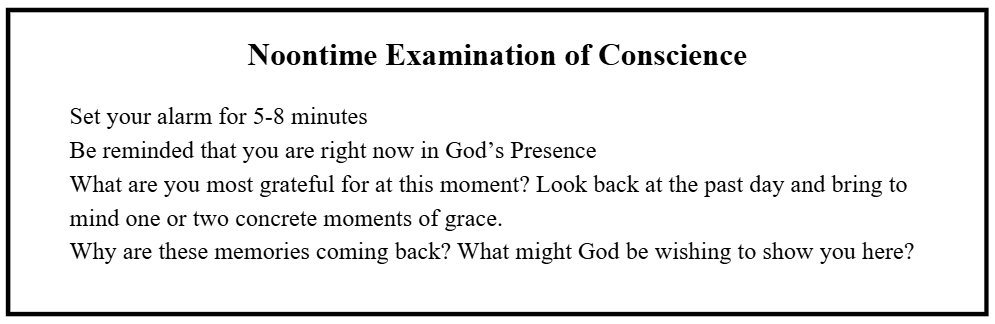
Pick one moment where you turned from God’s grace? Ask for forgiveness and ask yourself how you could work on this temptation or habit of sin?
When your alarm sounds, end with the Angelus or an Our Father and Hail Mary
Preparation for Afternoon or Evening Exercise: The Gospel tells us that, “The person who is trustworthy in very small matters is also trustworthy in great ones; and the person who is dishonest in very small matters is also dishonest in great ones” (Lk 16:10). Can you see this reality in your life—that Jesus will give you with what he can trust you? No doubt when you think of the most important “matters” in your life, faces and names come to mind. Please take a minute or two to bring those people and relationships to mind. This is the life Jesus has entrusted to you and it is here, and only here, you are going to become a saint. Finally, where have you intentionally and consciously cut corners and have been “dishonest” in small matters? Do you see how these failings have affected your spiritual life through the formation of bad habits and patterns of putting your ego first? Take a minute and ask forgiveness for these moments of selfishness.
Selection from Jean-Pierre de Caussade’s Abandonment to Divine Providence
You say you would be delighted to find an opportunity of dying for God, and would be completely satisfied with some such action, or with a life leading to the same result. To lose all, to die forsaken, to sacrifice your life for others, these are indeed charming ideas! But as for me, Lord, I glorify in all things the might of Your will in which I find all the happiness of martyrdom, austerities, and good works for others. Your will is enough, and I am content to live and to die as it decrees. In itself it is more pleasing to me than all the attributes of the instruments of which it makes use, or than their effects, because it pervades all, makes all divine, and changes all into itself. It is all heavenly to me, and every one of my moments is a genuine divine action, and living or dying I shall always be satisfied with it… (Abandonment, Bk. 1, ch. 2, sec. 11; p. 41).
We all need heroes to emulate, and the Church’s first were the martyrs. From the 2nd century on, tales of courageous men and women going to unbelievably barbaric deaths were told to encourage the faithful and to provide the Church with a growing sense of counter-cultural identity. When Catholicism was legalized in 313, the Christian martyr was replaced by the Christian monk. From blood to baptism, we began to understand that not all people are called to “red martyrdom” by allowing their life to drain from their bodies. Now most of Jesus’ friends were called to a “white martyrdom” which entails the daily laying down of one’s life. This white martyrdom is exactly what the art of abandonment requires. It is a perennial temptation, to say one is ready to “die for God” in the abstract, but fail to wake up early for morning Mass. The real challenge to our Christian faith is, for the most part, not the infidel but the internet, not the pagan but the phone. Where in your day-to-day life are you being invited to “die to self,” to forego immediate (and usually mindless, unhelpful) pleasantries to focus on something more salvific?
Never make the mistake of thinking that we need to destroy ourselves or squash our needs and wants in order to impress God. Your desires do not to be killed but consecrated. Do not confuse this Christian call of self-denial with a form of Buddhism that wants to extinguish all your desires. You cannot die to self unless there is a self to die to! What Jesus wants from you is a conformity, a communion, between you and him. So the austerities and ascetic practices that will increase grace in your soul cannot be viewed as a sort of competition or a test of one’s machismo, but a response to God’s call. This alone, God’s invitation, will make all the hours of prayer and fasts and acts of selfless service something holy. That is why de Caussade advises us never to confuse the “attributes of the instrument” with the one who provides what instruments we need for holiness from moment to moment. These are opportunities in which to delight not because of the struggle but because of the sanctity. What matters is not that we are being challenged or tempted but because such opportunities come from God’s loving (and often mysterious) will.
Therefore it is not within the narrow limits of a book, or the life of a saint, or in some sublime idea that I ought to seek You. These are but drops of that ocean which is poured out over every creature and in which they are all immersed. They are mere atoms that disappear in this deep abyss. I will no longer seek this action in the thoughts of spiritual persons. I will no longer beg my bread from door to door, nor pay court to creatures, but I will live as the child of an infinitely good, wise, and powerful father whom I desire to please, and to make happy. I wish to live according to my faith, and since the divine action is applied by every single thing and at every moment for my perfection, I will live on this immense fortune, this certain income, and in the most profitable manner (ibid; p. 41-42).
As Abandonment insists throughout, holiness is not a matter of technique and life in Christ will not be lived in a book or contained in a dogma or ritual. “I am the way, the life, and the truth,” (Jn 14:6), Christ explains, and not some formula or treatise about him, however beautiful. Relax, therefore, your lack of theological training or your intellectual limitations are not going to keep you from the holiness God wills for you. What you are being called to now is to live “as the child of an infinitely good, wise, and powerful father” who loves you and has ordained the life you are living right now.
For your perfection, God has seen that you were conceived and born when you were, that you are in the vocation you are in right now and the people who surround you are precisely how he means for you to become a saint. Do not be tempted to think that you missed out on God’s plan for you or that you are a disappointment to your Father. This is an insult against his holy will. To live with the freedom and the joy of being God’s son or daughter, you only need to name your sins and let him take those thoughts, words, or actions away from you. This is the perfection he wills for you—most likely not the seminary or convent but the carpool and neighborhood, the home and the times in which he has always needed you and your witness. This is the “immense fortune” in which you are right now called to live.
Questions to Ponder:
- Can you examine your soul to see where creatures might possibly impede your union with God? It is easy to detect the sins but are there other seemingly good and pious things which might move you away from charity?
- What are the things, who are the people, where are the places you are not yet ready to say, “Father, I offer this to you because I know you love me”? Creatures are good and they are the way God communicates to us, but all our attachments must be consecrated through proper abandonment.
- What keeps you from seeing and hearing God throughout the day? What in your heart is still in need of purification and trust?
Converting Thought into Possible Practice
After the consecration at the Catholic Mass, the priest leads the congregation with this prayer: “Therefore, as we celebrate the memorial of his Death and Resurrection, we offer you, Lord, the Bread of life and the Chalice of salvation, giving thanks that you have held us worthy to be in your presence and minister to you” (Eucharistic Prayer II). God has found you “worthy” to be with him, to serve him and to belong to him forever. You are being called to sainthood not because you are holy but because God is. This does not depend on your past or some acceptable proportion between the “sins” and the “good things” of which you keep a mental catalog. Your holiness depends 100% on God’s desire for your wholeness; you simply have to say “yes” to his longing for you.
Who are the saints in your life? Read Mark 2:1-5 and ask yourself, “Who are the 4 people who have lowered me most intimately down to Jesus?” Pray for those 4 and, if appropriate, reach out and thank them personally:
When Jesus returned to Capernaum after some days, it became known that he was at home. Many gathered together so that there was no longer room for them, not even around the door, and he preached the word to them. They came bringing to him a paralytic carried by four men. Unable to get near Jesus because of the crowd, they opened up the roof above him. After they had broken through, they let down the mat on which the paralytic was lying. When Jesus saw their faith, he said to the paralytic, “Child, your sins are forgiven.”
The four who have “lowered” me to Jesus Christ are:
- ______________________ 3. _____________________
- ______________________ 4. _____________________
After you have thanked the Lord for the presence of these people who have shown you the face of Christ most perfectly, pray about the possibility of sending them each a text or an email or even a letter of gratitude. If you discern that such contact would not be helpful, ponder what attributes of each of these persons most draws you to them and pray for them.
Theological Meditation on Becoming a Saint
Because God is love (1 Jn 4:8), love is the only way we can reach him. At the end of our life, love will be the only test, the only question. For love is the only reality that makes us saints. Furthermore, because God has become human, the only way to love God and to realize heaven is through the human, all those men and women God has providentially placed in your life. All those in your home, office and on your street are living invitations for you to see and honor God as well as his way of showing you his own care and affection. “We love because he first loved us. If anyone says, ‘I love God,’ but hates his brother, he is a liar; for whoever does not love a brother whom he has seen cannot love God whom he has not seen. This is the commandment we have from him: whoever loves God must also love his brother” (1 Jn 4:19-21). It is all too convenient to love in the abstract.
The word “holy” is related to our word wholeness (this is the root of our word “Catholic”—literally, “according to” or “throughout” [kata in Greek] the whole [holos in Greek]). Where in your life do you feel most divided, most torn between competing values. Similarly, where do you feel less than whole, incomplete, always stressed and struggling? Where do you feel divided internally or at odds with those outside of you? Can you offer what comes to mind to God and ask him to use even these challenges? Where can you not yet pray “Our Father”?
Since God is love, all love is divine. There is no such thing as human love. There is human affection and lust and the need to be admired—all sorts of love’s imposters. How often we divide our loves into those we think sacred and those we think secular, those loves which are holy and those which are just human. This is a trick of the Enemy and our job today is to see that wherever there is true love, there God is present, uniting us in an eternal bond of unbreakable charity.
In this way we can unite our loves and resist the worldly temptation to reduce the intimate friendships we enjoy on earth to just the natural result of romance or shared time together. The truth is that all love is one because all love is God. Therefore, if we truly love—if we love in virtue and with the other-centeredness the Bible demands (cf. 1 Corinthians 13), we are allowing God to be present in our daily life. Love is where God “happens.”
Hear, then, one excerpt from the early Church and the implications of this teaching. The following snippet of a sermon comes from the Archbishop of Constantinople around the turn of the 5th century, St. John Chrysostom (d. 407) and his challenge that the Church should have as much affection for the poor in the streets as for their Savior on the altar:
Do you want to honor Christ’s body? Then do not scorn him in his nakedness, nor honor him here in the Church with silken garments while neglecting him outside where he is cold and naked. For he who said: This is my body, and made it so by his words, also said: You saw me hungry and did not feed me, and inasmuch as you did not do it for one of these, the least of my brothers or sisters, you did not do it for me. What we do here in the Church requires a pure heart, not special garments…. Of what use is it to weigh down Christ’s table with golden cups, when he himself is dying of hunger? First, fill him when he is hungry; then use the means you have left to adorn his table. Will you have a golden cup made but not give a cup of water? What is the use of providing the table with cloths woven of gold thread, and not providing Christ himself with the clothes he needs?… Do not, therefore, adorn the Church and ignore your afflicted brother, for he is the most precious temple of all. (St. John Chrysostom, Homily on Matthew, no. 50:3-4)
We live in a modern culture that honors love but has no idea what it is. “Love is love,” we hear and see on banners and bumper stickers but that does not tell us anything about what love actually is. Christians adhere to a life that says love has become incarnate, love has taken on a particular body, a concrete way of life. Therefore, love is not some fleeting emotion or some vague feeling void of definition. In fact, because of God’s becoming visible, Christianity is able to define that which would otherwise be unknowable: “Love is patient, love is kind, it is not jealous, love is not pompous, it is not inflated, it is not rude, it does not seek its own interests, it is not quick-tempered, it does not brood over injury, it does not rejoice over wrongdoing but rejoices with the truth. It bears all things, believes all things, hopes all things, endures all things. Love never fails” (1 Cor 13: 4-8).
Take a moment and look at the very concrete ways it has been revealed to St. Paul what love is, and ask yourself where you feel most loving and where your love still could grow. Take some time and list the ways God is present in those you love most dearly. See the unity present, the unity between you and your beloved, but also the unity between you and God who is the cause of all true communion.