Day 3
All Things Speak to Us of God’s Love
Day 3 Overview: Christianity is not only about getting to heaven. It’s about living a heavenly life your entire life. This may sound unrealistic or too good to be true, but Jesus promises his followers that his life can be theirs here and now and not just in the future. This means that the life of Jesus within us allows us to do superhuman things throughout our lifetime, each day. For instance, as merely human we cannot lay our lives down for others, no mere human can truly love his enemies or pray for those who undermine him. But Jesus can and in the art of abandonment, we freely allow him to accomplish these things in us. How often do we feel unable to love those in our daily lives? We are too stressed, too hurt, too tired. Yet in one simple act of the will, “Jesus, love this person through me, as me…,” we can instantly become the love we deeply desire to see.
Preparation for the Morning Exercise: In Abandonment is Our Pledge of Heaven: Where do you still judge others through a human lens—by their appearance, by the color of their skin, by their apparent political persuasion or obvious challenges to my own values? Can you ask the Lord to become the lens through which you see those people who irritate you?
Too, can you look back over your life and trace the ways you have been led away by pursuits you once thought were going to make you happy that you now see were good but insufficient ends? Our goal today is to see how all things can speak to us of God’s loving care and how we sometimes make creatures into our Creator, making what should be his images into our idols. When we are young we “rush from one fountain to another,” as de Caussade knows. We might have begun our adult life thinking we were made in the image and likeness of eros or romance, and we felt chronically unloved. As we move in our career we secretly begin to think we are made in the image and likeness of financial success, and we are always feeling poorer than the other guy. Maybe then we start equating our worth with social status, resulting in our feeling like we simply do not belong to the right circle or country club. All of this is understandable, but it is not where God is calling any of us; these things are just the glitter, not the gold!
Selection from Jean-Pierre de Caussade’s Abandonment to Divine Providence
Is there any creature whose action can equal that of God? Why then should I go to creatures for help since all that happens to me is the work of His uncreated hand? Creatures are powerless, ignorant, and without affection and I should die of thirst rushing like this from one fountain to another, from one stream to another when there is a sea at hand, the waters of which encompass me on every side. All that happens to me therefore will be food for my nourishment, water for my cleansing, fire for my purification, and a channel of grace for all my needs. That which I might endeavor to find in other ways seeks me incessantly and gives itself to me through all creatures (Abandonment, Bk. 1, ch. 2, sec. 11; p. 42).
Are you tired of running from creature to creature? Hopefully with life’s experience you now see how empty things are apart from their Creator. The pursuit of riches has left you discouraged and the drive for human eros without divine direction only frustrates. God alone can nourish and to say that is not to imply we no longer need to eat or breathe, or that human sustenance or our sexual desires are meaningless. It is to live on an elevated plane and to see all of our human and bodily needs as channels of God’s presence. What is the point of trying to enjoy a sumptuous meal if our souls are misaligned and we therefore take no account of where that food has come from as well as its ultimate purpose in nourishing our bodies? That is to live like animals, only for the immediate moment, only for our biological existence with no real higher hope or unassailable joy.
You are being called to let every experience and every interaction communicate to you God’s perfect love and fruitful plan for your life. What you must insist upon is charity and openness to letting the Lord lead you in that love. This will be achieved as you begin to care more and more for those he puts into your life, as you begin to know and communicate the truths of Jesus Christ, and as you long more and more to serve others in that truth.
O Love of God! how is it that all creatures do not know how freely you lavish Yourself and Your favors on them while they are seeking You in byways and corners where You are not to be found? How foolish to refuse to breathe the open air! to search for a spot on which to place the foot when there is the whole countryside before you; to be unable to find water when there is a whole deluge at your service, nor to possess and enjoy God, nor to recognize His action when it is present in all things. You search for hidden ways of belonging to God, good people, but the only way is that of making use of whatever He sends you. All leads to union, to perfection, except what is sinful or not a duty. All that is necessary is to accept everything, placing no obstacle in the way of its action but letting it accomplish its work. All things are intended to guide, raise, and support you, and are in the hand of God whose action is vaster and more present than the elements of earth, air, and water. Even by means of the senses God will enter, provided they are used only as He ordains, because everything contrary to His will must be resisted. There is not a single atom that goes to form part of your being, even to the marrow of the bones, that is not formed by the divine power. From it all things proceed, by it all things are made (ibid.).
Here we learn that perfection is defined by communion, by the union of persons in a harmonious willing of each other’s presence. The primal problem is that Satan hates union. He wants to separate and divide but God wants to gather and unite. Satan wants to sap you of your desires or at least make you think they are not worthy of God. But de Caussade knows how much our desires matter: we are called to conform our wills with God, not extinguish them as if they were somehow divine distractions. Abandonment into love does not mean we become insignificant before the Almighty or we that we are reduced to puppets or automata. The art of abandonment means we allow our desires and God’s desires to converge to such a degree that what he wants is what we want and, as he transforms us into saints, we begin to see how what we want is really what God wants as well.
Your very life-blood flows through your veins by the movement this power imparts to it, and all the fluctuations that exist between strength and weakness, languor and liveliness, life and death, are divine instruments put in motion to effect your sanctification. Under its influence all bodily states become operations of grace. From this invisible hand come all your opinions, all your ideas on whatever subject they may be formed. What this action will effect in you, you will learn by successive experiences, for there is no created heart or mind that can teach it to you. Your life flows on uninterruptedly in this unsounded abyss in which each present moment contains all that is best for you, and as such must be loved and esteemed. It is necessary to have a perfect confidence in this action which of itself can do nothing but what is good (ibid.; p. 42-43).
Have you ever been taken by surprise how fast your life is going? We should be consoled that God is at work and that our very “life-blood flows” to where he needs us to be—“uninterruptedly” into each present moment which “contains all that is best for you.” Own this mysterious truth, that the life you have been leading has been the life best for you because it has come from God’s own hand. You might imagine an easier life, you might even be able to imagine a holier life, but can you imagine that God knew what was best and has planted you precisely where you are?
No created heart can teach this. We are all students—there is only one teacher (cf. Mt 23:8) because even the brightest among us learn as we impart knowledge. The more challenging parts of our retreat insist on our trusting that God knows what he is doing and that, as he himself tells us, “My thoughts are not your thoughts, nor are your ways my ways—oracle of the Lord. For as the heavens are higher than the earth, so are my ways higher than your ways, my thoughts higher than your thoughts (Is 55:8-9),” as the Prophet teaches.
Questions to Ponder
- List any practical knowledge you have received in these few days of retreat so far. How do you plan to hear Jesus’ voice more clearly in the present moment hereafter? How will this awareness and plan of action help your day-to-day life as a Christian?
- Do you trust your holy desires, your good impulses? What do they tell you? What do they move you to do? Can you begin to have confidence in how those are the various ways the Holy Spirit speaks to you personally and uniquely?
- How do you deal with ambiguity, living in a state of trust and not always having the answers or knowing where things are ultimately leading? Can you pray with the disciples who want concrete answers to Jesus’ whereabouts, and he simply turns to them and says, “Come and see” (Jn 1:39)? What might scare or frustrate you about being a follower without always knowing the next step to be taken?
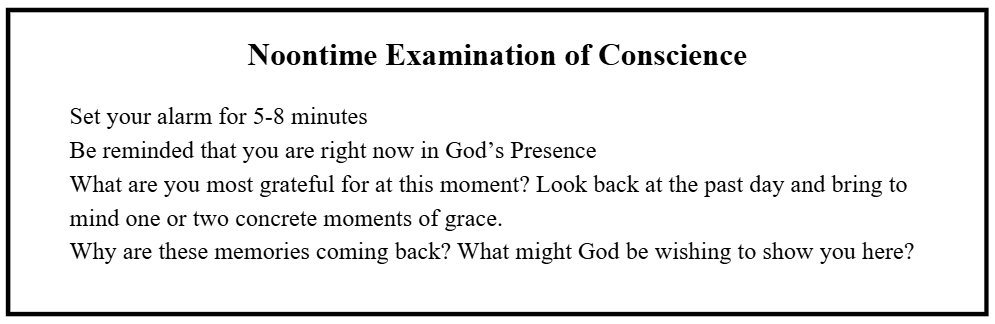
Pick one moment where you turned from God’s grace? Ask for forgiveness and ask yourself how you could work on this temptation or habit of sin?
When your alarm sounds, end with the Angelus or an Our Father and Hail Mary
Preparation for Afternoon or Evening Exercise: The Principle and Foundation
In many ways St. Ignatius of Loyola (1491-1556) revolutionized religious life immediately following the Protestant Reformation. His idea of a new community of clerics was to send highly trained men into the world to combat wherever the Gospel was being challenged. This meant some Jesuits might work in a parish, others at a lower school, some at the best universities of the day, while others would live their life out as missionaries in far-away lands. To find God “in all things” was the ultimate mission for every Jesuit. To encounter God in all things thus means to be free enough to recognize the divine presence in every creature, in every experience and in every moment. This requires great freedom and charity, as it is all too easy to constrict God into our own categories and unknowingly make idols.
The Principle and Foundation found at the beginning of St. Ignatius’ Spiritual Exercises runs through all of de Caussade’s spirituality. Here he learned the deep conviction that not only does God speak directly and tailor-made to each of us, he usually relies on revealing himself through the most mundane of our everyday lives: “God, who instructs men by means of their fellow creatures, never fails to make such souls encounter those who abandon themselves to Him with simplicity and fidelity” (Abandonment, Bk. 2, ch. 3, sec. 1; p. 83).
Selection from the Spiritual Exercises of St. Ignatius of Loyola
The author of Abandonment (de Caussade or perhaps another Jesuit brother of his) would have made the Spiritual Exercises of St. Ignatius of Loyola (d. 1556) every year of his religious life. These meditations begin with the Principle and Foundation which lays out the entire vision of Jesuit spirituality—to find God in all things.
God created human beings to praise, reverence, and serve God, and by doing this, to save their souls. God created all other things on the face of the earth to help fulfill this purpose.
From this it follows that we are to use the things of this world only to the extent that they help us to this end, and we ought to rid ourselves of the things of this world to the extent that they get in the way of this end.
For this it is necessary to make ourselves indifferent to all created things as much as we are able, so that we do not necessarily want health rather than sickness, riches rather than poverty, honor rather than dishonor, a long rather than a short life, and so in all the rest, so that we ultimately desire and choose only what is most conducive for us to the end for which God created us (Spiritual Exercises §23).
Converting Thought into Practice
One of the great gifts Ignatius of Loyola gave the Church is contained in this brief meditation: all things on the face of this earth have been given to you to help you save your soul. All things! Not just religious or ‘churchy’ things but your friends and family, your passions and hobbies, your eating and sleeping. Yet because of original sin, we can misuse some things and our job is to grow in self-awareness to realize what does in truth lead us closer to God and what blocks us from God. To achieve this level of self-knowledge, we must remain “indifferent” in allowing God to show us our best possible life. We can get so easily caught up in wanting what is ephemeral and ultimately useless. Of course health is better than sickness and of course a long life is better than a short one; but Ignatius realizes that God can use anything we offer to him. All things—even our sickness and sin, even our disappointment and dread—can lead us closer into eternal union.
So, your exercise now is to take a sheet of paper and divide it into two columns. One the left side, list all the places you feel close to God. This is what St. Ignatius means by “consolation”—those experiences where you find God and he finds you. These things could be names of people, emotions or experiences you have had where you deeply sensed the divine; they could be as mundane as laughter, a child’s smile, and so on.
On the right side, name the places of desolation that actually lead you away from faith, hope and love. These are the areas of life where you know you are cutting corners and actively disallowing God into this part of your life. Pray over these two lists, making firm resolve to continue the left side with gratitude, while making firm resolve to ask for the desire to be freed from the list on the right side.
Another way of thinking of these two columns is that the “Matters of Consolation” manifest different areas of your life which are God’s direct will for you. Keep those areas strong. For the “Matters of Desolation,” do not think these are God’s will for you but, rather, these are God’s invitations for you both to grow in holiness as you root sin and despair out of your life as well as areas where God loves you precisely as you are. He is present on both sides of these columns—on one he will strengthen and grant you the grace of perseverance, on the other he will guide you onto the right path with bands of love and the assurance of his unconditional care.
Matters of Consolation:
(Who are the people and what are the areas in my life which bring me greater faith, hope, and charity?)
Matters of Desolation:
(Who are the people and what are the areas in my life which move me away from faith, hope, and love?)
Theological Mediation on Finding God in All Things
Before Ignatius allowed a man to make this long 30-day retreat, he started the Spiritual Exercises with a couple of dozen points, what he called Annotations or little rules of how someone should approach the great gif of time set aside for prayer and contemplation. Here we learn that before someone was ready to enter into the Principle and Foundation (Annotation §23) Ignatius surmised, he or she must first be ready to put the most charitable spin on anyone else’s words or actions. That is why the Annotation just before the Principle and Foundation counsels thus:
In order that both he who is giving the Spiritual Exercises, and he who is receiving them, may more help and benefit themselves, let it be presupposed that every good Christian is to be more ready to save his neighbor’s proposition than to condemn it. If he cannot save it, let him inquire how he means it; and if he means it badly, let him correct him with charity. If that is not enough, let him seek all the suitable means to bring him to mean it well, and save himself (Annotation §22).
Do you see the connection between a charitable attitude toward all and the ability to see God laboring in every experience and in every creature? This is exactly what allows de Caussade to abandon everything to the Lord—his trust that all is a result as well as an invitation to love.
Yet when we are angry or impatient, when we are feeling hurt and betrayed, we can easily lash out and condemn others, even others we do not even know. We can begin to attribute all the world’s problems on that subset of humanity, on that group of people or on that way of life. What is perhaps even uglier, we can also do this to those we love. “The hurt, hurt,” it is said—meaning that where we feel rejected and unappreciated is exactly where we take our frustrations out on others. For the hurt soul loves to see others hurt as well. That is why Love became “hurt” on the Cross, to show us that even there we can love and be loved, that precisely there we are finally and fully redeemed.
That is why God can be found in all things, not just in the polished and the pious. That is the paradox of the Cross and the heart of de Caussade’s spirituality. This is what gives his writings the air of a child at play, because he knows his Father watches over him and guides all his steps, especially where he stumbles. This is how saints are made, not dividing their lives into things sacred and things secular, but to see everything from waking up to brushing one’s teeth at night as assurances of God’s glory and his constant invitations to me to grow in holiness a bit more every 24 hours.
Possible Prayers for guidance during this time:
God has created me to do Him some definite service. He has committed some work to me which He has not committed to another. I have my mission. I may never know it in this life, but I shall be told it in the next. I am a link in a chain, a bond of connection between persons.
He has not created me for naught. I shall do good; I shall do His work. I shall be an angel of peace, a preacher of truth in my own place, while not intending it if I do but keep His commandments.
Therefore, I will trust Him, whatever I am, I can never be thrown away. If I am in sickness, my sickness may serve Him, in perplexity, my perplexity may serve Him. If I am in sorrow, my sorrow may serve Him. He does nothing in vain. He knows what He is about. He may take away my friends. He may throw me among strangers. He may make me feel desolate, make my spirits sink, hide my future from me. Still, He knows what He is about.
—John Henry Cardinal Newman, “Mission of My Life” Prayer
My Lord God, I have no idea where I am going.
I do not see the road ahead of me.
I cannot know for certain where it will end.
nor do I really know myself, and the fact that I think I am following your will does not mean that I am actually doing so.
But I believe that the desire to please you does in fact please you.
And I hope I have that desire in all that I am doing.
I hope that I will never do anything apart from that desire.
And I know that if I do this you will lead me by the right road, though I may know nothing about it.
Therefore will I trust you always though I may seem to be lost and in the shadow of death.
I will not fear, for you are ever with me, and you will never leave me to face my perils alone.
—Thomas Merton, OCSO, from Thoughts in Solitude