Day 4
Discerning the Voice of God
Day 4 Overview: It is a comforting thought to realize that God created us with the gift of free will, showing that he would rather have lovers who might sometimes fail than robots who mechanically do whatever they are told. And here is the “messiness” of abandonment: we are not always sure what God wants but we walk in faith and in the trust of children who know deeply that their Father cares for them. There must be something about our maturing and growing at our own pace and in our own way which delights the Lord. But isn’t this how love works?
Love never demands or coerces but offers and tries to get the other to see what is best for them, but forcing or gaining compliance is the way of the world, not the way of Jesus Christ. That is why God simply whispers most of the time, trying to get our attention freely and softly. Sure, he may sometimes “yell,” but most of abandonment consists in trusting and doing what we can only sense might be the right reaction in the moment. We may realize later that was a wrong move on our part but if we make our way through each day in charity, we will never really be very far from God’s holy will.
Preparation for the Morning Exercise: We can all get caught in the temptation of comparing ourselves with others. In this worldly competition, we easily quit taking our cues from God and start racing against the values of the world. Perhaps a test of this is to ask yourself: Do I intentionally listen to my favorite news or social media site more than I do the Holy Spirit throughout any given day? To help us here, de Caussade wants us first to remember that we are images of the perfect God. Think of that: you and your circle of relations are the faces, the icons (the Greek word for image), of all that is godly. All other creatures may have some faint traces of his existence, but you are the living representatives of God on earth. If that were to sink deeply into your heart, your consciousness would awaken to the trust demanded by abandonment because you would finally come to realize the power of God which is all yours if you simply let it be.
Selection from Jean-Pierre de Caussade’s Abandonment to Divine Providence
Yes, divine Love! to what heights of supernatural, sublime, admirable and incomparable virtue would all souls arrive if they would but be satisfied with Your action! Yes, if they would leave the matter in this divine hand they would attain to an eminent degree of perfection! Everyone would arrive at it because it is offered to all. No effort is required because the work accomplishes itself. Every soul possesses in You an infinitely perfect model, and by your action which works ceaselessly to this end, is rendered like this model. If all souls were faithful copies of this divine example they would all speak, act, and live divinely. They would not require to copy each other, but would be singled out by the divine influence, and each would be rendered unique by the most simple and ordinary things. (Abandonment, Book 1, ch. 2, sec. 11; p. 43).
We again see that there is no human love, all love is divine because all love is God. Our one essential task as Christians is not to do something, but to let something happen—namely, to let God love us. As the Bride before the great Bridegroom, our role is passive not assertive, receptive not active. In this we avoid Jansenistic rigor and allow God to act in whatever way God chooses. This is why we are told “no effort is required.” This is not because Christianity means lying about all day but, instead, to stress that it is God who does the work while our task is to allow him to have us, to let him know us, to let him lead us. This is abandonment and when that happens, we begin to be formed into sons and daughters of the same Father and Blessed Mother as Jesus himself. He is our divine example who for our sake has become one of us. There is now nothing in our lives that God himself has not personally and humanly experienced. He has provided a model, a living paradigm for what it means to be human. Or, as we saw in the Introduction above, Vatican II teaches how Jesus reveals to us not only who God is but who we too can be: “The truth is that only in the mystery of the incarnate Word does the mystery of man take on light” (Gaudium et Spes §22).
By what means, O my God, can I make your creatures appreciate what is offered to them? Must I who possess so great a treasure with which I could enrich the whole world, see souls perish in poverty? Must I behold them withering like plants in a desert when I can show them the source of living waters? Come, foolish souls, you who have not an atom of sensible devotion, you too who possess no talent nor even the rudiments of education, you who cannot understand a single spiritual term, who stand astonished at the eloquence of the learned whom you admire; come, and I will teach you a secret which will place you far beyond these clever minds. I will make perfection so easy to you that you will find it everywhere and in everything. I will unite you to God, and make you walk hand in hand with Him from the moment that you begin practicing what I will teach you. Come, not to study the map of the spiritual country, but to possess it, to walk in it at your ease without fear of losing your way. Come, not to study the theory of divine grace, nor to find out what it has accomplished in the past and still continues to accomplish; but to become simply subject to its operations. It is not necessary that you should understand what it has said to others, nor to repeat the words intended only for them and which you have overheard, but you, yourself, will receive from it what is best for you (Abandonment, Book 1, ch. 2, sec. 11; p. 43-44).
Gratitude comes from the Latin term for something freely given, gratis. To recognize and to live out of the fact that all is gift, that everything we are and have has been given to us is Jesus’ first hope. In fact, as de Caussade puts it, Christ only wants to be acknowledged, as any of us do as well: “How can I make you creatures appreciate what is offered to you?” He is begging for us to realize our riches. On the other hand, our “poverty” lies in failing to see all as gift. Such ingratitude turns us in only on ourselves and that eventually leads to disgust and self-loathing, as we cannot stay in the position of our own “god” for too long (cf. Gen 3:5). So, what does the real God do? He promises that he “will make perfection so easy” for us by becoming one of us. In so doing this of course does not mean he is going to bend or force our will to the Good, but he instead surrounds us with such an abundance of blessings that even the ignorant and unlearned cannot fail (cf. Rom 1:18-32) to recognize him “everywhere and in everything.”
Here we must follow de Caussade and realize that this world is our map to another land, it is not our destination. This world exists to lead us to heaven where we shall no longer be pilgrims passing through but fully alive lovers who never have to leave the most perfect home. That is the goal of abandonment: to let all visible and created things lead us to the One who is permanent and everlasting. It means to live in this world with the joy and freedom of a child fully at play, knowing that the next moment and the moment after that will only open up more and more of our Father’s riches.
It is really and truly there present, but invisibly present, so that we are always surprised and do not recognize His operation until it has ceased. If we could lift the veil, and if we were attentive and watchful God would continually reveal Himself to us, and we should see His divine action in everything that happened to us, and rejoice in it. At each successive occurrence we should exclaim: “It is the Lord,” and we should accept every fresh circumstance as a gift of God. We should look upon creatures as feeble tools in the hands of an able workman, and should discover easily that nothing was wanting to us, and that the constant Providence of God disposed Him to bestow upon us at every moment whatever we required. If only we had faith we should show- good-will to all creatures; we should cherish them and be interiorly grateful to them as serving, by God’s will, for our perfection. If we lived the life of faith without intermission we should have an uninterrupted commerce with God and a constant familiar intercourse with Him.
If we only “recognize his operation until has ceased,” it is all the more essential we avail ourselves of times for retreat and reflection. The door to recognizing our growth in God opens only backwards. This does not mean God ever changes what is behind us but having endowed us with a rational mind and a free will, he expects us to look at where we have been for two reasons: to grow in the ways he longs to bless us and to turn from the ways we consciously keep him away. So, when that veil is finally lifted—fully in heaven but even now partially in our prayer and reflection—we shall evermore understand how God has been at work in “every fresh circumstance” of our life’s journey. All that surrounds us will be revealed as “the tools” God has used to bring us into full communion with him and all the (other) saints in his Kingdom, the Church. This “familiarity,” as de Caussade names it, is not some distant other-worldly goal but it is the way the art of abandonment works even now—to grow more and more acquainted with how God speaks to you as you are and to grow in the confidence that he has created you for this very moment.
Questions to Ponder:
- Is stress and anxiety for me a 24/7 reality? Where do I find calm? How might I do a better job fostering a sense of interior peace? Would focusing on God as perfect love alleviate some of my worries?
- When I read the daily Gospel for Mass this day (try it!), what most strikes me about Jesus’ way of being? List some qualities that impress you—his gentleness, his courage, etc…–and ask what these characteristics might inspire in you.
- How have you grown in familiarity with God and his ways? Is there anything you can point to (a feeling, an image, some internal sense) as a way of recognizing that this is the Lord speaking to you? In other words, what does God’s voice sound like to you?
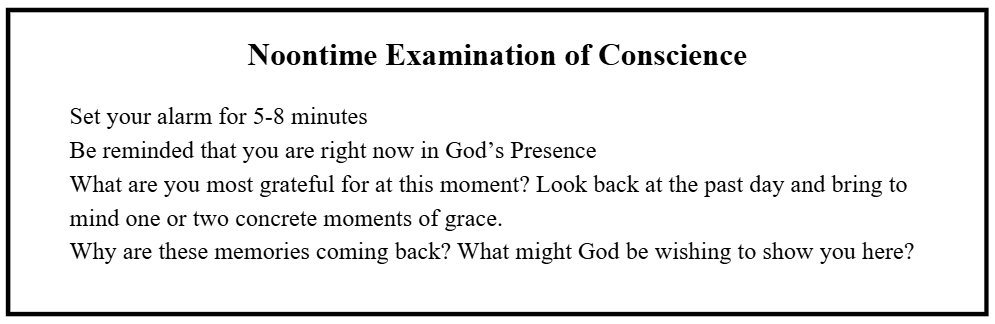
Pick one moment where you turned from God’s grace? Ask for forgiveness and ask yourself how you could work on this temptation or habit of sin?
When your alarm sounds, end with the Angelus or an Our Father and Hail Mary
Preparation for the Afternoon or Evening Exercise: When de Caussade was a young Jesuit novice, he would have made the Spiritual Exercises of St. Ignatius during a very regimented 30 day retreat, the Principle and Foundation of which we worked with above. Throughout the retreat, he would have been introduced to Ignatius’ Rules for the Discernment of Spirits, a sort of catalog meant for the retreat director to assist the retreatant in understanding how the Spirit speaks to him. For example, if the retreatant was being tempted to mortal sin, the Enemy of our human nature (Ignatius’ preferred image for the devil) would help us come up with bad reasoning why this act would be justified while the Good Spirit would prick our conscience. If, on the other hand, the person was moving from good to better, the Enemy would mock him and arouse thoughts of the impossibility of his becoming a saint, while the Good Spirit would begin to open doors and place the right creatures before him (perhaps like your making this retreat).
This evening, let us contemplate a few of the more important Rules, meant for those who are moving from good to better and praying for growth in God, as you are right now.
Selections from St. Ignatius of Loyola’s Rules for the Discernment of Spirits
To begin, we need to realize that there are two spirits at work in the world: the Spirit of Consolation (the Holy Spirit) and the Spirit of Desolation (the Enemy of our human nature, Satan). The Good Spirit acts in accord with our graced nature, encouraging and strengthening when intent on doing good and discouraging and placing obstacles when intent on some sin. The Enemy acts in one of three ways: like a petulant person who nags and nags, who insists and throws tantrums until we finally give in, leaving us no peace or calm. During such an attack we must fiercely dismiss him and be strong in doubling our prayers, fasts, and devotions (12th Rule). Or at times he is a secret lover who appears to ravish us and insists we tell no one that he was there, encouraging us never to open up to others and keep our deepest secrets and regrets hidden. In response, we must make ourselves transparent and vulnerable, either to a holy friend whom we wholeheartedly trust or even in the Sacrament of Reconciliation (13th Rule). The Enemy can also act like a military strategist who knows our weaknesses and insecurities and aims to attack precisely there. At these times we must call on the One even stronger and take refuge in the moral virtues of temperance, justice, courage and wisdom as well as the theological virtues of faith, hope, and love (14th Rule).
Which of these images of the Enemy is most “effective” at getting you to give into sinful temptations? Why? What does the Enemy know about you that he chooses to attack you as one who nags until you give in, like a secret lover who asks for your secrecy, or like a military genius who knows the weakest parts of your psyche?
When de Caussade delivered his conferences on the spiritual life, then, it is not surprising to hear him take Ignatius’ original images of Satan and warn the sisters against the primal one who now lives only to destroy God’s children:
This is also typified by the beast coming out of the pit to make war, from the beginning of time, against the interior and spiritual life of man. All that takes place in our days is the consequence of this war. Monster follows monster out of the pit, which swallows, and vomits them forth again amidst incessant clouds of smoke. The combat between St. Michael and Lucifer that began in Heaven, still continues.
The heart of this once magnificent angel has become, through envy, an inexhaustible abyss of every kind of evil. He made angel revolt against angel in Heaven, and from the creation of the world his whole energy is exerted to make more criminals among men to fill the ranks of those who have been swallowed up in the pit. Lucifer is the chief of those who refuse obedience to the Almighty. This mystery of iniquity is the very inversion of the order of God; it is the order, or rather, the disorder, of the devil.
This disorder is a mystery because, under a false appearance of good, it hides irremediable and infinite evil. Every wicked man, who, from the time of Cain up to the present moment, has declared war against God, has outwardly been great and powerful, making a great stir in the world, and being worshiped by all (Abandonment, Book 2, ch. 4, sec. 12; p. 116-17).
Do you know (and pray) the Prayer to St. Michael the Archangel?
Third Rule: Of Spiritual Consolation. I call it consolation when some interior movement in the soul is caused, through which the soul comes to be inflamed with love of its Creator and Lord; and when it can in consequence love no created thing on the face of the earth in itself, but in the Creator of them all.
Likewise, when it sheds tears that move to love of its Lord, whether out of sorrow for one’s sins, or for the Passion of Christ our Lord, or because of other things directly connected with His service and praise.
Finally, I call consolation every increase of hope, faith and charity, and all interior joy which calls and attracts to heavenly things and to the salvation of one’s soul, quieting it and giving it peace in its Creator and Lord.
Fourth Rule: Of Spiritual Desolation. I call desolation all the contrary of the third rule, such as darkness of soul, disturbance in it, movement to things low and earthly, the unquiet of different agitations and temptations, moving to want of confidence, without hope, without love, when one finds oneself all lazy, tepid, sad, and as if separated from his Creator and Lord. Because, as consolation is contrary to desolation, in the same way the thoughts which come from consolation are contrary to the thoughts which come from desolation.
Can you list what consolation feels like for you (those movements toward faith, hope, and love) and can you list what desolation feels like (those movements away from faith, hope, and love)?
Fifth Rule: Practical Advice When in Desolation. In time of desolation never to make a change; but to be firm and constant in the resolutions and determination in which one was the day preceding such desolation, or in the determination in which he was in the preceding consolation. Because, as in consolation it is rather the good spirit who guides and counsels us, so in desolation it is the bad, with whose counsels we cannot take a course to decide rightly.
We all learned early on not to go shopping when we are hungry, for in those moments everything looks good, everything promises nutrition. In desolation, make no major decisions but wait on the Holy Spirit to show you the next moment of light. It will come, promise, be patient (6th Rule). While in desolation, pray over these three reasons why you might be feeling far from the Lord:
- Have I been “tepid, lazy or negligent” in my spiritual life and (be honest) not really cared about growing in perfection?
- Has the Lord allowed me to be here in order to show me why I do in fact serve him? Am I faithful when I don’t really “feel” him close or do I need his “great pay of consolation and grace” in order to be faithful? What is my motive in being a Christian—the love of Christ or the “pay off” of heaven?
- Perhaps the Lord has allowed me to taste this momentary desolation in order to make me appreciate his grace and presence all the more when consolation returns. Maybe after this brief hiatus, I shall return to the Lord knowing ever more deeply that all is gift and that a bit more of my “pride or vainglory, attributing to myself devotion and other things of spiritual consolation” will be purified (9th Rule).
Please recall any major takeaways here: what will you do when in great consolation and what should you now avoid if feeling desolate?
Theological Meditation on Discerning Spirits
It seems we humans are constantly having to make a choice. Some choices are relatively insignificant: e.g., “What should I have for dinner?” “What should I wear today?” Other choices are rather weighty: e.g., “Should I go into finance or medicine?” “What about early retirement?” The truth is that we are all layers and layers of wants, needs, desires and instincts. For the most part, we function on this naturally human level rather easily, making choices as we go and doing the best we can. But the Christian Faith has also recognized warring “spirits” at work in our lives—the temptations of the Enemy as well as the inspirations of the Holy Spirit.
Discerning a right choice from a wrong choice takes practice as we go and reflection as we grow. As we go, we learn seek opportunities and avoid obvious dangers, we make lists pros and cons, map out benefits and costs, and so on. As we grow, we must learn to see where and why we have made healthy choices and where and why we continue to choose that which we know will not really ever make us happy.
In de Caussade’s spiritual vision, every conscious and free choice moves us either closer to or further from God and that is why it is essential to discern our decisions with the mind of God. This begins by paying attention to what is going on in our desires, the stirrings of our hearts. That is why discernment is very personal and unique to each person trying to hear God’s voice and follow his will for his or her own life. Discernment is thus rooted, first and foremost, in gratitude and our savoring of the gifts God has given us.
What we want to do next, then, is to ask how best to use those gifts at this point in our lives, given these particular circumstances. As we ask such intimate questions we become more and more “tenderized” in the Spirit, better recognizing not only our own—what Ignatius calls here—“motions of the soul,” but also how God uses those motions to bring us into greater union. Here, in this convergence of our soul’s desires and God’s will for us, we can begin to act.
This is exactly what Scripture tells us to do: to begin with being grateful for all we are and have and then to enter into the Holy Spirit to hear his voice in order to cling more firmly to what is good and to recognize and thus shun all that is noxious to our souls: “Rejoice always. Pray without ceasing. In all circumstances give thanks, for this is the will of God for you in Christ Jesus. Do not quench the Spirit. Do not despise prophetic utterances. Test everything; retain what is good. Refrain from every kind of evil” (1 Thess 5:16-22).
But why must we discern? Why does God seemingly refuse to tell us directly what is right and what is wrong? A time comes in every young mother’s life when she has to stop and let her little one tie his own shoes. She risks being late, she may stand there weighed down with arms full of groceries, but she knows that this is something her son must learn to do for himself. Again, for de Caussade, the Christian Faith is not only about reaching heaven. It is ultimately about a lived union of love right now, in the “present moment,” of which discernment is a part. The Lord trusts us and gives us the grace to see what is best. True, we may get this wrong every now and then. But what does it say about our God who prefers free lovers who periodically err than automata who are computerized to do whatever he commands?
Let’s face it, any parent’s life would have gone smoother if they had been able to “program” their children to say only, “Yes, mommy,” or “Yes, daddy,” and then do whatever they were instructed to do. However, this kind of programmed obedience would necessarily override any unique growth or maturity, it would certainly remove any act of sincere love, reducing free persons to robots.
But God’s trust in creating us to discern and choose accordingly is also what gives the Enemy room to act. The one who hates all things good and godly tries to compel us to move away from God. In such souls, the Enemy will assure them that they really aren’t that bad, “Compared to Hitler, I’m not so bad.” The Enemy will try to convince them that they can keep up this lifestyle and still be happy, “Come on, who am I hurting?” On the other hand, the Good Spirit will prick their conscience and inspire thoughts of inauthenticity and the fear of one day being found out.
For those who are actually striving to grow in holiness (like you), the opposite will occur in the soul. Where there is virtue and goodness, the Enemy will nag the individual, “This daily Mass thing is unsustainable, you deserve to sleep in,” or, “Who are you kidding? This isn’t you!” The Holy Spirit will instead seek to make such a life straightforward and seamless, inspiring the individual with the realization that his or her life seems better now, their internal stress levels have decreased, they enjoy being with others more and so on.
This battle between good and evil was understood by de Caussade as the war in one’s soul between consolation and desolation, Ignatian terms we first saw in the Principle and Foundation (Day 3 above). As we saw, consolation is the movement toward God and the things that unite us to God—faith, hope, and charity, while desolation contain all the movements away from God—toward doubt, despair, and an anxious self-centeredness.
Finally, as you grow in discerning how you attend to God’s voice, know that this requires 4 main points:
- Discernment requires maturity and trust that God is in fact at work in your soul. Be assured that you are on the right path and that your desire to serve him is indeed the first piece of evidence that you are growing in holy abandonment.
- Discernment requires your ability to live with the ambiguity of not having absolute clarity regarding a decision, “for we walk by faith, not by sight” (2 Cor 5:7). The Lord will guide us and in so doing, will ask for our trust in stepping out and not so much in our assurance that this is absolutely and unassailably the best thing to do right now.
- Discernment requires that you allow trusted external voices to help guide you. These “voices” will include the Commandments (Ex 20:1-17; Deut 5:16-20) and the Catechism of the Catholic Church (especially Part 3 on one’s “Life in Christ”), but helpful here might also be a regular confessor or a wise spiritual companion with whom you can discuss the movements of your heart.
- Finally, discernment requires the freedom to assess and adjust as you age. The peace that stems from your daily prayer should allow you to be free enough to ask if your routine and ways of following divine inspiration are still bearing as much fruit as possible.