Day 5
Stages of Trial and Growth
Overview: If God does not invite and inspire, even our noblest of plans and supposed holiest of practices will prove empty. As we grow in the Spirit, we shall go through various phases. This is something God honors. Have you ever wondered why God created in days and not just instantaneously? Is there something about gradualness and the slowness of transformation that God cherishes? Does the unfolding of created goodness please the Lord, allowing him to show his patience and understanding as we down here strive to get things right?
In the early part of the 3rd century a great theologian from Alexandria named Origen (d. c. 250) saw in the Christian pursuit of holiness three distinct phases: (1) the purgative phase when our sins become known and eventually rooted out, (2) the illuminative phase when we are able to receive more and more wisdom of God, his ways, and his plan for our lives, and (3) the unitive phase when we become more and more godlike, beginning to think, speak and act like Jesus himself. In his studies, de Caussade would have been quite familiar with this pattern, and it echoes through the later sections of Abandonment. Today will therefore be dedicated to the phases of trials (morning) and the steps in total surrender (afternoon or evening).
o
Preparation for Morning Exercise: Detecting and rooting out sin is essential for our holiness. It is required that we know ourselves and are able to confess not only what we have done wrong but why. So often the devil is hiding not in the matter of our misconduct but in the motive. That is why retreats like this are essential—to step away from our normal routine and look calmly into our souls to evaluate and then name what is going on.
Since you are making this retreat, chances are pretty good that you know your patterns of sin fairly well. Daresay, the chances are pretty good that you make the Sacrament of Reconciliation a regular practice. This is why de Caussade did not provide us with a manual trying to get us to see the ugliness of gossip or hatred, lust or greed. No, he is on to something even bigger: those places where “Satan masquerades as an angel of light” (2 Cor 11:14). This morning will therefore be spent trying to see where abandonment is going to shatter some categories and maybe get us to be honest and see if we ever make an idol out of something that could very well be holy in and of itself. Perhaps there are things like Church teaching, a particular style of celebrating the sacraments, the ways we think things have to be done, etc… which we have twisted into our own image and likeness. Haven’t you ever “said” your prayers or “prayed” your rosary but realized immediately after that you never really talked with living God at all during that time? This is what true abandonment entails—the thirst for divine communion that the “average” Christian cannot understand and often ridicules.
o
Selection from Jean-Pierre de Caussade’s Abandonment to Divine Providence
- The first trial is ridicule and condescension from those who pride themselves on being religiously sophisticated and dutifully pious.
Prejudice goes so far as to affirm that this soul deceives itself, and deludes itself because, after having submitted to all that the Church prescribes, it holds itself free to be in the condition to give itself without hindrance to the interior operations of God, and to attend to the impressions of His grace at times when no other duty intervenes to expressly compel them. In a word they are condemned because they employ that time which others give to amusements and temporal affairs, in loving God (Abandonment, Book 2, ch. 3, sec. 1; p. 81).
Of course every follower of Jesus must fulfill the requirements of Jesus’ Body, the “hierarchical Church” (a term coined by St. Ignatius of Loyola). We are therefore called to follow all Church teaching and to honor the most basic of Commandments. Yet the soul called further to abandonment will do more and spend its free time seeking God’s will instead of losing oneself in the chronic “amusements” which are constantly available, only a cellphone and computer away. Those who are thus being weaned from the minimum of Christian discipleship, may very well suffer condemnation by those who are Christian and can tolerate the faith of others, but only if they do not take it too seriously. If you are in this latter camp, consider it grace that the Lord is allowing you to begin to suffer for his name (cf. Acts 5:41).
o
Is not this a crying injustice? This cannot be too strongly insisted upon. If anyone keeps the ordinary course, goes to confession once a year, nothing is said about it, he is left in peace with an occasional injunction, not pressed with too much importunity, nor making it an obligation, to do a little more. If he should change his ways and try to improve them, then he is overwhelmed with counsels for his conduct, and with different methods; and if he does not follow these pious rules diligently, then he is done for, he is a subject of suspicion, and nothing is too bad to predict of him. Are they not aware that these practices, however good and holy they may be, are, after all, only a way leading to divine union? Is it necessary, then, to be always on the road when one has already arrived at the goal? (ibid.).
If you seek total abandonment, you will meet resistance in those who think themselves more advanced in matters of the Spirit. They will try to make sure you download this or that app, that you read just the right author or find that one particular devotion or litany that helped them in the past, and so on. We can easily get so caught up in the means and methods (with good intention) that we can lose sight of the goal, union with the Living God, however he chooses to bring that about. Your job right now is simply to offer yourself to the Good Spirit and allow him to lead you where you feel he is going to be most able to meet you. Apart from charity, there are no guarantees and no surefire one way for all of God’s children. Our salvation lies in filial trust, knowing that God dwells within you and relies on you to lead others to him and to consecrate this world all the more. This is the “goal” you already know, so refuse to let others lead you on another path without profoundly testing that.
o
For all else it holds itself in perfect liberty, always ready to obey every movement of grace directly it perceives it, and to abandon itself to the care of Providence. God makes known to this soul that He intends to be its Master, and to direct it by His grace… It feels that, if it tied itself down, to the rules of those who live by their own efforts and industry, instead of acting according to the attraction of grace, it would be deprived of many things necessary in order to be able to fulfill future duties. But, as no one knows this, it is judged and condemned for its simplicity, and, though it does not find fault with others but approves of every state, and well knows how to discern every degree of progress, it is despised by pretended wiseacres who cannot appreciate this sweet and hearty submission to divine Providence… Worldly wisdom cannot understand the perpetual wanderings of the Apostles, who did not settle anywhere. Ordinary spirituality cannot endure that souls should depend for their action on divine Providence. There are but few in this state who approve of them, but God, who instructs men by means of their fellow creatures, never fails to make such souls encounter those who abandon themselves to Him with simplicity and fidelity (Abandonment, Book 2, ch. 3, sec. 1; p. 83).
The stern-minded cannot comprehend the freedom of those in a state of abandonment. While the ceremonious Christian concentrates on the task at hand, those in abandonment look “through” their plans to see where God is speaking to them. Divine Providence thus frees abandoned souls like yourself from judging his presence only by some grandiose activity. You now realize that he is instructing you through your “fellow creatures,” encountering you in the mundane circumstances of the everyday. And since there is no systematic program in where you will be led each day, it takes great maturity to be comfortable with the unknowing and with the ambiguous nature of being a creature discerning a perfect Creator’s will.
The second trial is appearing “useless” to the rest of the world, both in secular society as well as in Christ’s Church. God always chooses the weak in order to let the world know that it is his strength shining through. This can lead to the trial of insecurity and the humility that accompanies being a humble receiver and not the shining star.
They are, so to say, quite stupid, and possess nothing of that culture, study, or reflection which go to the making of a man. They are like children of nature before they are placed in the hands of masters to be formed. They have noticeable faults which, without rendering them more guilty than children, cause more offense. God takes away everything but innocence in order that they should have nothing to rely upon but Him alone. The world, being in ignorance of this mystery can only judge by appearance, and can find nothing in them to its taste, nor anything that it values. It, therefore, rejects and despises them, and they seem to be exposed to censure from all. The more closely they are observed, the less is thought of them and the more opposition do they encounter; no one knows what to make of them… Their actions are pried into to find out their opinions, and like the Pharisees who could not endure the actions of Jesus, they are regarded with such prejudice that everything they do appears either ridiculous or criminal (Abandonment, Book 2, ch. 3, sec. 2; p. 85).
Maybe in your pursuit of holiness, you appear foolish to the more connected Christians in your community. Rejoice, for like St. Paul, you have been chosen to be a “fool” for Jesus: “We are fools on Christ’s account, but you are wise in Christ; we are weak, but you are strong; you are held in honor, but we in disrepute” (1 Cor 4:10). This is the way of the Cross. This is the way the world cannot understand. As you grow in union with the Crucified Christ, then, you too will be treated as he was by the Pharisees and those who trust in their own abilities and religious observances rather than in God’s constant care and daily direction.
The next phase of trials is found in interior humiliations. At this point the abandoned soul will come to realize that they are not fasting as long or praying as long as those who make their great deeds known. You may begin to suffer imposter syndrome and wonder if God really is at work in you. This is a temptation of the Enemy who always tries to hate ourselves by making our neighbor our enemy. To overcome this third trial, those seeking abandonment must evermore secure their trust in God’s love and in his desire for immediate union, knowing (from the previous trial) how God is able to use our sorrow and suffering more than our successes and strengths.
Neither heroic undertakings, nor fasts, large alms, nor ardent and far-reaching zeal can be discerned in them; but united to God by faith and love they behold in themselves nothing but disorder. They despise themselves still more by comparison with those who pass for saints, and who, besides adapting themselves with facility to rules and methods show nothing irregular either in their persons or actions. Therefore their own short-comings in this respect fill them with confusion, and are unbearable to them. It is on this account that they give way to sighs and tears, marking the grief with which they are oppressed. Let us remember that Jesus Christ was both God and man; as man He was destroyed, and as God He remained full of glory. These souls have no participation in His glory, but they share in the sadness and misery of His sufferings. Men regard them in the same way as Herod and his court regarded Jesus Christ… They aspire to something quite different, but all the avenues leading to the sanctity they so much desire, remain closed to them. They must live on this bread of suffering, on this bread mingled with ashes, with a continual shrinking both exterior and interior. They have formed an idea of saintliness which gives them constant and irremediable torment (Abandonment, Book 2, ch. 3, sec. 3; p. 86).
When we are scared, we make plans. When things feel unsure or out of our control, we tend to formulate the future and safeguard against any ambiguity. Our thirst for holiness can do this as well, thinking that there is only one way to be a saint and we must therefore pattern our lives on, say, a Mother Theresa. But in so doing, we tend to think that our family life is less holy as her consecrated celibacy or that our needed business dealings in the world disappoints God compared to her poverty, and the list continues. But this is the Enemy’s doing and we must ask to be rid of the constant torment we might feel when thinking about the heroic lives of the saints. The saints are necessary instantiations of Christ’s own life but there are many more saints in heaven than the Vatican has ever canonized. If you trust that God is at work in you and if you allow him to have you in full and not in fractions any longer, your own saint’s life is being written right now as well.
The fourth trial is the obscurity to which God calls the souls he perfects and, conversely, the doubt the Enemy tries to place in such purified souls that maybe they have been a disappointment to God all along.
For a soul that desires nothing else but the will of God, what could be more miserable than the impossibility of being certain of loving Him? Formerly it was mentally enlightened to perceive in what consisted the plan for its perfection, but it is no longer able to do so in its present state. Perfection is given to it contrary to all preconceived ideas, to all light, to all feeling. It is given by all the crosses sent by Providence, by the action of present duties, by certain attractions, which have in them no good beyond that of not leading to sin; but seem very far from the dazzling sublimity of sanctity, and all that is unusual in virtue. God and His grace are given in a hidden and strange manner, for the soul feels too weak to bear the weight of its crosses, and disgusted with its obligations. Its attractions are only for quite ordinary exercises. (Abandonment, Book 2, ch. 3, sec. 4; p. 88-89).
The final trial one may face, as an old adage puts it, is to let the good be the enemy of the perfect. We are all still traveling on the road to heaven and that means we shall inevitably fall. There is room for moral failure in God’s plan and those who eat with Jesus deeply relish his love for sinners. Your cross, “sent by Providence,” may lie precisely in allowing yourself to thirst for perfection while not experiencing it fully just yet. Find God in the ordinary and quit judging yourself against a life to which you are not currently being called. There is no imperfection in heaven, but for now you are being asked to let go of “preconceived ideas” of what it means to be a friend of Jesus and to trust in his life in and for you right now.
Questions to Ponder
- From the Latin word for a threshold or doorway (limen), the state of liminality is living in the “in between,” in the “already but not yet” parts of life. Spiritual masters all know this is not an easy place to be, having to transition from something that has been familiar and secure into something more unknown and uncertain. Are you in this transitional phase right now and are you able to function in the mysteriousness of abandonment or do you try to secure surefire plans first? What might God be doing calling you into such a state right now?
- Abandonment warns us against feeling remorse that we are not like the great saints. Are you content with the life you are leading? Are you comfortable with the life you are leading or are you at times tempted to live another life if given that chance? Can you thank God for having planted you in the world, family, neighborhood, etc… at this point in time right now because he is relying on you to advance his own goodness and joy?
- What might it mean for you to find God in the ordinary? Will your image of God have to change? Might your image of the world as the place God acts (and not just in Church?) have to change? Perhaps your own self-understanding as a constant and careful cultivator of God’s plan in this world might have to mature as well.
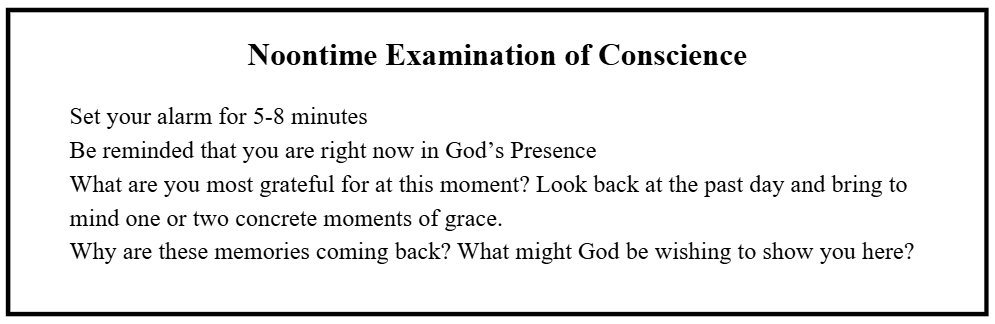
Pick one moment where you turned from God’s grace? Ask for forgiveness and ask yourself how you could work on this temptation or habit of sin?
When your alarm sounds, end with the Angelus or an Our Father and Hail Mary
Preparation for the Afternoon or Evening: The Stages of Holy Abandonment
Knowing that the previous trials may perdure throughout our life, we can never let the Enemy use our insecurities or even our sins to keep us from allowing every moment to be an occasion to grow in divine trust. God loves us not despite our weaknesses but because of them—for it was our need for salvation that brought him to earth like us in all things but the very sin for which he came to redeem: For we do not have a high priest who is unable to sympathize with our weaknesses, but one who has similarly been tested in every way, yet without sin (cf. Heb 4:15). This is why we must persevere and seek God out precisely as we are. To guide us here, de Caussade lists three stages of duties that we must follow. The first consists of the precepts and fulfilling the duties of our state in life. This means not only following Church teaching but seeing in our studies or in our work, in our marriage or celibacy, in our busyness or in our retirement, we must abandon ourselves to God. The second consists in the necessities of allowing God’s plan to guide us through life. This means we trust in divine providence and both receive blessings as well as endure trials as lovingly coming from our Lord. The third duty is being inspired by the Holy Spirit throughout each moment of the day to be sensitive enough to hear and brave enough to follow God’s will for us at that very instant.
Selection from Jean-Pierre de Caussade’s Abandonment to Divine Providence
“Sacrificate sacrificium, et sperate in Domino” (“Offer fitting sacrifices and trust in the Lord”; Ps 4:6). That is to say that the great and solid foundation of the spiritual life is the sacrifice of oneself to God, subjecting oneself to His good pleasure in all things, both interior and exterior, and becoming so completely forgetful of self thereafter as to regard oneself as a chattel, sold and delivered, to which one no longer has any right. In this way the good pleasure of God forms one’s whole felicity; and His happiness, glory and existence one’s sole good. This foundation laid, the soul has nothing else to do but to rejoice that God is God, and to abandon itself so entirely to His good pleasure that it feels an equal satisfaction in whatever it does, nor- ever reflects on the uses to which it is applied by the arrangements of this good pleasure. To abandon oneself, therefore, is the principal duty to be fulfilled, involving, as it does, the faithful discharge of all the obligations of one’s state. The perfection with which these duties are accomplished will be the measure of the sanctity of each individual soul. A saintly soul is a soul freely submissive, with the help of grace, to the divine will. All that follows on this free consent is the work of God, and not of man. The soul should blindly abandon itself and be indifferent about everything. This is all that God requires of it, and as to the rest He determines and chooses according to His own plans, as an architect selects and arranges the stones for the building he is about to construct. It is therefore of the first importance to love God and His will, and to love this will in whatever way it is made manifest to us, without desiring anything else (Abandonment, Book 2, ch. 2, sec. 1; p. 63-64).
As we have been stressing this past week, the first and foundational move for any soul desiring greater holiness must be total abandonment. This for de Caussade is the first duty, to offer God everything “both interior and exterior.” This means that I no longer consider my life “mine,” but begin to see it as an “ours,” the collaborative effect of my allowing God to direct every aspect of my life. This does not mean that I or my holy attachments and relationships do not matter or that I must now consider myself nothing. Instead, what stands out here in the first duty is that Jesuit sense of “indifference” we saw earlier (Day 3 above). Here becoming “indifferent about everything” means that I let God have and use every single thing about me and my life. I quit dividing my story into things that I believe glorify God and things which disappoint God, but realizing more and more deeply that he (the perfect architect) can use all the “stones” of my life to build me into a saint.
The second step is not simply to trust God in abandonment but to move from passive surrender to active accomplishments.
Although souls called by God to a state of abandonment are much more passive than active, yet they cannot expect to be exempted from all activity. This state being nothing else but the virtue of abandonment exercised more habitually, and with greater perfection, should, like this virtue, be composed of two kinds of duty; the active accomplishment of the divine will, and the passive acceptance of all that this will pleases to send…. It consists essentially, as we have already said, in the gift of our whole self to God to be used as He thinks fit. Well! the good pleasure of God makes use of us in two ways; either it compels us to perform certain actions, or it simply works within us. We, therefore, submit also in two ways; either by the faithful accomplishment of its clearly defined orders, or else by a simple and passive submission to its impressions of either pleasure or pain. Abandonment implies all this, being nothing else but a perfect submission to the order of God as made manifest at the present moment: It matters little to the soul in what manner it is obliged to abandon itself, and what the present moment contains; all that is absolutely necessary is that it should abandon itself unreservedly (Abandonment, Book 2, ch. 2, sec. 3; p. 68).
While de Caussade never explicitly labels this stage as the “second,” it is a midway point of two realities, so reminiscent of the French School of Spirituality: the passive acceptance of God’s indwelling and my living in him (typical of the best parts of Quietism) alongside that growing sense that I must at all times act in accord with God’s will (typical of the best parts of Jansenism) and learn to follow God’s promptings in every thought, word and action. As he just wrote, this step involves “the active accomplishment of the divine will, and the passive acceptance of all that this will pleases to send.”
Yet we must also do our part to cooperate with his initiative. We must fulfill all the precepts of our holy religion—Mother Church’s expectations regarding our prayer life, our moral life, our sacramental life, as well as our familial, civil and communal obligations. These should not be burdensome, for when we abandon our entire selves to God, we begin to seek him at gently work in every aspect of our lives. This new acceptance of God’s life for us will also result in a new inner-peace that is not inordinately disturbed by the changes of our life’s situation. This does not mean we become cold and stoic, not indifferent in that secular way, but that we remain at peace knowing that despite what the world may be suffering, God is still everyone’s Creator and Savior. He sees each of us better than we see ourselves and that should be enough for us to trust him wholeheartedly and without reserve.
So, when you are disturbed by Wall Street or by the news from Washington, D.C., are you able to trust in God’s ways or are you dragged down into where the devil delights—gossip and ridicule, flippancy and doubt? Finally, this active living out of a good Christian’s way of life will be individually tailored for each of us and that is why in this second stage of abandonment, “It matters little to the soul in what manner it is obliged to abandon itself, and what the present moment contains; all that is absolutely necessary is that it should abandon itself unreservedly.”
The third state is the blossoming of the second, the move into a more active pursuit of God’s will and a courageous assurance that I can purposely follow his plans for me throughout each moment of my life.
There are, then, prescribed duties to be fulfilled, and necessary duties to be accepted, and further there is a third kind which also forms part of active fidelity, although it does not properly belong to works of precept. In this are comprised inspired duties; those to which the spirit of God inclines the hearts that are submissive to Him. The accomplishment of this kind of duty requires a great simplicity, a gentle and cheerful heartiness, a soul easily moved by every breath of directing grace; for there is nothing else to do but to give oneself up, and to obey its inspirations simply and freely. So that souls may not be deceived, God never fails to give them wise guidance to indicate with what liberty or reserve these inspirations should be made use of. The third kind of duty takes precedence of all law, formalities, or marked-out rules. It is what, in saints, appears singular and extraordinary; it is what regulates their vocal prayer, interior words, the perception of their faculties, and also all that makes their lives noble, such as austerities, zeal, and the prodigality of their self-devotion for others. As all this belongs to the interior rule of the Holy Spirit, no one ought to try to obtain it, to imagine that they have it, to desire it, nor to regret that they do not possess the grace to undertake this kind of work, and to practice these uncommon virtues, because they are only really meritorious when practiced according to the direction of God. If one is not content with this reserve one lays oneself open to the influence of one’s own ideas, and will become exposed to illusion.(Abandonment, Book 2, ch. 2, sec. 3; p. 68-69).
Wow! For a soul growing in holy abandon, its actions become holier, its inner-peace becomes more resolute but now we learn there is a third mark, actively following that often small, still voice we come to see as divine inspiration. We have now moved from (1) surrendering passively to God and trusting him wholeheartedly to (2) receiving more of God’s Spirit so we fulfill the precepts of the Christian faith fully, to (3) taking on more than “expected” and thus pursuing God’s active will in all things which move us beyond what our Faith asks. This is what de Caussade calls “inspiration” and so inspired, the Holy Spirit now dictates all aspects of one’s life. This is not to be thought of as some sort of mind-meld or hostile takeover of one’s faculties. On the contrary, one’s mind and will are now bathed by the Spirit and assured that their “devotion for others” is empowered by charity and for the salvation of the world. This is the highest state of abandonment and cannot be conjured through one’s own powers or merits. It is total gift.
This shows that each soul ought to content itself with the duties of its state, and the over-ruling of Providence; clearly God exacts this equally from all. As to attraction and the impressions received by the soul, these are given by God alone to whom He pleases. One must not try to produce them oneself, nor to make efforts to increase them. Natural effort is in direct opposition and quite contrary to infused inspirations, which should come in peace. The voice of the divine Spouse will awaken the soul, which should only proceed according to the inspirations of the Holy Spirit, for, if it were to act according to its own ideas it would make no progress (Abandonment, Book 2, ch. 2, sec. 3; p. 69).
Think of how many saints there are in heaven that never knew the acclaim of some pope. Even our Lady never underwent an official recognition, but in her simplicity and in the obscurity of her Nazareth she was raised to the heights of heaven. This is what it means to be a saint—not to wear a collar or a religious habit, but to live one’s life as God asks in all things. In one way it is that simple; at another level, that is terribly frightening because we come so easily to rely on externals and surety, on symbols and that which can be measured. However, holiness has no metric; it is the result of abandoning all matters of one’s life into the providential hands of a loving Father. It cannot be produced and it cannot be insisted upon. It is “the voice of the divine Spouse” which calls and who acts. We simply need to learn to allow him by learning what we still hold on to and what we still expect apart from him.
Questions to Ponder:
- Is it easier for you to give a gift or to receive one? Many of us need to give and produce to feel worthwhile, but the spiritual life is much more a matter of receiving, of being more “passive” than “active” as de Caussade maintains. Ask yourself: Why do I find it sometimes unnerving to receive something with no opportunity to return that gift?
- How does relying purely on God’s grace before your own plans or strengths make you feel—relieved, stressed, nervous? What would it mean for you to be purified of any inappropriate earthly attachments? Can you list those?
- What are some ways you might practice active abandonment? Where are some places the Lord might be stretching you and calling you out of your comfort zone? Have you ever forfeited the opportunity to evangelize or cowered away from risking a touchy conversation that had to be done? Ask the Holy Spirit to show you where you might be called to act more intentionally and courageously.
Converting Thought into Possible Practice
Are you able to retrace the various phases of trial as well as growth as outlined by de Caussade above?
Discern where you might see yourself in one of these. Then ask the Lord what he wants to show you by placing you in this trial and/or in this state of abandonment.
As you select one trial and one stage of abandonment, list some ideas which come to mind regarding why the Lord might have placed you there. What is he trying to teach you? What have you come to learn about yourself? Do you have any plans on what you could do with these new insights?
Theological Meditation on Trials and Growth
As we grow in abandonment, de Caussade and all the spiritual masters knew that we would face trials. For de Caussade, the theme underlying all these trials was our conformity to the misunderstood and wrongly-judged Christ. While it is good to be with Jesus wherever he is, even on the Cross, it can be naturally uncomfortable and even embarrassing. But remember, before Calvary, Jesus spent 30 years in an insignificant hamlet passing his days in menial labor.
Have you ever thanked God for your littleness? Have you ever been grateful that he has kept you unnoticed off the world stage? Your life is most likely quite ordinary and typical, not unlike millions of other lives in this world. Yet, you are becoming a saint by living this life of obscurity, a life that will be forgotten in this world in just a couple of generations. But perhaps this hiddenness is keeping you from pride, from self-reliance, from self-importance. Therefore, be content with the externals God has given you, while continuing to strive to imitate the saints interiorly and then, only then, will you finally value this world and its offerings rightly.
This act of humility is to ward off any pride, in that the great Medieval theologian St. Thomas Aquinas (and others) argue that the need for novelty is a sign of the proud soul never content with the everyday. Do you deep down desire drama? The art of abandonment seeks to foster the humility that counteracts such secret yearnings. As St. Paul told the first generation of Christians and with whom we can hopefully relate:
Consider your own calling, brothers. Not many of you were wise by human standards, not many were powerful, not many were of noble birth. Rather, God chose the foolish of the world to shame the wise, and God chose the weak of the world to shame the strong, and God chose the lowly and despised of the world, those who count for nothing, to reduce to nothing those who are something, so that no human being might boast before God. It is due to him that you are in Christ Jesus, who became for us wisdom from God, as well as righteousness, sanctification, and redemption (1 Cor 1:26-30).
This is true humility. Remember, humility is not humiliation (just as surrender is not submission). When we are humbled we are shown the truth of ourselves—first and foremost that because of God’s goodness, “we live and move and have our being” (1 Cor 17:28). Humiliations on the other hand are lies. Humiliations are how the world and the Enemy seek to make truth and joy repugnant—acts of desolation seeking to turn us from faith, hope, and charity. Similarly, surrender is the honest acknowledgement that God’s will is where we shall find our only joy, while submission can be a form of self-annihilation and self-loathing which not only destroys our truest self but brings sorrow upon our heavenly Father.
When we examine our souls, we must always keep the Cross before us. God’s ways are not the ways of the world and when you are honest and still, you realize that the person who knows the worst things about you is also the person who loves you the most. This is the paradox of a God who came to earth and found himself in need of human affection, a God who enjoyed a career and friends, a God who is able to die. The Son of God himself understands what it is to be human better than we imperfect humans do, so trust him. He knows the trials and he sees the stages of growth we who now live in time must undergo. Let him have you wherever you are, knowing that he is the One who has given you all that is good and all you have loved in your life. He promises to take nothing good, true, and beautiful away from you.
Are we not perhaps all afraid in some way? If we let Christ enter fully into our lives, if we open ourselves totally to him, are we not afraid that He might take something away from us? Are we not perhaps afraid to give up something significant, something unique, something that makes life so beautiful? Do we not then risk ending up diminished and deprived of our freedom? . . . No! If we let Christ into our lives, we lose nothing, nothing, absolutely nothing of what makes life free, beautiful and great. No! Only in this friendship are the doors of life opened wide. Only in this friendship is the great potential of human existence truly revealed. Only in this friendship do we experience beauty and liberation. And so, today, with great strength and great conviction, on the basis of long personal experience of life, I say to you, dear young people: Do not be afraid of Christ! He takes nothing away, and he gives you everything. When we give ourselves to him, we receive a hundredfold in return. Yes, open, open wide the doors to Christ – and you will find true life (the last lines of Benedict XVI’s first Sunday homily as pope, April 24, 2005).