
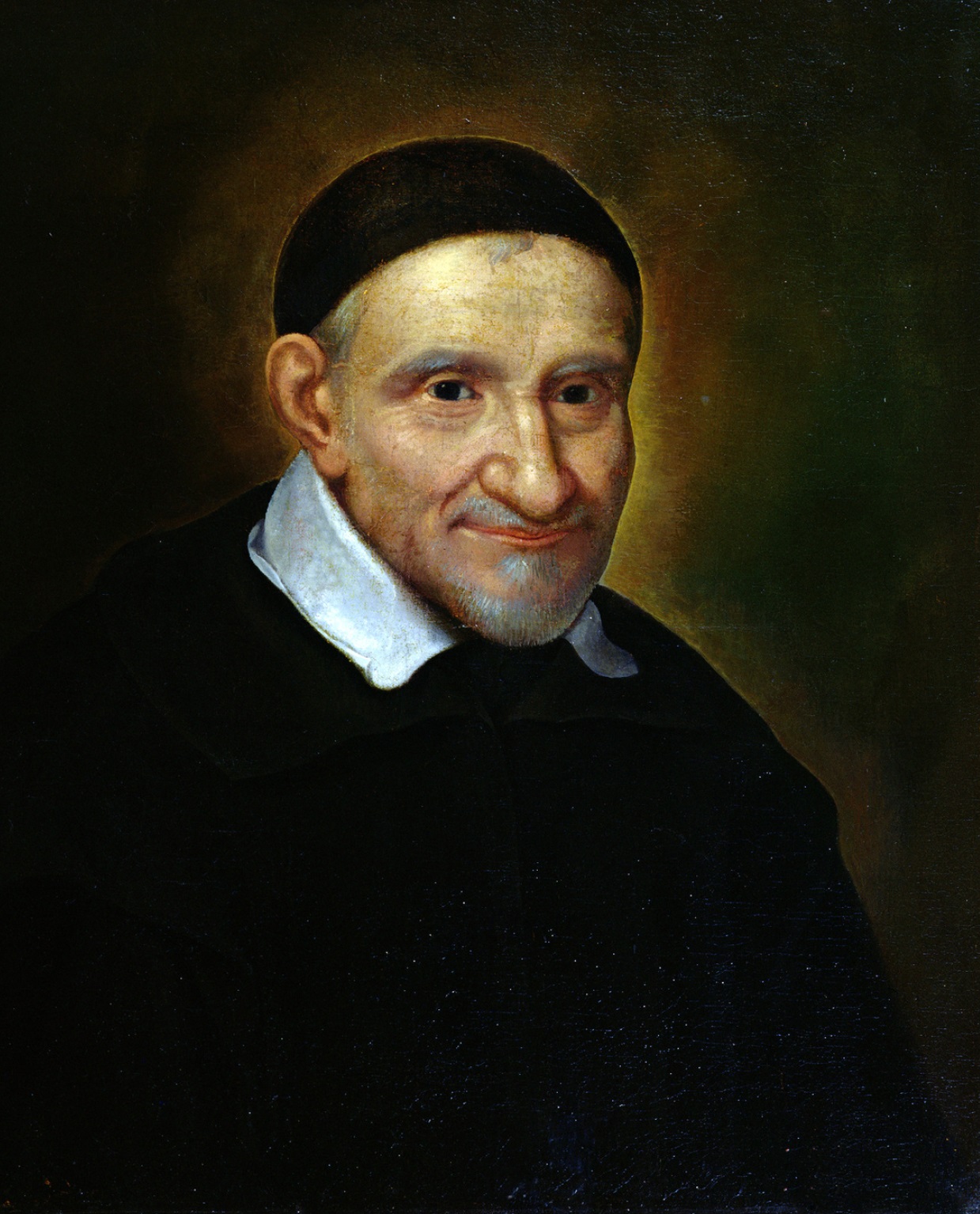
Opening Prayer
St. Vincent de Paul, we ask for a portion of your apostolic zeal. Grant us the grace to see the suffering Christ in the poor and to serve Him with a heart that is humble, mortified, and tireless.
O Sorrowful Mother, grant us the grace to keep the memory of thy sorrows perpetually alive in our hearts [28]. As we contemplate the Seven Swords that transfixed thy soul, let us never become indifferent to the price of our salvation, but rather walk as faithful servants in the shadow of thy Cross.
Amen.

John 19:25-27
25Now there stood by the cross of Jesus, his mother, and his mother’s sister, Mary of Cleophas, and Mary Magdalen. 26When Jesus therefore had seen his mother and the disciple standing whom he loved, he saith to his mother: Woman, behold thy son. 27After that, he saith to the disciple: Behold thy mother. And from that hour, the disciple took her to his own.

Saint Vincent de Paul
The Servants of Mary (Servites) were founded on Good Friday, 1233. Seven Florentine noblemen received a vision of the Virgin accompanied by angels who bore the instruments of the Passion, a palm of victory, and a book containing the Rule of St. Augustine. Mary presented them with black garments, instructing them to wear this habit as a continual reminder of the sorrows she experienced at the death of her Son. This was the origin of the Black Scapular, a sign of perpetual mourning and total consecration to the Mother of Sorrows.

The Black Scapular represents a transition from external sign to internal conversion. This devotion has been enriched by the Magisterium with “numerous indulgences“, specifically confirmed by Popes Benedict XIII, Clement XII, and Leo XIII. These spiritual favors are tools used by the Church to force the interior gaze back toward the Passion. As Father Faber notes, worldliness finds “no soul harder to attack than one entrenched in the sorrows of our Blessed Lady.” The scapular serves as a spiritual livery that renders the soul impenetrable to the “empty joys” of the age.
“Behold this garment; wear it in future. The black color should continually remind you of the sorrows which I experienced on this day at the death of my Son.”
— The Blessed Virgin to the Seven Noblemen
Mary and the Magisterium
The Church identifies the “Servants of Mary” identity as a universal call for all the faithful. By inserting the Seven Dolors into the liturgical life (Missal and Breviary), the Magisterium ensures that her children recognize her as the Queen of Martyrs. Her station at the Cross merited her the title “Help of Christians” and “Refuge of Sinners“.

- How does the "garment" of my daily life reflect the reality of the Cross—am I clothed in the memory of her sorrows or the distractions of the world?
- Do I utilize the "papal indulgences" and devotions of the Church as strategic aids for my conversion, or do I view them as mere relics of the past?
Closing Prayer
Holy Mother, make my heart with thine accord, that I may be a faithful servant of thy sorrows.
Amen.