
Opening Prayer
O God, we invoke the wisdom of St. Gregory the Great, the Apostle of the English and Master of the Word. May his love for Your Scriptures illuminate our hearts, that we may see the hidden depths of Your plan for our salvation and the co-redemptive role of the Sorrowful Mother.
Holy Mother, pierce me through; In my heart each wound renew Of my Savior Crucified. Lord, grant us the courage to face the prophetic sword in our own lives. Just as Mary accepted the word that would transfix her soul, give us the strength to accept the truths of Scripture, even when they reveal the trials we must endure for the sake of Your Name.
Amen.

Luke 2:35
35And thy own soul a sword shall pierce, that, out of many hearts, thoughts may be revealed.

St. Gregory the Great
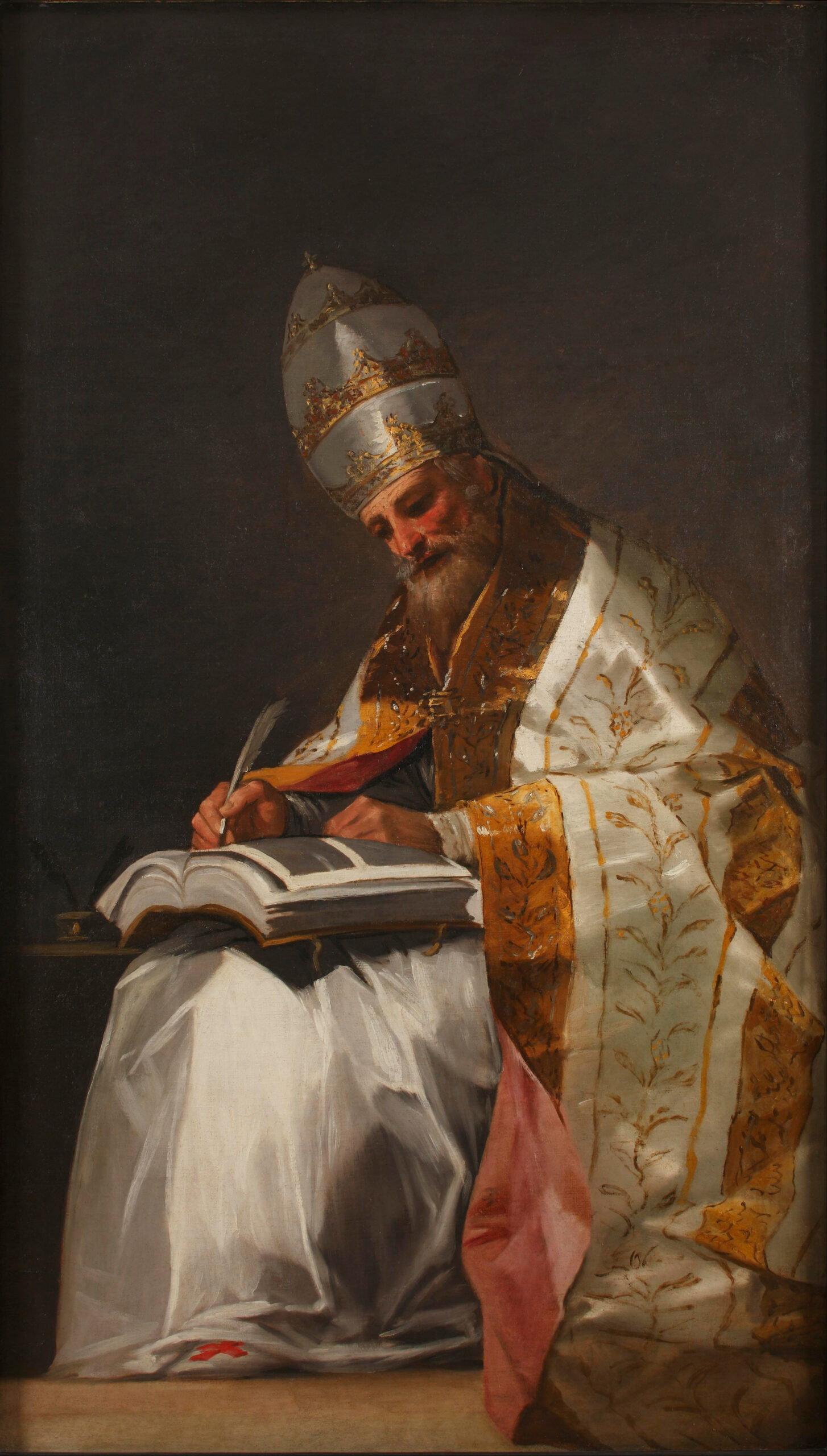
St. Gregory the Great stands as a titan of the Faith whose devotion to the “Scriptural Sword” provides the key to the Seven Sorrows. Gregory taught that the Word of God “grows with the one who reads it“. His love for the Word helps us unpack Simeon’s prophecy, showing that the sword which pierced Mary’s soul was first a word spoken by God—a word demanding total faith. Following the lead of St. Alphonsus, we see through Gregory’s eyes how the Passion was a dual sacrifice; so perfectly were their hearts united that it can be said “Two hung upon one Cross.“

The wisdom of the Seven Sorrows begins with the deconstruction of Luke 2:35: “And thy own soul a sword shall pierce.” This initiated a lifelong martyrdom. In the Dialogue of St. Anselm, we learn of the terrifying continuity of Scripture: the thirty pieces of silver given to Judas were the very same coins the Ishmaelites used to buy Joseph—a detail of Sacred Tradition that shows the ancient roots of the “Scriptural Sword“. This sword was sharpened by the necessity of identification; because of the striking similarity between Jesus and the apostle James, the “sword” of a kiss was required to betray the Word Incarnate, a trial Mary foresaw from His very infancy.
“To do penance is to bewail the evil we have done and to do no evil to bewail.”
— St. Gregory the Great
Mary and the Magisterium
The Magisterium, following St. Gregory, uses the Scripture to illuminate “personal trials“. The Church evaluates Mary’s suffering through the lens of Christ’s dual nature. She suffered “twice“: once through His human nature, as a mother seeing her Child in agony, and again through His Divine nature, seeing her God mocked and spat upon. As the “Queen of Martyrs“, her suffering was proportioned to her sanctity. The Magisterium teaches that this scriptural foundation reveals Mary’s heart as the most “patient” (patior) of all, perfectly accepting the “sword of truth” as the instrument of our redemption.

- When you look at your own "foreseen trials," do you face them with Mary's heroic resignation or with the fear of the world?
- How can you use the "sword of Scripture" today to pierce the pretenses of your own heart and allow your hidden thoughts to be revealed before God?
Closing Prayer
Lord, grant us the fortitude to bear the sword of truth and to remain faithful to Your Word unto the very end.
Amen.