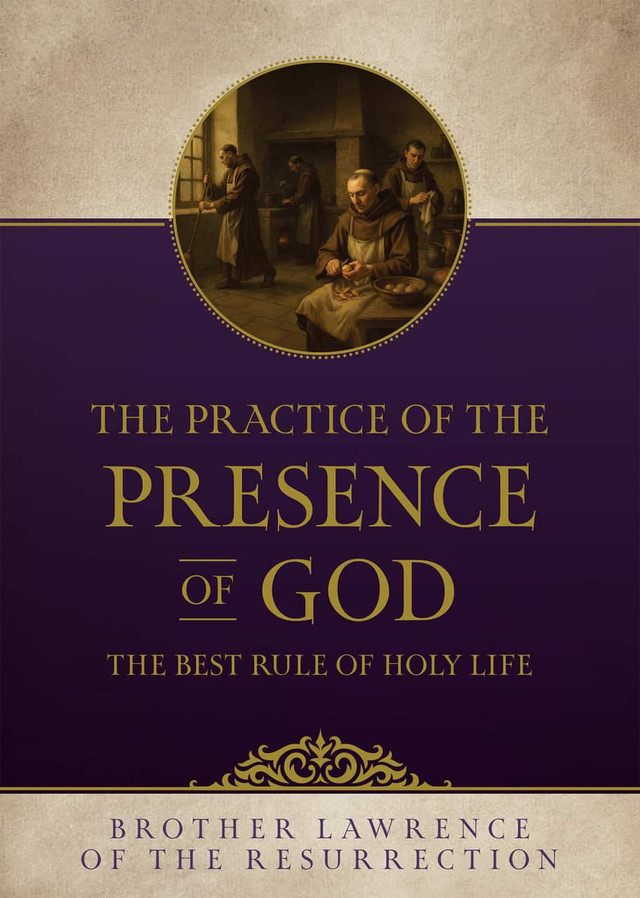

In this excerpt from The Practice of the Presence of God, Brother Lawrence of the Resurrection reveals the heart of his spirituality: continual conversation with God in all things. He teaches that holiness is not found in extraordinary works but in doing ordinary tasks with extraordinary love. Through humility, perseverance, and faith, the soul learns to dwell joyfully in God’s presence at every moment.
The Simplicity of Going to God
He discoursed with me very frequently, and with great openness of heart, concerning his manner of going to GOD, whereof some part is related already.
He told me, that all consists in one hearty renunciation of everything which we are sensible does not lead to GOD; that we might accustom ourselves to a continual conversation with Him, with freedom and in simplicity. That we need only to recognize GOD intimately present with us, to address ourselves to Him every moment, that we may beg His assistance for knowing His will in things doubtful, and for rightly performing those which we plainly see He requires of us, offering them to Him before we do them, and giving Him thanks when we have done.
A Life of Unceasing Praise
That in this conversation with GOD, we are also employed in praising, adoring, and loving him incessantly, for His infinite goodness and perfection.
That, without being discouraged on account of our sins, we should pray for His grace with a perfect confidence, as relying upon the infinite merits of our LORD. That GOD never failed offering us His grace at each action; that he distinctly perceived it, and never failed of it, unless when his thoughts had wandered from a sense of GOD’s Presence, or he had forgot to ask His assistance.
That GOD always gave us light in our doubts, when we had no other design but to please Him.
Doing All Things for God Alone
That our sanctification did not depend upon changing our works, but in doing that for GOD’s sake, which we commonly do for our own. That it was lamentable to see how many people mistook the means for the end, addicting themselves to certain works, which they performed very imperfectly, by reason of their human or selfish regards.
That the most excellent method he had found of going to GOD, was that of doing our common business without any view of pleasing men, [Gal. i. 10; Eph. vi. 5, 6.] and (as far as we are capable) purely for the love of GOD.
Prayer in Every Moment
That it was a great delusion to think that the times of prayer ought to differ from other times. that we are as strictly obliged to adhere to GOD by action in the time of action, as by prayer in its season.
That his prayer was nothing else but a sense of the presence of GOD, his soul being at that time insensible to everything but Divine love: and that when the appointed times of prayer were past, he found no difference, because he still continued with GOD, praising and blessing Him with all his might, so that he passed his life in continual joy; yet hoped that GOD would give him somewhat to suffer, when he should grow stronger.
That we ought, once for all, heartily to put our whole trust in GOD, and make a total surrender of ourselves to Him, secure that He would not deceive us.
That we ought not to be weary of doing little things for the love of GOD, who regards not the greatness of the work, but the love with which it is performed. That we should not wonder if, in the beginning, we often failed in our endeavours, but that at last we should gain a habit, which will naturally produce its acts in us, without our care, and to our exceeding great delight.
The Foundation of True Religion
That the whole substance of religion was faith, hope, and charity; by the practice of which we become united to the will of GOD: that all beside is indifferent and to be used as a means, that we may arrive at our end, and be swallowed up therein, by faith and charity.
That all things are possible to him who believes, that they are less difficult to him who hopes, they are more easy to him who loves, and still more easy to him who perseveres in the practice of these three virtues.
The Goal of the Spiritual Life
That the end we ought to propose to ourselves is to become, in this life, the most perfect worshippers of GOD we can possibly be, as we hope to be through all eternity.
That when we enter upon the spiritual we should consider, and examine to the bottom, what we are. And then we should find ourselves worthy of all contempt, and such as do not deserve the name of Christians, subject to all kinds of misery, and numberless accidents, which trouble us, and cause perpetual vicissitudes in our health, in our humours, in our internal and external dispositions: in fine, persons whom GOD would humble by many pains and labours, as well within as without. After this, we should not wonder that troubles, temptations, oppositions and contradictions, happen to us from men. We ought, on the contrary, to submit ourselves to them, and bear them as long as GOD pleases, as things highly advantageous to us.
ooo
This article is taken from a chapter in The Practice of the Presence of God by Brother Lawrence of the Resurrection which is available from TAN Books.